

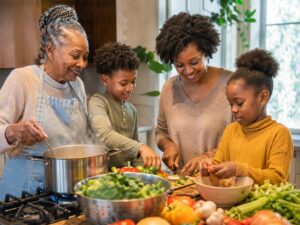

How Family Cooking Traditions Teach Children Across The Black Community.
Family cooking traditions can teach children lessons that go far beyond the kitchen. A child who helps wash vegetables, stir a pot, season food, set the table, roll dough, prepare rice, taste a sauce, or listen to an elder explain a recipe is learning more than how to make a meal. They are learning patience, responsibility, culture, memory, care, and the value of feeding the people they love. Cooking can become one of the most natural classrooms in family life. Across the Black community, food has always carried deep meaning. Meals have helped families celebrate, survive, gather, mourn, welcome guests, honor elders, and pass down culture. A recipe may come from a grandmother, a father, an auntie, a church kitchen, a family reunion, a homeland, a Southern table, a Caribbean gathering, an African market, or an Afro-Latin tradition. Each dish can carry a story about where the family has been and how love has been shared. Children today may grow up surrounded by fast food, packaged snacks, delivery apps, school meals, and busy schedules. These things can be useful at times, but they can also separate children from the process of making food. When families invite children into the kitchen, they help them understand that meals do not simply appear. Someone plans, shops, chops, cooks, serves, and cleans. That understanding can build gratitude and respect. Cooking traditions do not need to be perfect, expensive, or complicated. A simple breakfast, a pot of soup, a family dessert, a rice dish, a plate of greens, a pan of cornbread, a stew, a homemade tea, or a favorite holiday meal can all become teaching moments. What matters is the time, the story, and the connection created while preparing food together. 1. Cooking Teaches Children Responsibility. When children help in the kitchen, they learn that food preparation requires care and follow-through. Even a small task can teach responsibility. A young child can rinse fruit, place napkins on the table, stir batter with help, or carry safe items. An older child can measure ingredients, help chop with supervision, read a recipe, or prepare a simple side dish. Teens can learn to cook full meals, plan menus, and help with grocery lists. These responsibilities help children understand that they are part of the household. They are not only waiting to be served. They can contribute. That sense of contribution can build confidence and maturity. Cooking also teaches children that steps matter. If they forget an ingredient, rush the process, or ignore timing, the meal may not turn out the same. These lessons are practical and memorable. Children begin to understand that care, patience, and attention affect the final result. Families can start small. The goal is not to make children perfect cooks overnight. The goal is to help them become more capable, helpful, and aware over time. 2. Family Recipes Carry Stories. Many family recipes come with stories attached. A dish may have been made every Sunday after church. A dessert may have belonged to a grandmother. A stew may remind someone of a homeland. A holiday meal may connect to a family reunion, migration story, or special celebration. When children hear these stories, they learn that food is part of memory. A parent or elder can explain where a recipe came from, who taught it, and why it matters. They might say, “Your great-grandmother made this when the family gathered,” or “This spice reminds me of home,” or “We made this when money was tight because it could feed everyone.” These stories help children connect food to real people and real experiences. Children may begin asking questions. Who cooked this first? Did you eat this when you were young? Why do we make this on holidays? What did our family eat when you were growing up? These questions open the door to deeper family history. A recipe with a story becomes more than instructions. It becomes a piece of family identity. 3. Cooking Helps Children Learn Practical Math And Reading. The kitchen is full of learning. Measuring flour, counting cups, doubling a recipe, setting a timer, reading labels, comparing prices, dividing portions, and following instructions all support math and reading skills. Children may not even realize they are learning because the activity feels useful and real. A child who struggles with math may understand fractions better when measuring ingredients. A child who dislikes reading may become more willing to read a recipe because they want the food to turn out well. Cooking connects school skills to everyday life. Parents can ask simple questions while cooking. How many cups do we need? What happens if we double this? How long should this bake? Which ingredient comes next? These questions help children think without making the moment feel like a test. Learning through cooking can build confidence. Children see that reading and math are not only for school. They are tools that help families live, eat, plan, and care for one another. 4. Elders Can Teach Wisdom Through Food. Elders often carry cooking knowledge that has never been written down. They may know how to season by memory, knead dough by feel, choose ripe produce by sight, or cook a dish until it “looks right.” This kind of wisdom is valuable, and children should have opportunities to learn from it. Cooking with elders can also build connection between generations. A grandparent, auntie, uncle, or older neighbor may share stories while teaching a child how to prepare a dish. The child learns a skill, but they also receives time, attention, and family memory. Families can preserve elder wisdom by recording recipes, taking notes, making short videos, or asking children to interview older relatives. Even if the measurements are not exact, the method and story can be captured. When children learn from elders in the kitchen, they are reminded that older generations still have much to give. The kitchen becomes a place where respect and memory are passed down. 5. Cooking Builds Cultural Pride. Food can help children