

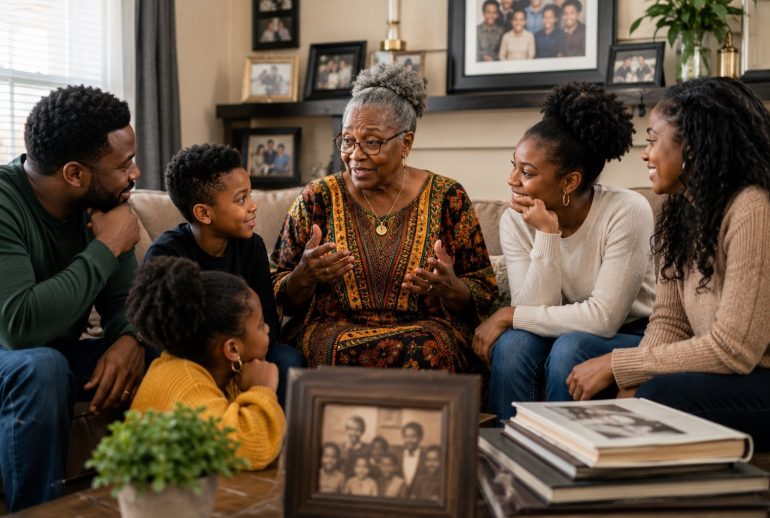
Every Black family carries stories that deserve to be remembered. Some stories are full of joy, humor, faith, music, food, migration, hard work, and celebration. Other stories carry pain, sacrifice, loss, struggle, and survival. Together, these stories help families understand where they come from, what they have overcome, and what kind of strength has been passed down from one generation to the next.
Intergenerational storytelling is more than sitting around and talking about the past. It is a way of connecting children, parents, grandparents, aunties, uncles, cousins, elders, and community members through memory and meaning. When one generation shares what they lived through, the next generation receives more than information. They receive identity, wisdom, warning, encouragement, and belonging.
For Black families, storytelling has always carried power. Long before many histories were written down, families and communities used spoken stories to teach values, protect culture, explain hardship, celebrate victories, and remind young people who they were. A grandmother’s kitchen table, a grandfather’s porch, a church gathering, a barbershop, a family reunion, a long car ride, or a holiday meal can all become places where history is passed from one heart to another.
In a world where young people are surrounded by fast information, social media, outside opinions, and changing cultural messages, family stories can help them stay rooted. They need to know that they are part of something bigger than the present moment. They need to hear about the people who prayed, worked, migrated, built, loved, cooked, laughed, struggled, and kept going before them. These stories can help children understand that their family history is not distant or disconnected. It lives inside them.
1. Family Stories Help Children Understand Where They Come From.
Children need more than names and dates to understand their family history. They need stories that help them imagine the people who came before them as real human beings with dreams, challenges, personalities, choices, and lessons. A child may know the name of a grandparent or great-grandparent, but when they hear how that person lived, what they loved, what they survived, and what they believed, the name becomes a person.
For Black families, this kind of knowledge can be especially meaningful because many families have experienced broken records, migration, separation, displacement, or histories that were not fully preserved in official documents. Some families may not know every branch of the family tree, but they may still carry memories through recipes, sayings, songs, faith practices, photographs, traditions, and stories told by elders. These pieces matter because they help children feel connected to a larger family journey.
A parent might tell a child about how their grandmother moved from one state to another to find better work, or how an uncle started a small business with very little money, or how an elder kept the family together during a difficult season. These stories teach children that family history is not only about famous people or major public events. It is also about ordinary people making brave choices, loving their families, and finding ways to survive.
When children know where they come from, they often feel more grounded. They begin to understand that they are not starting from nothing. They are standing on the lives, prayers, labor, and love of people who came before them. That knowledge can become a quiet source of confidence as they grow.
2. Storytelling Preserves Culture In Everyday Life.
Culture is often preserved through the small details of family life. It is found in the way people cook, speak, celebrate, worship, dress, laugh, grieve, and gather. It is found in family recipes, holiday traditions, church memories, music, hair care routines, community events, home remedies, nicknames, family sayings, and the way elders explain life lessons. Storytelling helps keep these details alive.
A family recipe, for example, is not only about ingredients. It may carry the memory of a grandmother who cooked for everyone, a father who made breakfast on weekends, an auntie who always brought the same dish to family gatherings, or a holiday meal that brought relatives together after a long year. When someone tells the story behind the food, the recipe becomes part of the family’s cultural memory.
The same is true for music. A song may remind an elder of their youth, a church choir, a family celebration, a neighborhood, or a loved one who has passed away. When young people hear those stories, they learn that music is not only entertainment. It can carry history, emotion, identity, and connection across generations.
In many Black families and African Diaspora communities, culture is not preserved in one formal lesson. It is passed through everyday conversation. A child may learn about family values while helping in the kitchen, sitting in a salon chair, riding with a grandparent, listening to stories after church, or watching relatives laugh together at a reunion. These moments may seem simple, but they become part of how children understand who they are.
3. Elders Carry Wisdom That Young People Need.
Elders often carry wisdom that cannot be found in a textbook or online search. They have lived through seasons of change, hardship, joy, disappointment, work, parenting, faith, illness, loss, and community life. Their stories can help young people understand how to handle challenges with patience, courage, and perspective.
Many young people are trying to navigate a world that moves quickly. They may feel pressure from school, social media, friendships, identity questions, family expectations, and future plans. Elders may not understand every modern trend or technology, but they often understand human struggle. They know what it feels like to be afraid, to make mistakes, to lose someone, to start over, to work hard, to wait, and to keep going when life does not happen as planned.
When elders tell their stories, they can offer guidance without simply giving instructions. A grandmother sharing how she handled loneliness may help a teenager feel less alone. A grandfather talking about his first job may teach patience and work ethic. An auntie explaining how she rebuilt her life after disappointment may teach resilience. A community elder sharing stories about activism, church life, migration, or family responsibility may help young people see that their current struggles are part of a much larger human story.
These conversations also honor elders. Many elders want to know that their lives still matter and that their memories will not disappear. When younger generations ask questions and listen with respect, they show elders that their experiences are valuable. This can create healing on both sides, because young people receive wisdom while elders receive recognition.
4. Storytelling Helps Build Pride And Confidence.
Black children need to hear stories that help them feel proud of who they are. The world does not always reflect Black life with the fullness, beauty, intelligence, creativity, and dignity it deserves. Too often, young people may see images that focus only on struggle, conflict, or limitation. Family storytelling can help balance that by showing children the strength, joy, brilliance, humor, faith, and love that live inside their own family and community history.
A child who hears about a relative who bought a home, raised children, served in the military, started a business, graduated from school, cared for neighbors, created art, worked through hardship, or stood up for what was right begins to see success in personal and reachable ways. These stories help children understand that greatness is not always loud or famous. Sometimes greatness looks like consistency, sacrifice, care, and the courage to keep building.
Pride also grows when children hear stories of Black joy. It is important for families to talk about struggle, but children also need to hear about laughter, celebrations, music, love stories, family jokes, favorite meals, childhood games, community gatherings, and moments of beauty. Joy is part of history too. When families only tell stories of pain, children may begin to see identity through heaviness. When families also tell stories of joy, children learn that their heritage is full, rich, and alive.
Confidence grows when young people feel connected to people who believed in themselves and their families. A story about an elder who refused to give up can become something a child remembers during a hard season. A story about a parent’s mistake and recovery can help a teenager understand that failure does not have to be the end. These stories become emotional tools children can carry with them.
5. Family Stories Can Teach Values Without Lecturing.
Young people do not always respond well to long lectures, especially when they feel judged or misunderstood. Storytelling can be a softer and more powerful way to teach values. A family story can teach patience, responsibility, honesty, courage, forgiveness, faith, respect, and perseverance in a way that feels natural instead of forced.
For example, instead of only telling a child to work hard, a parent might tell the story of a grandfather who woke up before sunrise every day to provide for his family. Instead of only telling a teenager to be careful with money, an aunt might share how she learned from a financial mistake when she was younger. Instead of only telling children to value education, an elder might explain how difficult it was for earlier generations to access certain opportunities and why learning mattered so much.
Stories help values feel real because they connect lessons to people the child knows or can imagine. The lesson is no longer just a rule. It becomes part of a lived experience. Young people may not remember every instruction, but they often remember a story that touched them.
This does not mean adults should avoid direct guidance. Children still need clear boundaries and honest teaching. But when guidance is supported by family stories, it often reaches deeper. It helps young people understand not only what the family believes, but why those values matter.
6. Storytelling Can Strengthen Bonds Between Generations.
Sometimes there can be distance between generations. Young people may feel that elders do not understand their world, and elders may feel that young people do not listen or respect the past. Storytelling can help close that gap by creating a space where both sides can share, ask questions, and learn from each other.
When an elder tells a story about growing up, a young person may discover that their grandparent was once playful, nervous, ambitious, heartbroken, funny, or rebellious too. This can make elders feel more human and relatable. At the same time, when young people share their own experiences, elders may begin to understand the pressures that youth face today, including social media, school stress, online comparison, and changing cultural expectations.
These conversations can create mutual respect. The older generation can offer wisdom, and the younger generation can offer fresh perspective. Both are valuable. A healthy family does not treat the past as outdated or the present as disrespectful. It creates room for both memory and growth.
Intergenerational bonds are strengthened through time, patience, and listening. A single conversation may not change everything, but repeated storytelling can build trust. A teenager who once rolled their eyes may later remember a story and ask a follow-up question. A grandparent who once felt ignored may begin to feel needed again. These small openings can bring families closer.
7. Storytelling Helps Families Process Pain And Healing.
Not every family story is easy. Some stories involve grief, separation, racism, addiction, financial hardship, family conflict, illness, loss, or painful choices. Families may sometimes avoid these stories because they do not want to reopen old wounds or burden younger generations. While every story must be shared with wisdom and care, silence can also leave children with confusion.
Healthy storytelling can help families process pain in a way that leads to understanding and healing. This does not mean sharing every detail with every child at every age. It means finding age-appropriate and respectful ways to explain family experiences so that younger generations are not left to guess. When families hide everything, children may sense that something is wrong but not know how to understand it.
A parent might say, “Our family went through a hard season, but people helped each other and we kept going.” An elder might explain, “There were things I wish had been different, but I learned from them.” These kinds of honest conversations can help young people see that families are not perfect, but healing is possible.
Storytelling can also break cycles of shame. When adults speak honestly about challenges they survived, young people may feel safer talking about their own struggles. They learn that pain does not have to be hidden forever. They learn that families can name hard things and still love one another.
8. Family Stories Help Children Understand Sacrifice.
Many children benefit from understanding the sacrifices that helped create their present opportunities. This does not mean making children feel guilty. It means helping them appreciate the work, choices, and love that made their lives possible. When young people understand sacrifice, they often gain a deeper sense of gratitude and responsibility.
A child may not realize how much a parent worked to pay for school supplies, sports fees, food, rent, transportation, or family needs. A teenager may not understand how much an elder gave up to move to a new city, take a difficult job, care for siblings, or keep the family together. Storytelling helps make those sacrifices visible.
In Black families, sacrifice has often been tied to survival and hope. Parents and elders may have done hard things so that children could have better choices. They may have endured discrimination, long work hours, limited resources, or personal disappointment while still trying to create a path forward. Sharing these stories can help young people understand that they are loved in practical ways, not only emotional ways.
When sacrifice is explained with love instead of pressure, it can inspire young people. They may begin to see their own education, work ethic, choices, and dreams as part of a family legacy. They may understand that honoring sacrifice does not mean living under guilt. It means using opportunity with awareness and purpose.
9. Storytelling Can Keep Family Traditions Alive.
Family traditions can fade when no one explains why they matter. A holiday meal, a reunion, a song, a prayer, a recipe, a birthday ritual, a family saying, or a cultural celebration may continue for years, but younger generations may not know the story behind it. When the meaning is not passed down, traditions can become habits without roots.
Storytelling gives traditions deeper life. When children learn why the family gathers a certain way, why a dish is always made, why certain songs are played, why elders are honored, or why a particular place matters, the tradition becomes more meaningful. They are more likely to carry it forward because they understand its emotional value.
Traditions do not have to remain exactly the same forever. Each generation may add something new, especially in families shaped by migration, blended cultures, and changing lifestyles. But when new traditions are connected to old stories, families can grow without losing their roots.
A family might record recipes, write down memories, create photo albums, interview elders, save voice recordings, or start a family storytelling night. These simple actions can protect traditions that might otherwise disappear. The goal is not perfection. The goal is continuity.
10. Storytelling Helps Young People Feel Less Alone.
Many young people believe their struggles are unique. They may think they are the only one who has felt insecure, afraid, confused, rejected, or uncertain about the future. Family stories can remind them that other people have faced hard seasons too and found a way through.
A teenager struggling with school pressure may feel comforted by hearing that a parent once failed a class and still built a good life. A young person dealing with friendship problems may learn that their aunt went through something similar. A child who feels different may hear about an elder who once felt out of place but grew into confidence. These stories can reduce shame because they show young people that struggle is part of life, not proof that something is wrong with them.
When adults only present themselves as perfect, young people may feel like they cannot admit weakness. But when adults share honest stories with wisdom, they create room for connection. The message becomes, “You are not the first person in this family to face something hard, and you do not have to face it alone.”
This kind of storytelling can be especially powerful during major life transitions, such as starting a new school, moving to a new place, preparing for college, dealing with grief, or entering adulthood. Family stories can become emotional anchors during uncertain seasons.
11. Families Can Preserve Stories In Simple Ways.
Preserving family stories does not have to be complicated. Families do not need professional equipment, expensive software, or a formal genealogy project to begin. They can start with simple conversations and build from there. The most important step is making time to ask and listen.
A family can begin by asking elders about childhood memories, favorite foods, first jobs, family traditions, lessons learned, migration stories, love stories, church memories, neighborhood life, school experiences, or moments they will never forget. These questions can be asked during family visits, holidays, phone calls, car rides, or quiet evenings at home.
Families can also write stories down in a notebook, record short voice memos, save family photos with names and dates, create a shared digital folder, or ask each relative to share one memory at a gathering. Even small efforts can become valuable later. A five-minute recording of an elder’s voice may become a treasure after that person is gone.
Children and teens can be included in this process. They can ask questions, take notes, record interviews, organize photos, or create family history projects. This helps them feel involved instead of only being listeners. It also teaches them that preserving history is a family responsibility.
12. Storytelling Builds A Stronger Community Beyond The Home.
Family storytelling does not only strengthen individual households. It can strengthen the wider Black community. When families share stories in community spaces, they help preserve local history, cultural memory, and collective identity. Churches, schools, community centers, libraries, neighborhood groups, and cultural organizations can all create opportunities for storytelling across generations.
Community storytelling can help young people understand the history of the place they live. They can learn who built local businesses, who organized community events, who fought for better schools, who served as mentors, who helped families in need, and who kept traditions alive. This helps youth see their community as more than streets and buildings. They begin to see it as a living story shaped by people.
These shared stories can also build respect between families. When people hear one another’s experiences, they often develop deeper empathy. They begin to understand that every family carries both beauty and burden. This can reduce isolation and remind people that community is built through connection.
Akukulu Family’s mission of supporting families and community connection fits naturally with this kind of storytelling. When families share their stories, they help build a stronger foundation for children, elders, and future generations. They remind the community that every voice matters and every family history has value.
Conclusion.
Intergenerational storytelling matters because it helps Black families preserve culture, strengthen identity, teach values, honor elders, and build deeper connections across age groups. These stories help children understand where they come from and remind them that they are part of a family history filled with strength, sacrifice, wisdom, creativity, and love.
Families do not need to wait for a special occasion to begin. A story can be shared at the kitchen table, during a car ride, after church, while cooking, at a family gathering, or through a simple phone call to an elder. What matters is the willingness to ask, listen, remember, and pass the story forward.
When Black families preserve their stories, they give the next generation something powerful. They give them roots. They give them language for who they are. They give them examples of resilience and joy. They give them a connection to the past and confidence for the future.
Akukulu Family encourages families to start one storytelling conversation this week. Ask an elder about their childhood, invite a parent to share a family memory, or encourage children to ask questions about where they come from. One story can open the door to deeper connection, stronger identity, and a family history that continues to live through the next generation.
