

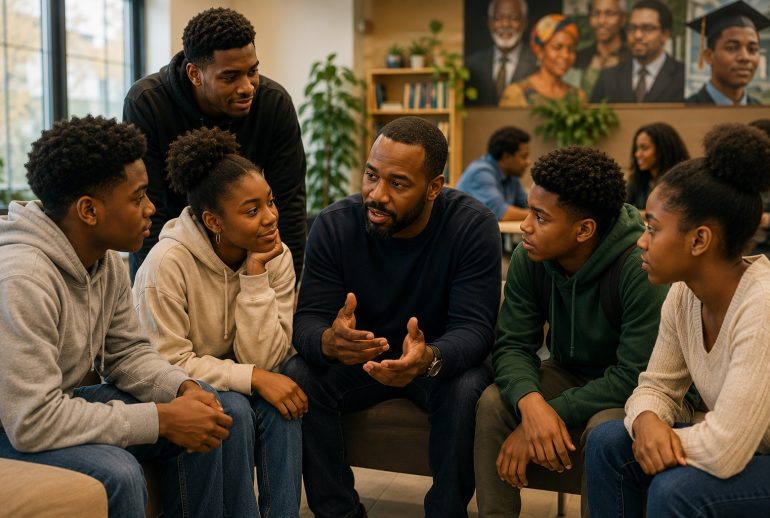
How Positive Role Models Support Youth Confidence Across The Black Community.
Young people need examples they can see, trust, and learn from. A positive role model can help a child or teen believe that their life has value, their future has possibility, and their choices matter. In a world filled with pressure from school, social media, peer groups, entertainment, family responsibilities, and uncertain future plans, youth need steady voices that remind them who they are and what they can become.
Across the Black community, positive role models are especially important because young people are often receiving mixed messages about identity, success, strength, beauty, leadership, and belonging. Some messages may encourage them, but others may limit them, stereotype them, pressure them, or make them feel invisible. A caring adult can help balance those messages by showing young people that they are more than what the world assumes about them. They are thinkers, creators, leaders, helpers, learners, builders, and future decision-makers.
A role model does not have to be famous, wealthy, perfect, or highly educated to make a difference. Sometimes the most powerful role models are the people young people see every day. A parent who keeps showing up, a teacher who refuses to give up on a student, a coach who teaches discipline, a barber or stylist who listens with care, an elder who shares wisdom, a business owner who models responsibility, a mentor who checks in consistently, or an older cousin who chose a better path can all become examples that shape a young person’s confidence.
Youth confidence grows when young people see adults living with purpose, honesty, humility, and care. They need to see people working hard, apologizing when wrong, solving problems, serving others, managing emotions, building businesses, caring for family, respecting community, and continuing to grow. These examples help young people understand that confidence is not about acting like life is easy. It is about knowing they can keep learning, keep trying, and keep becoming.
1. Positive Role Models Help Youth See What Is Possible.
Many young people only imagine futures based on what they have seen. If a child has never met someone who works in a certain field, owns a business, attends college, serves in leadership, creates art, uses technology, works in healthcare, practices a trade, or builds a strong family life, that path may feel distant or unrealistic. Positive role models help expand a young person’s imagination by showing them examples of what is possible.
A student who meets a nurse, engineer, teacher, chef, contractor, entrepreneur, artist, lawyer, mechanic, social worker, designer, software developer, pastor, coach, or community organizer may begin to think differently about their own future. They may ask questions they had never asked before. They may begin to connect school subjects, hobbies, talents, and interests to real-life opportunities.
This exposure matters because confidence often begins with vision. A young person needs to see that there are many ways to succeed and many ways to contribute. Not every child will follow the same path, and they should not feel pressured to become someone they are not. But seeing different examples helps them understand that their future is not limited to one narrow idea.
Families and community organizations can help by introducing youth to local role models. Career days, mentorship programs, church panels, business visits, community events, and family conversations can all expose young people to adults who are building meaningful lives. When youth see possibility in people close to them, the future feels more reachable.
2. Role Models Teach Confidence Through Consistency.
Confidence is not built only through big speeches. It is built through consistent encouragement and steady presence. A young person may not remember every word an adult says, but they will remember who kept showing up. They will remember who asked about their goals, who checked on their grades, who noticed their mood, who came to their game, who read their writing, who helped them after a mistake, and who believed in them when they were unsure of themselves.
Consistency matters because many young people have experienced disappointment from adults who appeared for a short time and then disappeared. When a role model stays present, follows through, and remains dependable, they teach trust. That trust can help youth feel more secure and more willing to receive guidance.
A consistent role model does not have to be available every hour. What matters is reliability. If an adult says they will call, they should call. If they promise to attend an event, they should do their best to attend or communicate if they cannot. These small acts show young people that they are worth commitment.
Confidence grows when youth know they are not walking alone. A consistent adult presence can help them believe that someone cares about their progress and future. That belief can become a foundation they carry into school, friendships, work, and adulthood.
3. Youth Need Examples Of Healthy Emotional Strength.
Many young people are taught to be strong, but they are not always taught what healthy strength looks like. Some may think strength means never crying, never asking for help, never admitting fear, or always acting tough. Positive role models can help youth understand that real strength includes honesty, self-control, emotional awareness, patience, and the courage to seek support when needed.
A role model who speaks calmly during conflict, apologizes after making a mistake, talks about stress in healthy ways, or asks for help when necessary is teaching emotional maturity. Young people learn by watching. If they only see adults yell, shut down, avoid problems, or pretend everything is fine, they may copy those patterns. If they see adults handle emotions with wisdom, they learn another way.
This is especially important for teens who may be dealing with anxiety, anger, sadness, pressure, or confusion but do not know how to express it. A trusted role model can help them name what they feel and think through healthier responses. Instead of saying, “Stop being emotional,” a positive adult might say, “Let’s talk through what happened,” or “It makes sense that you feel frustrated, but let’s decide what to do next.”
Healthy emotional strength teaches young people that feelings are not the enemy. They are information. With support, youth can learn how to manage feelings without being controlled by them.
4. Positive Role Models Can Strengthen Cultural Identity.
A strong sense of identity can help young people move through the world with more confidence. When youth know their history, culture, family values, and community strengths, they are less likely to be defined only by outside opinions. Positive role models can help strengthen cultural identity by sharing stories, teaching history, celebrating heritage, and modeling pride without arrogance.
Across African Diaspora communities, cultural identity may include many roots and traditions. Some youth may connect with African American history, Caribbean culture, African heritage, Afro-Latin traditions, Southern family roots, DMV community life, faith traditions, music, food, language, or family migration stories. Role models can help youth understand that identity can be rich and layered.
A mentor might introduce a young person to books by Black authors, take them to a cultural event, explain the importance of local history, share family stories, or talk about leaders who shaped the community. A coach might teach discipline while also reminding youth that they represent something larger than themselves. An elder might explain how the community survived earlier struggles and why pride matters.
Cultural identity becomes stronger when youth experience it through trusted relationships. A young person who hears, “You come from people who built, created, survived, and led,” may begin to see themselves differently. That message can support confidence in a deep and lasting way.
5. Role Models Help Youth Learn Better Decision-Making.
Young people are constantly making decisions, even when those decisions seem small. They choose how to respond to friends, how to handle conflict, how to spend time, how to use social media, how to approach schoolwork, how to treat others, and how to respond when they feel pressure. Positive role models can help youth think through choices before consequences become serious.
A good role model does not only tell young people what to do. They help them understand why choices matter. They may ask questions like, “What do you think will happen if you do that?” “Does this choice match your goals?” “Who could be affected by this?” “Is this pressure or wisdom?” These questions help youth develop thinking skills instead of only following rules out of fear.
Decision-making is a skill that grows with practice. Teens especially need chances to talk through real situations. They may be dealing with peer pressure, dating, online drama, school stress, friendship conflict, or future planning. A trusted role model can provide perspective without immediately shaming them.
When youth learn to pause, think, and ask for guidance, they become more confident in their choices. They begin to understand that their decisions are connected to their future, their character, and their relationships.
6. Role Models Can Help Youth Recover From Mistakes.
Every young person will make mistakes. They may fail a test, say something hurtful, choose the wrong friends, break a rule, miss an opportunity, or make a poor decision online. The way adults respond to those mistakes can shape whether the young person grows or becomes discouraged. Positive role models help youth understand that mistakes require accountability, but they do not have to destroy confidence.
A helpful role model can say, “You made a poor choice, but this is not the end of your story.” That message matters. It allows the young person to face the truth without feeling hopeless. Accountability should include honesty, consequences, repair, and learning. It should not include humiliation that makes the youth believe they are permanently bad or incapable.
Role models can also share their own lessons from mistakes. When adults are honest about how they learned, changed, and grew, young people understand that growth is part of life. They learn that responsible adults were not always perfect. They became wiser through experience, correction, and humility.
Youth confidence grows when young people know they can recover. A mistake can become a turning point when a caring adult helps them reflect, repair, and choose better next time.
7. Positive Role Models Support School Confidence.
School can be a place of growth, but it can also be a place where some students feel discouraged. A child may struggle with reading, math, writing, behavior expectations, organization, test pressure, or motivation. If they begin to believe they are not smart, school confidence can decline quickly. Positive role models can help students rebuild belief in their ability to learn.
A role model can remind a young person that intelligence is not measured by one grade, one subject, or one difficult season. They can help students understand that learning requires practice. They can encourage tutoring, reading routines, homework organization, teacher communication, and better study habits. They can also celebrate progress that the student may not notice.
Sometimes students need someone to connect school to life. A mentor can explain how communication, math, technology, reading, discipline, and problem-solving matter beyond the classroom. When students understand why learning matters, they may become more motivated.
School confidence is not only academic. It is emotional. A young person who believes they can improve is more likely to keep trying. A role model who encourages effort, patience, and growth can help a student stay engaged even when school feels hard.
8. Role Models Show Young People How To Treat Others.
Youth learn relationship habits from the adults around them. They notice how adults speak to family members, handle disagreement, show respect, treat service workers, talk about neighbors, respond to elders, and interact with children. Positive role models teach young people how to treat others by living the example.
Respect cannot be taught only through commands. Adults must model it. A young person who sees a role model listen patiently, speak kindly, keep promises, and admit mistakes learns that respect is more than words. They see how character looks in action.
This matters for friendships, school, future workplaces, dating relationships, family life, and community involvement. A young person who learns respect early is better prepared to build healthy relationships. They are also more likely to recognize when others are not treating them well.
Role models can also teach youth how to stand up for others. They can model kindness toward people who are left out, patience with those who are different, and courage when something unfair happens. These lessons help young people become community-minded instead of only self-focused.
9. Community Role Models Can Inspire Leadership.
Leadership does not begin only when someone receives a title. It begins when a young person learns responsibility, service, courage, and influence. Community role models can help youth see leadership in everyday life. A local business owner, teacher, coach, pastor, artist, organizer, nurse, volunteer, or elder may show leadership through service and consistency.
Youth need to see that leadership can happen close to home. It is not only for famous people, politicians, or celebrities. A person who organizes a food drive, mentors children, supports elders, starts a business, teaches a class, cleans up a neighborhood, or speaks up for fairness is practicing leadership.
Positive role models can invite youth into leadership opportunities. They may ask a teen to help plan an event, lead a discussion, mentor a younger child, volunteer at a community program, or take responsibility for a project. These experiences help youth build confidence through action.
When young people are trusted with responsibility, they begin to see themselves as capable. Leadership confidence grows when adults give youth both guidance and opportunity.
10. Role Models Can Help Youth Build Healthy Ambition.
Ambition can be healthy when it is connected to purpose, discipline, and character. Young people should be encouraged to dream, set goals, and work toward a better future. However, ambition can become stressful when youth feel they must prove their worth through achievement, money, popularity, or comparison. Positive role models can help youth build ambition in a balanced way.
A healthy role model teaches that success is not only about status. It is also about integrity, service, wellness, learning, and contribution. They help youth think about what kind of life they want, not only what they want to own or show. They encourage goals while also teaching patience.
Young people need adults who believe in their potential but do not pressure them into burnout. A role model can encourage a teen to apply for opportunities, practice skills, and work hard while also reminding them to rest, ask for help, and protect their mental health. This balance helps ambition remain healthy.
When ambition is grounded in purpose, youth are more likely to pursue goals that build them up instead of chasing approval. They learn that confidence comes from growth and character, not only outside recognition.
11. Families Can Help Children Choose The Right Role Models.
Not every public figure, influencer, entertainer, athlete, or online personality should become a role model simply because they are popular. Children and teens may admire people they see online, but families should help them think critically about who is worth following and why. Popularity is not the same as character.
Parents and caregivers can ask questions that guide reflection. What do you admire about this person? How do they treat others? What choices do they make? What values do they represent? Are they helping you become better, or are they just entertaining? These questions help youth think beyond fame, beauty, money, or attention.
Families can also introduce children to role models with strong values. This might include historical figures, local leaders, family members, professionals, artists, authors, entrepreneurs, veterans, teachers, and mentors. Children benefit from seeing many kinds of examples, not only celebrities.
The goal is not to control every person a child admires. The goal is to teach discernment. Youth should learn that admiration should be connected to character, effort, service, wisdom, and positive influence.
12. Every Adult Can Be A Role Model In Some Way.
Some adults avoid mentoring or guiding youth because they feel they are not successful enough, educated enough, or perfect enough. But young people do not only need perfect examples. They need honest, caring, consistent adults who are willing to show up. Every adult has something they can model, whether it is responsibility, kindness, faith, work ethic, patience, creativity, family care, or resilience.
A parent models love through daily sacrifice. An elder models wisdom through stories. A teacher models patience. A coach models discipline. A business owner models courage. A neighbor models kindness. A young adult who made better choices after a difficult season can model growth. These examples matter.
Adults should remember that youth are watching even when they seem uninterested. They notice how adults handle stress, speak about others, manage money, treat children, respect elders, and keep commitments. This means role modeling happens not only during formal speeches, but in everyday behavior.
A stronger community is built when more adults understand their influence. Every positive example gives young people another picture of what they can become.
Conclusion.
Positive role models support youth confidence across the Black community by helping young people see possibility, build identity, make better decisions, recover from mistakes, strengthen school confidence, and develop leadership. A role model does not have to be famous or perfect. They simply need to be consistent, caring, honest, and willing to guide youth with patience and respect.
Young people need adults who show them what healthy strength looks like. They need examples of courage, discipline, emotional maturity, cultural pride, service, and purpose. They need people who will encourage them, correct them with care, and remind them that their future is worth preparing for.
Families and communities can help by surrounding youth with positive examples in homes, schools, churches, businesses, sports, arts, mentorship programs, and local events. When young people see adults living with purpose and care, they are more likely to believe they can do the same.
Akukulu Family encourages parents, caregivers, mentors, educators, elders, and community members to be intentional role models for young people this month. Check in with a child or teen, share a life lesson, invite them to learn a skill, encourage their goals, or connect them with someone who can help them grow. One positive example can strengthen a young person’s confidence for years to come.
