

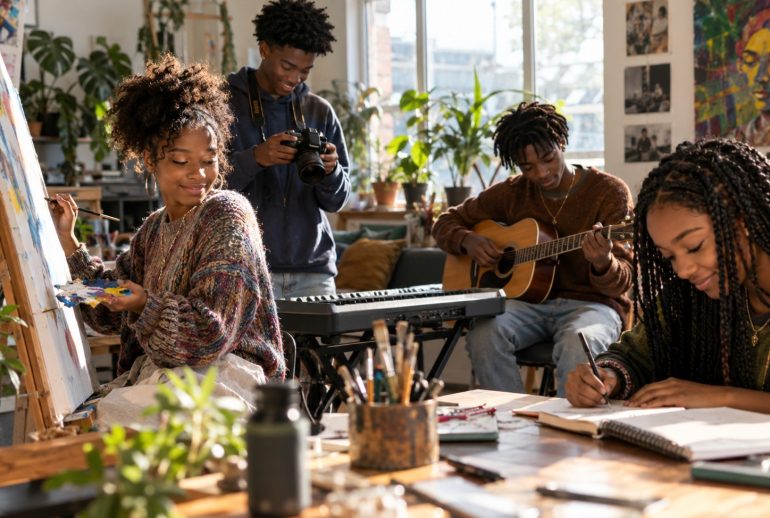
Teenagers need places where they can discover who they are without every activity being graded, judged, or compared. Creative hobbies can provide that space. Drawing, music, photography, cooking, sewing, writing, dance, filmmaking, woodworking, jewelry making, fashion, gardening, crafts, and many other activities allow young people to experiment, improve, and create something that feels personal.
Across the Black community, creativity has long been a powerful part of culture and family life. Music, visual art, storytelling, fashion, dance, food, hair, photography, poetry, and craftsmanship have helped generations express identity, document history, celebrate joy, and respond to difficult seasons. When teens participate in creative hobbies, they are joining a much larger tradition of making, imagining, and expressing.
Creative activities can also support emotional wellness. A young person who has had a stressful day may find relief in playing guitar, sketching, baking, writing lyrics, editing photos, or dancing. The activity may give them a way to focus their mind and express feelings that are difficult to explain directly.
A hobby does not have to become a career to be valuable. Teens do not need to monetize every interest or become the best person in the room. Sometimes the healthiest purpose of a hobby is simply enjoyment, growth, and having something meaningful to do.
1. Creative Hobbies Give Teens A Healthy Way To Express Themselves
Teenagers experience emotions they may not always know how to explain.
A young person might feel disappointed, excited, lonely, hopeful, frustrated, or confused without knowing exactly what to say. Creative hobbies can provide another language.
A teen may write a poem about something they cannot discuss easily. They may draw when they are overwhelmed. They may play music when they need to calm down. Photography may help them notice beauty when they are having a difficult week.
Creative expression does not replace conversation when a teen needs help, but it can help them begin processing what they feel.
Sometimes creating something makes the emotion easier to understand.
2. Hobbies Help Teens Discover What They Are Good At
School can make young people feel that ability is mainly measured through grades.
But intelligence and talent appear in many forms.
A student who struggles with algebra may have an incredible eye for photography. A quiet teen may be an excellent writer. Someone who dislikes traditional classroom work may become completely focused while cooking, building, sewing, or producing music.
Creative hobbies give young people more opportunities to experience competence.
That matters for confidence.
When a teen realizes, “I can actually do this,” that belief can influence how they approach other challenges.
Confidence often grows from doing something repeatedly and seeing improvement.
3. Creativity Can Help Reduce Stress
Teen life can be busy.
Schoolwork, sports, jobs, friendships, social media, family responsibilities, and future decisions can create pressure.
Creative hobbies can offer a mental break.
A teen working on a drawing or practicing an instrument may focus deeply enough to stop thinking about other pressures for a while.
That kind of focused activity can be refreshing.
Families can encourage teens to make time for hobbies without treating them as unproductive.
Rest does not always mean doing nothing.
Sometimes healthy rest looks like making something.
4. Creative Hobbies Can Reduce Passive Screen Time
Not all screen time is the same.
A teen spending hours scrolling without purpose may feel very different afterward than a teen using technology to edit a video, create digital art, record music, learn photography, or design something.
Creative hobbies can help shift technology from passive consumption toward active creation.
Parents can ask, “What are you making?” instead of only focusing on how many minutes the device is being used.
That does not mean unlimited screen time becomes healthy simply because a creative app is open.
Balance still matters.
But creativity can give teens a reason to use technology intentionally rather than only consuming what other people create.
5. Art Can Build Confidence Without Requiring Perfection
Young people sometimes quit creative activities because they think they are not naturally talented enough.
Parents can help change that mindset.
Drawing, painting, photography, music, dance, writing, and design all improve through practice.
A first attempt does not need to be impressive.
Families can praise progress instead of perfection.
“You have improved since the last one.”
“I like how much detail you added.”
“You kept practicing even when it was frustrating.”
These comments help teens understand that ability grows.
Creative hobbies are valuable partly because they teach that becoming good at something takes time.
6. Music Can Become A Powerful Outlet
Music can be especially meaningful during adolescence.
Teens may listen to music, learn an instrument, sing, write songs, produce beats, join a choir, perform at church, or create playlists connected to different moods.
Making music can become a form of expression.
A teen learning guitar may experience the satisfaction of finally playing a difficult chord progression. Someone producing beats may begin understanding rhythm, technology, and arrangement. A young singer may gain confidence performing in front of others.
Families can support musical interests even without expensive lessons.
Community programs, school music departments, churches, online tutorials, used instruments, and local mentors can provide starting points.
The goal is giving young people room to explore.
7. Writing Can Help Teens Find Their Voice
Writing offers many forms of creative expression.
Teens may enjoy poetry, short stories, journaling, screenwriting, blogging, songwriting, spoken word, or even creating fictional worlds.
Writing can help young people organize thoughts and develop a stronger personal voice.
Parents do not need to correct every grammar mistake in creative writing.
Sometimes the first goal should simply be expression.
A teen who becomes comfortable writing creatively may later become more confident writing academically or professionally.
Words become easier to use when young people have reasons to care about them.
8. Photography Can Teach Teens To Notice Their World
Photography encourages observation.
A young person begins to notice light, expression, color, architecture, family moments, neighborhood life, nature, and details other people may walk past.
Most teens already have access to a camera through a phone, so photography can be one of the easier creative hobbies to explore.
Parents can challenge teens to photograph a neighborhood, family tradition, community event, or changing season.
They can also discuss privacy and consent.
Not every moment needs to be posted publicly.
Photography can be about documenting life, not simply collecting likes.
9. Cooking Can Be Both Creative And Practical
Cooking is another powerful creative hobby.
Teens can experiment with flavors, recipes, presentation, baking, grilling, cultural foods, or family recipes.
Cooking builds confidence because the result is tangible.
The teen creates something people can actually enjoy.
It also teaches practical skills such as measuring, planning, timing, cleanup, budgeting, and food safety.
Families can give teens increasing responsibility in the kitchen.
A teenager who becomes confident preparing meals gains a skill that can support them for life.
Creativity and independence grow together.
10. Fashion And Sewing Can Connect Creativity With Culture
Some young people express themselves strongly through clothing and style.
They may enjoy sewing, customizing clothes, designing outfits, making jewelry, learning about fabrics, styling hair, or studying fashion history.
Families can support this interest while also discussing cultural traditions and responsible spending.
A teen might learn how African Diaspora designers use color, pattern, history, and identity.
They may also discover careers in design, styling, photography, tailoring, merchandising, or fashion business.
A hobby may remain something enjoyable—or eventually reveal a career direction.
Both outcomes are valuable.
11. Creative Hobbies Can Build Friendships
Shared interests make it easier for young people to connect.
A teen who joins an art club, band, dance group, photography club, theater program, maker space, or writing group may meet peers with similar interests.
These friendships can be especially helpful for teens who feel awkward in larger social settings.
A shared activity gives people something to talk about.
Relationships grow around the work.
Parents can look for school programs, libraries, community centers, churches, cultural organizations, or local workshops where youth can participate safely.
Creative communities can become important support networks.
12. Elders Can Pass Down Creative Skills
Creative knowledge often exists within families.
A grandmother may sew. A grandfather may play an instrument. An aunt may braid hair. An uncle may work with wood. Someone may bake, garden, paint, quilt, crochet, or photograph family events.
Teens may not realize how much skill exists around them.
Families can create opportunities for elders and young people to work together.
This preserves knowledge while strengthening relationships.
A teen learning an old recipe or traditional craft may also hear family stories during the process.
The creative skill becomes connected to heritage.
13. Hobbies Can Teach Patience
Creative work takes time.
A song may sound terrible at first. A drawing may not look right. A recipe may fail. A sewing project may need to be redone.
That frustration is part of learning.
Parents should resist the urge to fix every problem immediately.
A teen who learns to keep working through difficulty develops patience.
They discover that mistakes are not evidence they should stop.
They are information about what needs improvement.
This lesson transfers far beyond hobbies.
14. Creative Projects Can Build A Sense Of Accomplishment
Finishing something feels good.
A completed painting, song, photograph, cake, dress, short story, piece of furniture, or garden project gives a teen visible evidence of effort.
Families can celebrate that accomplishment without making everything into a competition.
Display the artwork.
Eat the meal together.
Listen to the song.
Ask the teen about the process.
Showing genuine interest tells young people that what they create matters.
That recognition can strengthen confidence.
15. Parents Should Avoid Turning Every Hobby Into A Business
Entrepreneurship can be valuable, but young people also deserve hobbies that are simply enjoyable.
A teen who becomes good at drawing does not immediately need to sell commissions.
A young baker does not automatically need a business page.
A musician does not need to monetize every song.
Constant pressure to turn creativity into income can remove the joy that made the activity meaningful.
Parents can ask whether the teen wants to pursue business before pushing that direction.
Some hobbies may eventually become careers.
Others should remain places where young people can breathe.
16. Creative Hobbies Can Help Teens Build Identity
Adolescence is a period of discovering preferences, values, talents, and interests.
Creative hobbies give teens room to experiment.
A young person may discover they love storytelling, design, photography, music, cooking, or craftsmanship.
Those discoveries become part of how they understand themselves.
“I am someone who makes music.”
“I love photography.”
“I can cook.”
“I write.”
These identities can be healthy anchors, especially when young people are surrounded by pressures telling them who they should be.
Creativity gives them room to explore who they actually are.
17. Families Can Support Creativity Without Spending A Lot
Creative hobbies do not always require expensive equipment.
A notebook can support writing.
A phone can support photography.
Pencils and paper can support drawing.
A kitchen can support cooking.
Recycled materials can become craft projects.
Libraries may offer creative programs and equipment. Schools may have art rooms, music programs, or clubs. Community centers may provide workshops.
Families can begin with what is already available.
Interest should come before expensive investment.
If a hobby becomes serious, equipment can be added gradually.
Conclusion
Creative hobbies can support teen confidence across the Black community by giving young people healthy ways to express emotions, discover strengths, reduce stress, build skills, form friendships, and explore identity.
Creativity does not need to lead to a career or business to matter.
A teenager who draws because it makes them peaceful, plays music because it helps them focus, cooks because they enjoy serving family, or takes photographs because they notice the world differently is gaining something valuable.
Families can support creativity by providing time, encouragement, materials when possible, and access to mentors or community programs.
Most importantly, adults can show genuine interest without demanding perfection.
When teens have something meaningful they enjoy creating, they gain more than a hobby.
They gain another place to discover who they are becoming.
Akukulu Family encourages parents, caregivers, educators, elders, mentors, and community members to ask one young person what they enjoy creating. Help them find a notebook, instrument, recipe, camera, art supply, workshop, or mentor that supports that interest. One creative outlet can become a source of confidence, connection, and healthy self-expression.
