

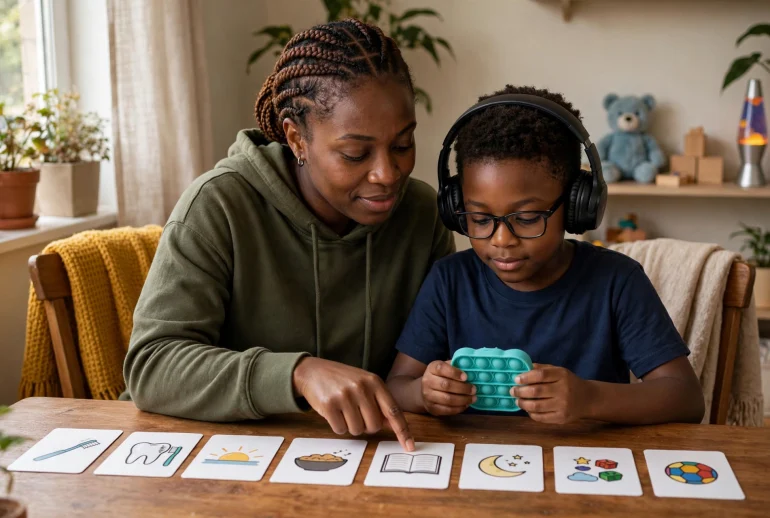
Routines can help many children feel organized, but for some autistic children, predictability can be especially important. Knowing what is happening now, what comes next, and when something will change may help reduce uncertainty and make everyday situations easier to manage.
A morning routine, after-school schedule, bedtime pattern, church-day plan, or simple visual calendar can give a child a clearer picture of the day. That does not mean every minute needs to be controlled or that families can never be spontaneous. It means giving children enough structure to understand what to expect.
Across the Black community, families may be balancing school, work, church, extended family, sports, appointments, community events, and busy household schedules. Creating predictable routines can feel difficult when life itself is unpredictable. But routines do not need to be complicated to be useful.
A few consistent steps may be enough.
Wake up. Get dressed. Eat breakfast. Brush teeth. Pack the backpack. Leave for school.
When children understand the sequence, they may need fewer verbal reminders and feel more confident completing parts of the routine independently.
The goal is not perfect behavior. The goal is helping the child move through daily life with greater understanding, security, and dignity.
1. Predictability Can Reduce Uncertainty
Unexpected changes can be difficult for some autistic children.
A substitute teacher, different route home, canceled activity, unfamiliar visitor, or sudden change in plans may create stress because the child expected something else.
Adults sometimes see the reaction but miss the reason behind it.
A child may cry, refuse to move, repeat a question, become quiet, or have a meltdown after a change that seems small to everyone else.
Predictability helps by making the day easier to understand.
When possible, parents can tell the child what will happen before it happens.
“We are going to Grandma’s house after lunch.”
“Your teacher will be different today.”
“The store is closed, so we are going somewhere else.”
Advance information can give the child time to adjust.
2. Visual Schedules Can Make Routines Easier To Understand
Some children understand information better when they can see it.
A visual schedule may use pictures, symbols, written words, or a combination of all three.
A morning schedule might show:
Wake up.
Bathroom.
Get dressed.
Breakfast.
Brush teeth.
Backpack.
School.
The child can look at the schedule instead of relying only on repeated verbal instructions.
Families can use printed pictures, sticky notes, a whiteboard, phone images, or simple drawings.
The schedule does not have to look professional.
It only needs to make sense to the child.
3. Morning Routines Can Reduce Family Stress
Mornings can become stressful in any household.
Everyone may be rushing, searching for shoes, preparing food, packing bags, and trying to leave on time.
For an autistic child, too many instructions at once can add to the pressure.
A consistent morning routine can help.
Families can prepare clothing, school bags, lunches, and other items the night before when possible.
Then the child can follow the same basic steps each morning.
Predictability helps the child know what is expected and may reduce the number of decisions they need to make while still waking up.
A calmer morning can help the whole household start the day better.
4. Transition Warnings Can Help Children Move Between Activities
Stopping one activity and beginning another can be difficult for some autistic children.
A child may be deeply focused on a toy, video, game, book, or special interest and become upset when told to stop immediately.
Transition warnings can help.
“Ten more minutes, then bath.”
“Five minutes until we leave.”
“One more turn, then it is time for dinner.”
Timers may also help some children.
The goal is to make the transition less sudden.
Adults should still maintain reasonable boundaries, but giving advance warning can help the child prepare mentally for what is coming next.
5. After-School Routines Can Provide A Needed Reset
School can require a great deal of energy.
An autistic child may spend the day handling classroom noise, social interaction, transitions, instructions, lights, crowds, and sensory input.
Coming home may be the first opportunity to relax.
Families can create an after-school routine that allows time for recovery before immediately demanding homework or chores.
A routine might include a snack, quiet time, movement, favorite activity, or sensory break.
Then homework or household responsibilities can follow.
Parents can observe what helps their child regulate after school.
Some children need movement.
Others need silence.
Others may want to talk immediately.
The routine should reflect the actual child rather than a one-size-fits-all plan.
6. Bedtime Routines Can Help The Body Prepare For Sleep
Consistent bedtime routines can help signal that the day is ending.
A routine may include bathing, pajamas, brushing teeth, dimmer lights, a story, quiet music, prayer, or another calming activity.
Doing these steps in a similar order may help the child know sleep is approaching.
Screens and highly stimulating activities close to bedtime may make settling harder for some children, so families can observe whether reducing them helps.
Sleep difficulties can have many causes, and persistent problems should be discussed with an appropriate healthcare professional.
But a calm and predictable bedtime routine can still provide useful structure.
7. Routines Should Support Independence
A routine should not mean adults do everything for the child.
Over time, predictable steps can help children become more independent.
A child may learn to check the schedule and put on shoes without being reminded.
Another may pack a backpack using a picture checklist.
An older child may follow a shower routine or prepare a simple snack.
Breaking larger tasks into small steps can help.
Parents can gradually reduce assistance as the child becomes more confident.
Independence may look different for every child.
Progress should be measured against the child’s own abilities, not someone else’s.
8. Flexibility Can Be Taught Gradually
Routines are useful, but life will not always follow the plan.
Children also need support learning how to handle change.
Families can introduce small changes in a predictable way.
For example, a parent might say, “Usually we go to the park after lunch, but today we are going to the library.”
A visual symbol for “change” or “different plan” may help some children understand.
Adults can acknowledge that the change may feel disappointing.
“You expected the park. I know this is different.”
This validates the child’s experience without suggesting the family can never change plans.
Flexibility is a skill that can develop gradually.
9. School And Home Routines Can Work Together
Communication between families and schools can be helpful.
If a child uses a visual schedule at school, parents may be able to use a similar approach at home.
Teachers can also let parents know about upcoming changes such as assemblies, field trips, substitute teachers, testing days, or schedule adjustments.
Parents can share strategies that help the child transition successfully.
Consistency does not mean home and school must operate exactly the same way.
It means adults can coordinate enough that the child receives familiar support.
A strong home-school partnership can make routines easier to maintain.
10. Church And Community Events May Need Preparation
Church services, reunions, festivals, weddings, birthday parties, and community gatherings may have less predictable schedules.
For some autistic children, this can be challenging.
Families can prepare by explaining the event beforehand.
Who will be there?
How long might it last?
Will it be loud?
Where can the child take a break?
What happens when it is time to leave?
Bringing headphones, familiar items, snacks, or visual supports may help depending on the child’s needs.
Families should also feel comfortable leaving early when necessary.
Participation does not need to look exactly the same for every child.
11. Relatives Can Help By Respecting The Routine
Extended family may not always understand why routines matter.
A relative might say, “Just let the child stay up late,” or “Why does everything have to happen in the same order?”
Parents may need to explain simply.
“This routine helps her know what to expect.”
“He handles the gathering better when we give him a warning before leaving.”
Relatives do not need to understand every detail of autism to be supportive.
They can respect the caregiver’s guidance and avoid intentionally disrupting routines simply to test the child.
Family cooperation reduces unnecessary stress.
12. Routines Should Not Become Punishment
A routine is meant to provide structure, not control every part of the child’s life.
Children still need choices, play, creativity, and room to develop preferences.
Within a routine, adults can offer appropriate choices.
“Blue shirt or green shirt?”
“Homework first or reading first?”
“Apple or yogurt for snack?”
Choice can help the child feel more involved while maintaining overall structure.
Routines work best when they make life more understandable, not when they become rigid systems used to punish differences.
13. Special Interests Can Be Included In Routines
Many autistic children have interests they care deeply about.
These interests can become positive parts of the daily routine.
A child might have time after homework to learn about trains, animals, maps, space, music, gaming, or another favorite topic.
Special interests can motivate learning and provide comfort.
Parents can use them thoughtfully.
A child interested in numbers may enjoy a visual schedule with times.
A child who loves characters may respond to pictures connected to that interest.
Building around strengths can make routines more engaging.
14. Older Children And Teens Need Age-Appropriate Routines
As children grow, routines should grow with them.
A teenager may not want a picture chart designed for a small child.
They may prefer phone reminders, calendars, written checklists, alarms, or planner apps.
Teens may need routines around school assignments, hygiene, medication when applicable, transportation, chores, work, exercise, and sleep.
Parents can include teens in creating the routine.
“What would help you remember this?”
“What part of your morning feels hardest?”
Giving teens some ownership respects their growing independence.
15. Families Should Notice What Actually Works
Not every routine will help every child.
One child may love visual schedules.
Another may find them unnecessary.
One child may need detailed transition warnings.
Another may do well with a simple reminder.
Families can observe patterns.
When does the child seem calmer?
Which transitions create the most stress?
What part of the routine causes conflict?
What can be simplified?
The best routine is not the one that looks impressive.
It is the one that helps the child function more comfortably and independently.
16. Routines Can Support The Whole Household
Predictability can benefit more than the autistic child.
Siblings may also appreciate knowing what happens next.
Parents may feel less rushed.
Morning responsibilities may become clearer.
Bedtime may feel more organized.
A household routine can reduce the number of decisions everyone has to make during busy parts of the day.
Families should still remain flexible when real life changes.
Structure and flexibility can exist together.
17. Progress Can Be Slow And Still Matter
Families may create a routine and expect immediate results.
Learning takes time.
A child may need repeated practice before following a schedule independently.
Some days may go smoothly and others may not.
That does not mean the routine has failed.
Parents can notice small progress.
The child checked the chart independently.
They handled a transition with less distress.
They completed one more step without assistance.
Small improvements matter.
Support should focus on growth rather than perfection.
Conclusion
Predictable routines can support autistic children across the Black community by reducing uncertainty, helping with transitions, supporting independence, and making everyday life easier to understand.
Routines do not need to control every moment.
They can be simple.
A morning checklist. A five-minute warning. A bedtime sequence. A visual calendar for the weekend. A consistent after-school break.
Families can adapt routines to the child’s age, communication style, sensory needs, and abilities.
The most important goal is not making the child appear more convenient to adults.
It is helping the child understand their environment, participate with greater confidence, and build skills that support everyday life.
Akukulu Family encourages parents, caregivers, educators, relatives, and community members to identify one part of the day that could become more predictable for an autistic child. Create a simple visual schedule, offer transition warnings, establish a calming after-school routine, or help a teen build a checklist that works for them. One clear routine can make daily life feel more understandable and manageable.
