

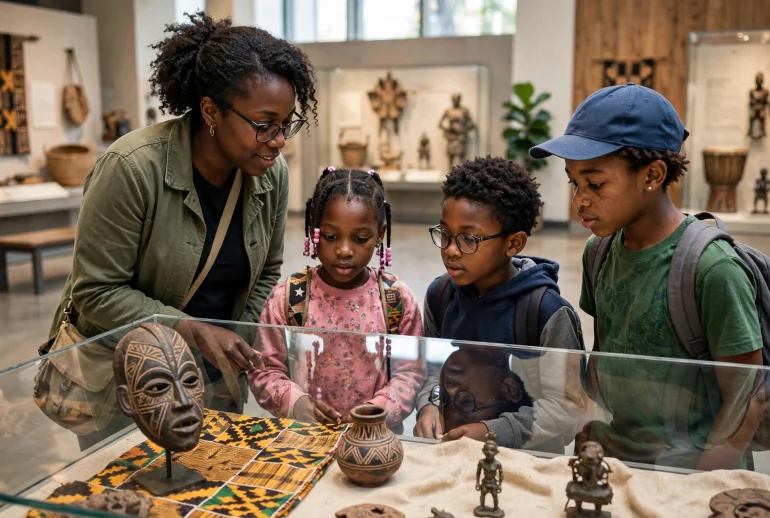
History can feel distant when children only encounter it through textbooks, worksheets, or short classroom lessons. A name, date, or event may be important, but it can remain abstract until a young person sees an object, photograph, painting, document, building, or personal story connected to it.
Museum visits can help change that.
For families across the Black community, museums can become places where children explore history, art, science, migration, music, local communities, and the wider African Diaspora in a more tangible way. A child may stand in front of a photograph from another generation and suddenly begin asking questions. A teenager may discover an artist they have never heard of. A grandparent may recognize something that reminds them of childhood.
That is when learning becomes personal.
Families do not need to visit only large national museums. Local history museums, African American cultural centers, art museums, science museums, historic homes, university galleries, community exhibits, and small regional collections can all create meaningful learning opportunities.
The most important part is not simply walking through a building.
It is helping children notice, question, connect, and talk about what they see.
1. Museums Can Make History Feel Real
Children may read about an event without fully understanding that real people experienced it.
Objects can make that connection stronger.
A piece of clothing, handwritten letter, old photograph, musical instrument, tool, newspaper, or household object can make the past feel closer.
Parents can ask:
“Who might have used this?”
“What do you think their daily life was like?”
“How is this different from what we use today?”
These questions encourage children to imagine history as lived experience rather than a collection of facts.
The past becomes human.
2. Black Children Benefit From Seeing Themselves In History
Children should encounter Black history as more than struggle.
Museums can introduce them to inventors, artists, scientists, entrepreneurs, writers, athletes, teachers, musicians, community organizers, craftspeople, and ordinary families.
This broader view matters.
Children need to know that Black history includes creativity, leadership, joy, innovation, family life, business, culture, and achievement alongside difficult chapters.
Seeing that range can strengthen identity.
A child begins to understand that people who looked like them helped shape communities, industries, art, science, and culture.
Representation in history can influence how young people imagine their own future.
3. Museum Visits Can Support What Children Learn In School
A museum visit can reinforce classroom learning.
If a child is studying civil rights, visit an exhibit connected to that period.
If the class is learning about ancient civilizations, explore African history.
If a student is studying art, find works by Black artists.
If science is the current subject, visit a science museum and connect exhibits to school lessons.
Families can ask teachers what topics are coming up.
A visit before or after the classroom unit can deepen understanding.
Learning becomes stronger when children encounter the same idea in different ways.
4. Local Museums Can Teach Children About Their Own Community
History is not only something that happened far away.
Every neighborhood, town, and city has a story.
Local museums may include photographs of old streets, businesses, schools, neighborhoods, industries, community leaders, or major local events.
Black families can look for information about Black residents and institutions in their area.
Were there historically Black neighborhoods?
Who were local business owners?
What churches played important roles?
Were there Black educators, musicians, veterans, or community leaders?
Children may be surprised to learn that important history happened only a few blocks from home.
Local history creates a deeper connection to place.
5. Museums Can Open Conversations About Difficult History
Some exhibits deal with slavery, segregation, racism, war, displacement, or other painful subjects.
Children may have questions.
Families can answer honestly in ways appropriate for the child’s age.
There is no need to hide difficult history, but young children should not be overwhelmed with details they are not ready to process.
Parents can focus on both the injustice and the humanity of the people involved.
Who resisted?
Who helped others?
How did families survive?
What changed afterward?
What still needs understanding today?
These conversations can teach children that history includes both hardship and human agency.
6. Art Museums Can Build Cultural Confidence
Art provides another way to explore identity.
Families can look for paintings, photographs, sculpture, textiles, and other works created by Black artists and artists across the African Diaspora.
Ask children what they notice.
What emotions does the artwork create?
What story might it be telling?
What colors or materials stand out?
There is no need to have an expert interpretation.
Children should feel comfortable forming their own observations.
Art encourages them to slow down, look closely, and communicate what they see.
That builds both cultural awareness and critical thinking.
7. Museums Can Connect Children With The African Diaspora
The African Diaspora includes many histories, cultures, languages, and experiences.
Museums can help children see those connections.
An exhibit might explore West African textiles, Caribbean music, African American migration, Afro-Latin traditions, or contemporary African art.
Families can use these exhibits to discuss similarities and differences.
How did traditions change as people moved?
Which foods, musical styles, religious practices, clothing traditions, or artistic techniques traveled across regions?
Children begin to understand that Black culture is not one single story.
It is a network of histories connected across places and generations.
8. Children Should Be Allowed To Ask Unexpected Questions
Museum visits often create questions adults did not anticipate.
A child may notice something completely different from what the parent expected.
That is good.
Instead of rushing to the next exhibit, pause.
“What made you notice that?”
“What do you think it means?”
“Let’s see if we can find out.”
Parents do not need to know every answer.
Saying “I don’t know, let’s learn together” models curiosity.
Children learn that education is not about adults pretending to know everything.
It is about asking better questions.
9. Teens May Need More Freedom To Explore
Teenagers may not want to follow parents from display to display.
Give them some ownership.
Let the teen choose an exhibit.
Ask which section they want to spend more time in.
If it is safe and appropriate, allow older teens to explore part of the museum independently and meet back at a set time.
Later, ask what they found interesting.
Teens are more likely to engage when they feel the visit is not simply another adult-directed assignment.
Museum learning should include independence.
10. Families Can Use Museum Visits To Practice Observation Skills
Looking carefully is an important skill.
Families can turn observation into a simple game.
Find the oldest object in the room.
Find something used for music.
Find something made by hand.
Find an object connected to childhood.
Find something that reminds you of a relative.
This encourages children to examine displays instead of walking past them quickly.
Younger children especially may enjoy having something specific to search for.
Learning becomes active.
11. Photographs Can Be Powerful Teaching Tools
Historical photographs can help children see details textbooks may overlook.
Look at clothing.
Buildings.
Hair styles.
Signs.
Transportation.
Workplaces.
Schools.
Family gatherings.
Ask children what is familiar and what is different.
A photograph can lead to conversations about daily life, social expectations, economics, and culture.
Parents can also compare museum photographs with their own family albums.
History becomes easier to understand when children see connections between public history and family history.
12. Elders Can Add Another Layer To The Visit
Grandparents and older relatives may notice things younger generations miss.
A museum display may remind an elder of something they used growing up.
A photograph may resemble a neighborhood they remember.
A piece of music may bring back a story.
Invite elders when possible.
Ask what the exhibit reminds them of.
Their memories can turn a museum trip into an intergenerational experience.
Children get both the institution’s history and the family’s perspective.
Those two sources can enrich each other.
13. Families Can Research Before They Go
A little preparation can make a visit more meaningful.
Look at the museum’s website.
Check current exhibits.
See whether there are family programs, guided tours, activity sheets, or special events.
Choose two or three things the family especially wants to see.
This prevents the visit from feeling overwhelming.
Large museums can be exhausting if families try to see everything.
It is better to explore a few exhibits carefully than rush through an entire building.
14. Free And Discounted Museum Days Can Make Visits More Accessible
Museum admission can be expensive for larger families.
Before assuming a visit is out of reach, check for free days, community programs, library passes, student discounts, military discounts, reciprocal memberships, or special family events.
Some museums also offer reduced admission through local programs.
Libraries and community centers may know about nearby opportunities.
Families can make museum learning part of recreation without spending heavily.
Planning ahead helps.
15. Children Can Keep A Simple Museum Journal
A museum journal does not need to feel like homework.
After the visit, children can write or draw:
Their favorite object.
Something surprising.
A person they learned about.
One question they still have.
A picture of something memorable.
Teens might take notes on their phones or save photographs where museum rules allow.
This helps children process what they saw.
It also creates a record of family learning experiences.
16. Museums Can Inspire Creative Projects At Home
Learning does not have to end when families leave.
A child might recreate a piece of art.
Build a model.
Research a historical person.
Cook a dish connected to an exhibit.
Create a playlist inspired by a music exhibit.
Interview a grandparent.
Make a family timeline.
These activities turn museum learning into something active.
Children remember more when they create something from the experience.
17. Families Can Talk About Who Gets Remembered
Museums also create an opportunity to discuss how history is presented.
Ask older children:
“Whose stories are included here?”
“Whose stories might be missing?”
“Who decided what was important enough to display?”
These questions build critical thinking.
Museums are valuable educational resources, but no single institution can tell every story.
Children can learn to appreciate an exhibit while still asking what perspectives are absent.
That is an important historical skill.
18. Museum Visits Can Become A Family Tradition
Families do not need to visit museums every weekend.
A few thoughtful visits each year can become meaningful traditions.
Choose a museum during school breaks.
Visit a cultural exhibit during Black History Month, but do not limit Black history learning to February.
Explore a museum while traveling.
Return to a favorite museum when exhibits change.
Children may eventually begin requesting places they want to visit.
When learning becomes part of family recreation, curiosity can continue beyond school.
Conclusion
Museum visits can help Black children connect with history and culture by turning abstract lessons into tangible experiences.
Children can see objects that people once held, examine photographs of communities that came before them, encounter Black artists and innovators, explore the African Diaspora, and discover stories from their own neighborhoods.
Families do not need to know every historical fact before entering the museum.
They simply need curiosity.
Ask questions. Slow down. Let children choose what interests them. Invite elders when possible. Connect exhibits to family stories. Continue the conversation after returning home.
The goal is not completing every gallery.
It is helping children understand that history belongs to real people—and that their own family and community are part of that continuing story.
Akukulu Family encourages parents, caregivers, educators, elders, and young people to choose one museum, cultural center, gallery, or local history site to explore together. Before leaving, ask every family member to choose one object, person, or story they want to remember. A single afternoon of curiosity can open conversations that continue long after the visit ends.
