

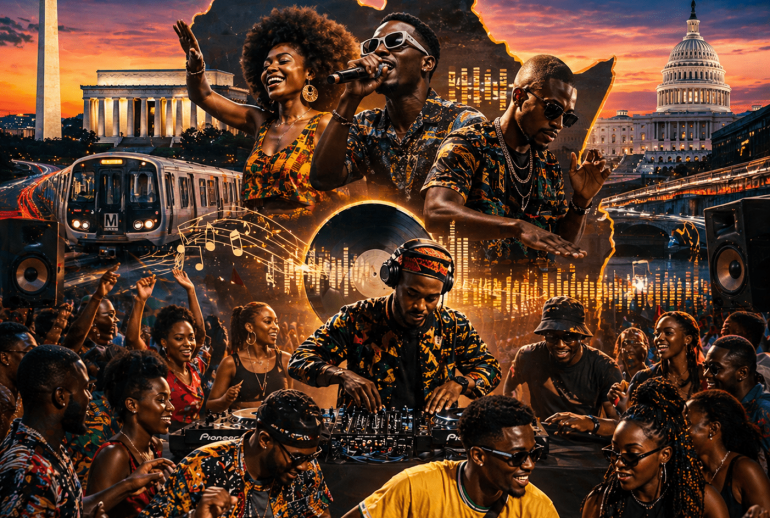
It is a Friday night in Washington, D.C. At a rooftop venue in Northeast, the bass drops — not the familiar thud of hip-hop, but the deep, rolling percussion of Amapiano, a South African genre built on log drums and shakers that has rewritten what a dance floor sounds like in the 21st century. Bodies move in unison. The crowd is Black, beautiful, and from everywhere — Nigeria, Ethiopia, Cameroon, Ghana, South Africa, the Caribbean, and deep in the roots of American soil. Languages mix. Accents meet. And for a few hours, the music makes the whole thing feel inevitable.
This is the DMV’s African Diaspora music scene — and it is one of the most vibrant, diverse, and culturally rich music communities in the United States. Afrobeats nights, Amapiano day parties, Highlife evenings, Afrobeats block parties and jollof cook-offs, festival stages featuring artists from Lagos to Johannesburg to Accra — the region’s African Diaspora has built a music culture that is no longer niche, no longer underground, and no longer a secret.
Here is the full story — where these sounds came from, why they matter, and exactly where to experience them right here in the DMV.
Understanding the Sounds: Afrobeats, Highlife and Amapiano Are Not the Same Thing
Before going further, it is worth being clear about what these terms actually mean — because they are often used interchangeably when they are, in fact, distinct musical traditions that happen to be traveling together in the same cultural moment.
Afrobeats (with an ‘s’):
Afrobeats is an umbrella term — not a single genre but a broad family of contemporary popular music that emerged from Nigeria and Ghana in the early 2000s. It fuses traditional West African rhythms with hip-hop, R&B, dancehall, and electronic music. Think Burna Boy, Wizkid, Davido, Rema, Tems, Ayra Starr. The term itself was coined in the early 2010s by British-Ghanaian DJ Abrantee, who needed a label for the new wave of African pop music rising out of Lagos and Accra. It is important not to confuse Afrobeats with Afrobeat — singular — the politically charged, jazz-infused genre pioneered by Fela Kuti in the 1960s and 70s. Both are African. Both are important. They are not the same.
Highlife:
Highlife is one of the oldest and most influential African popular music genres — born in Ghana in the late 19th century from the meeting of West African traditional music and European brass band influences brought by colonial contact. It is melodic, sophisticated, and deeply rooted in the rhythms of the Akan and other Ghanaian peoples. Highlife spread across West Africa, took root in Nigeria, and became a building block for nearly everything that followed — including Afrobeats, which draws directly on highlife’s guitar tones and rhythmic sensibility.
Amapiano:
Amapiano is the newest of the three — born in the townships of South Africa around 2012 and 2013, characterized by its distinctive log drum bass lines, jazz-inflected piano chords, and hypnotic, rolling rhythms. Artists like DJ Maphorisa, Kabza De Small, and Daliwonga built it from a local underground phenomenon into a global force. Tyla’s song ‘Water,’ which reached the Billboard Hot 100 and became the highest-charting single by a South African artist in U.S. history, introduced millions of American listeners to the Amapiano sound. Today Amapiano’s log drums appear in Afrobeats productions, pop songs, and on dance floors from Johannesburg to Washington, D.C.
The Global Rise — How African Music Conquered the World
The global rise of Afrobeats is one of the most remarkable stories in 21st century music — and it did not happen overnight or by accident. It happened through a combination of extraordinary talent, the democratizing power of streaming platforms, and the growing cultural influence of African Diaspora communities in cities like London, Toronto, Houston, Atlanta — and the DMV.
The watershed moment many point to is 2016, when Drake’s global smash ‘One Dance’ featuring Nigerian superstar Wizkid topped the Billboard Hot 100 for ten weeks — making Wizkid one of the first Nigerian artists ever to reach the summit of that chart. It was a signal that could not be ignored: African music had crossed over, not as a novelty, but as a chart-dominating cultural force.
What followed was extraordinary. Rema’s ‘Calm Down’ — boosted by a remix featuring Selena Gomez — became the longest-running number one in U.S. Afrobeats chart history and the longest-charting African song in Billboard Hot 100 history. Tems and Wizkid’s ‘Essence’ became the first Nigerian song to crack the Hot 100. Burna Boy performed to over 9,000 people in Brooklyn and won a Grammy for Best Global Music Album. The Grammy Awards created an entirely new category — Best African Music Performance — recognizing that African music could no longer be lumped into ‘world music’ catch-all categories.
Beyoncé leaned heavily on Afrobeats artists — including Burna Boy, Wizkid, Mr Eazi, Yemi Alade, and Tiwa Savage — for her Lion King: The Gift album. That collaboration gave the sound an unprecedented level of mainstream American exposure and a cultural endorsement from one of the most influential artists alive.
The music did not conquer the world by mimicking Western pop. It conquered it by being unapologetically itself — African in its rhythms, African in its language, African in its celebration of African joy.
Why the DMV Is One of the Most Important African Music Cities in America
The DMV is uniquely positioned to be one of the most important African music cities in the United States — and increasingly, it is claiming that position.
The reason begins with demographics. The DMV holds the fourth-largest African immigrant population in the United States. It is home to Ethiopians, Nigerians, Ghanaians, Cameroonians, Senegalese, Sierra Leoneans, South Africans, Congolese, and communities from virtually every nation across the continent. These are not dispersed, isolated communities — they are concentrated, culturally active, and deeply invested in maintaining their musical identities in their adopted home.
Add to that a large, educated, professionally established African American community with its own deep musical roots and a growing appetite for African Diaspora sounds — and you have the ingredients for exactly the kind of cultural mixing that produces extraordinary music scenes. Afrobeats in the DMV is not just a nostalgia project for recent immigrants. It is a genuine cultural fusion: continental African, African American, Caribbean, and global, all inhabiting the same dance floor.
The DMV’s Afrobeats scene was not built by major labels or festival corporations. It was built by the community — by DJs who started spinning at house parties, by event organizers who rented venues and hustled tickets, by artists who performed to crowds of fifty before they performed to crowds of five thousand. That community-built foundation is part of why the scene feels so genuine when you are inside it.
The Events and Collectives Shaping the DMV Scene Right Now
The DMV’s African Diaspora music scene is organized around a thriving network of events, collectives, and promoters who have turned the region into a genuine destination for African music. Here is who is building it:
- AmapianoDMV — Perhaps the most important collective in the region’s African music scene right now. AmapianoDMV has built Amapiano Sunday into a cultural institution — a weekly event that has brought some of the genre’s biggest international names to Washington, D.C., including DJ Maphorisa and Daliwonga performing live. Their events at Culture DC and other venues regularly sell out, drawing crowds from across the region. AmapianoDMV describes itself as a space for everyone — welcoming all identities and backgrounds under the umbrella of the music
- AfroAmp Festival — Created by DJ Mambo and presented by TAG Soundz, AfroAmp is an annual Afrobeats and Amapiano festival held at Culture DC in Northeast Washington. It has featured an impressive lineup of international DJs and performers and positioned itself as ‘a safe space for people to feel free, dance, and enjoy themselves.’ The festival draws DJs from across the world and has become one of the signature events on the DMV’s African music calendar
- DMV Afrobeats Festival — Organized by the North America African Culture Diversity Inc. (NAACD), the DMV Afrobeats Festival has been held at major venues including the Merriweather Pavilion in Columbia, Maryland. The three-day festival showcases Afrobeats artists from Nigeria, South Africa, Cameroon, Ghana, Sierra Leone, Ethiopia, and the United States — along with African food vendors, fashion showcases, art installations, and cultural workshops. It is one of the most comprehensive celebrations of African music and culture in the region
- AfroPlus Festival — Presented by Events DC and held at the RFK Festival Grounds, AfroPlus brings Afrobeats, Dancehall, R&B and more to one of the region’s largest outdoor venues — legitimizing African music in the same spaces that host the region’s biggest mainstream concerts
- DC Afrobeats Block Party and Jollof Cook-Off — A community event that turns African music into a neighborhood celebration. Five DJs, a popup shop, an Afro-Caribbean food market, and a blind-tasting jollof cook-off between six countries — settling, temporarily at least, the greatest debate in West African food culture. This event captures something essential about the DMV scene: it is not just concerts, it is community
- Weekly Afrobeats and Amapiano nights — Beyond the festivals, the DMV scene runs on a steady calendar of weekly events. Amapiano and Afrobeats Sundays at Saint-Ex, Rosebar Fridays, Gazuza Saturdays, and I Love Fridays DMV all provide regular, accessible entry points into the scene. These are not tourist events — they are community rituals that happen week after week, building the culture from the inside out
Music as Identity: What These Sounds Mean to the African Diaspora
For members of the African Diaspora in the DMV, Afrobeats, Highlife and Amapiano are not simply entertainment. They are a form of cultural maintenance — a way of staying connected to a home that may be thousands of miles away, and of passing that connection to children who were born here but carry the continent in their blood.
When a Nigerian family in Silver Spring puts on Burna Boy at a Sunday gathering, they are not just playing music. They are keeping Lagos alive in a Maryland living room. When Ghanaian students at Howard University organize a Highlife night on campus, they are honoring a musical tradition that their grandparents danced to. When a second-generation Ethiopian American learns to dance Amapiano at a D.C. rooftop party, they are participating in a pan-African cultural conversation that their parents’ generation could not have imagined.
The DMV Afrobeats Festival noted it explicitly in its mission: the festival is ‘one sure way of re-igniting unity amongst its people.’ That framing matters. This is not just music for music’s sake. It is a unifying force for a community that spans dozens of nationalities, languages, and cultural traditions — finding common ground in a shared African heritage expressed through sound.
And there is something else worth naming: these sounds are healing. For people navigating the daily labor of being Black in America — the code-switching, the hypervisibility, the exhaustion of operating in spaces not designed for you — an Afrobeats dance floor where everyone looks like you, where the music is yours, where your joy is not exceptional but simply normal, is genuinely restorative.
The Economic Impact: Music as Cultural Commerce
The African Diaspora music scene in the DMV is not just culturally significant — it is economically significant. Festivals, weekly events, ticket sales, food vendors, fashion vendors, DJs, promoters, sound engineers, photographers, videographers, designers — the scene generates a commercial ecosystem that puts money in the hands of Black and African entrepreneurs throughout the region.
The DMV Afrobeats Festival explicitly documented this impact: international visitors attending the festival spend on accommodation, transportation, food, and local attractions, boosting the regional economy. Local businesses — food vendors, artisans, and service providers — gain exposure and sales. Major brands seek sponsorship opportunities to reach a diverse, engaged, and economically active audience. The festival creates what few cultural events can: a genuine economic ripple effect that extends well beyond the event itself.
When you buy a ticket to an Afrobeats night or a festival in the DMV, you are not just buying a music experience. You are participating in a community economy — and that participation matters.
Where to Experience It: Your Guide to the DMV African Music Scene
Whether you are a longtime community member or someone newly curious about these sounds, here is where to start:
- Culture DC (2006 Fenwick St NE, Washington DC) — The beating heart of the DMV’s Afrobeats and Amapiano scene. Home to AmapianoDMV’s Amapiano Sunday series and AfroAmp Festival. Follow their events calendar closely
- Gazuza DC — A popular venue for weekly Amapiano and Afrobeats Saturday nights. Consistent, high-energy, and deeply connected to the community
- Saint-Ex (DC) — Hosts regular Afrobeats and Amapiano Sunday evenings that have become a weekly ritual for the community
- Rosebar DC — Regular Afrobeats and Amapiano Friday nights with open bar offerings that make it one of the more accessible regular events on the calendar
- Merriweather Pavilion, Columbia Maryland — For the larger festival experiences. The DMV Afrobeats Festival has used this prestigious outdoor venue, bringing world-class African artists to the Maryland suburbs
- RFK Festival Grounds, DC — Home to AfroPlus Festival, one of the largest Afrobeats events in the region
- Follow AmapianoDMV and AfroAmpFest on social media — both collectives announce events regularly and their event calendars represent the most consistent programming in the region
- Check Eventbrite for ‘Afrobeats DMV’ — the scene generates dozens of events monthly across the region, from intimate rooftop parties to large outdoor festivals
The Sound of Africa Is Reshaping the DMV — One Dance Floor at a Time
Afrobeats was once a sound that existed primarily in Nigerian living rooms, Ghanaian nightclubs, and the memory of immigrants who carried it across oceans. Today it fills arenas across America, tops Billboard charts, wins Grammys, and draws sellout crowds to venues throughout the DMV — built not by the music industry establishment, but by a diaspora community that refused to leave its culture behind when it crossed the Atlantic.
The DMV’s African Diaspora music scene is proof of something important: culture does not weaken in migration. When communities bring it with them, tend to it, share it, and let it evolve in its new environment, culture grows. It cross-pollinates. It creates something that could not have existed in either the old place or the new one separately.
The music playing on D.C.’s rooftops right now — the log drums of Amapiano, the electric rhythms of Afrobeats, the melodic warmth of Highlife — is the sound of that evolution happening in real time. Get out and experience it.
