

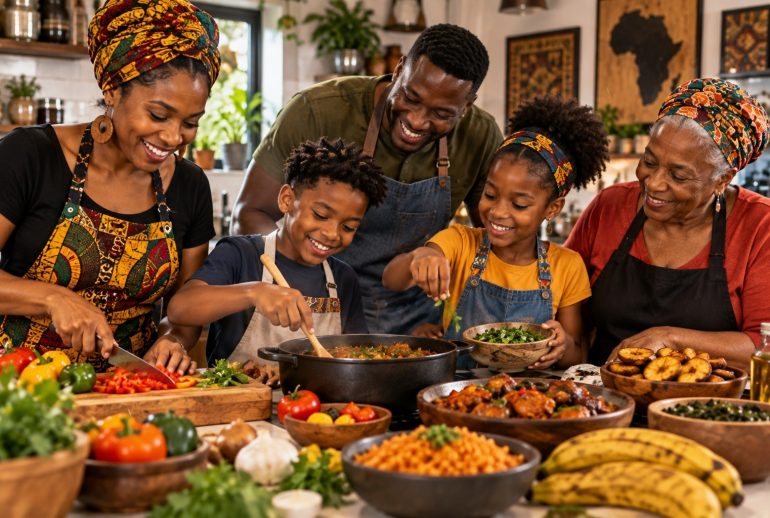
Ask someone about a favorite childhood meal and notice what happens.
They rarely describe only the food.
They tell you who made it.
“My grandmother used to cook that every Sunday.”
“My dad made it whenever the whole family came over.”
“My aunt never wrote the recipe down.”
“We always had that at Christmas.”
“My mother made it differently after we moved.”
Suddenly, the conversation is not really about food anymore.
It is about people.
Across Black communities and the wider African Diaspora, food has traveled extraordinary distances. Ingredients, cooking techniques, traditions, and tastes have moved between Africa, the Caribbean, North America, South America, Europe, and other parts of the world.
Along the way, families adapted.
They substituted ingredients.
They combined traditions.
They created new dishes.
And generations later, something served at an ordinary family dinner may carry pieces of a much larger story.
1. Ask Who Taught the Cook
One of the simplest ways to uncover a food story is to ask:
“Who taught you how to make this?”
That question can open an entire family history.
Maybe Grandma learned from her mother.
Perhaps Dad learned by watching his grandfather.
An aunt may have recreated a dish after immigrating to the United States because she missed the food she grew up eating.
Sometimes nobody remembers exactly where a recipe began.
That is okay.
The conversation itself has value.
Children who help prepare a family recipe can learn the names and stories of relatives they may never have met.
Suddenly, dinner connects generations.
2. Understand That Diaspora Food Is Not One Cuisine
There is no single “African Diaspora food.”
Africa itself contains enormous cultural and culinary diversity. The foods of Senegal are not identical to those of Ethiopia, Ghana, Nigeria, South Africa, or Kenya.
Caribbean traditions vary between Jamaica, Haiti, Trinidad and Tobago, Barbados, Cuba, Puerto Rico, the Dominican Republic, and other islands and communities.
Black American food traditions also differ by region.
Louisiana has its own influences.
The Lowcountry of South Carolina and Georgia has others.
Texas, Mississippi, Maryland, New York, Chicago, California, and Washington, D.C., have all developed food cultures shaped by their histories and populations.
Exploring those differences can be part of the fun.
Instead of asking, “What does the African Diaspora eat?”
Ask:
“What can this particular dish teach us about the people and place that created it?”
3. Follow an Ingredient Across the World
Sometimes an ingredient can tell an extraordinary story.
Rice appears in countless cuisines.
So do beans, greens, peppers, plantains, okra, corn, yams, peanuts, and many other foods.
Choose one ingredient and explore how different communities prepare it.
Take rice.
One family may know it through jambalaya.
Another through jollof rice.
Another through rice and peas.
Another through red beans and rice.
Another through a completely different regional tradition.
The ingredient is familiar, but the preparation tells us something about geography, history, available ingredients, and cultural preference.
This can become a wonderful family activity.
Pick one ingredient and prepare it in two different ways from two different cultures.
Then talk about what changed.
4. Let Children Become Food Explorers
Children can sometimes be hesitant about unfamiliar food.
Turn trying something new into exploration rather than pressure.
Choose a country or region.
Find it on a map.
Learn a few basic facts about the people who live there.
Listen to some music from the region.
Then prepare or visit a restaurant serving a dish connected to that culture.
Ask children what they notice.
Is it spicy?
Sweet?
Smoky?
Crunchy?
Soft?
What ingredients do they recognize?
What tastes completely new?
They do not have to love everything.
Learning to experience something respectfully is valuable even when the answer is:
“I don’t think I want that again.”
5. Visit Restaurants Like Cultural Classrooms
Independent restaurants can introduce families to cultures they may know very little about.
Instead of always ordering something familiar, occasionally choose a restaurant representing a cuisine the family has never tried.
Ask the staff what dish they recommend.
Find out where the food originates.
Learn how it is traditionally eaten.
You may discover Ethiopian injera, Senegalese dishes, Nigerian soups and stews, Jamaican jerk traditions, Haitian griot, Trinidadian doubles, or foods from another community represented in your area.
The purpose is not to become an expert after one meal.
It is to become curious.
A restaurant can sometimes provide the first introduction to a culture that a child later wants to learn much more about.
6. Preserve the Recipes That Exist Only in Someone’s Head
Every family seems to have one cook who refuses to measure anything.
“How much seasoning?”
“Enough.”
“How long does it cook?”
“Until it’s ready.”
“How much flour?”
“You’ll know.”
That approach may work beautifully until nobody else knows how to recreate the dish.
Spend an afternoon cooking with that person.
Watch.
Take notes.
Measure ingredients when possible.
Record a video if they are comfortable with it.
Most importantly, capture the stories that appear while they cook.
The recipe matters.
But twenty years from now, hearing Grandma explain why she prepares it that way may matter even more.
7. Accept That Family Recipes Change
Families sometimes argue about authenticity.
“That isn’t how Grandma made it.”
“We never put that in ours.”
“That’s not real macaroni and cheese.”
Those debates can be entertaining because food traditions are personal.
But recipes have always changed.
People move.
Ingredients become unavailable.
Families combine traditions through marriage.
Someone makes a healthier modification.
Another person adds a spice they love.
A new generation puts its own personality into the dish.
That does not necessarily erase tradition.
Sometimes adaptation becomes the next tradition.
The important thing is knowing the story.
“This is how Grandma made it, and this is how we make it now.”
Both can belong to the family.
8. Use Food to Talk About Migration
Food can make migration history easier for children to understand.
Ask why particular foods became common in particular places.
What crops were available?
Who moved there?
What did people bring with them?
What ingredients did they have to substitute?
What neighboring cultures influenced one another?
A dish can reveal stories about trade, migration, agriculture, economics, colonization, resilience, creativity, and community.
These subjects can be complicated.
Food gives families a tangible starting point.
Children can taste the history before they fully understand all of it.
9. Keep Celebration Foods Special
Not every traditional dish needs to become an everyday meal.
Part of what makes certain foods meaningful is when they appear.
A particular cake may belong to birthdays.
Another dish may appear at Thanksgiving.
Something else might be associated with church gatherings, weddings, reunions, funerals, holidays, or Sunday dinner.
Those patterns create anticipation.
Children learn:
“When this food appears, something important is happening.”
That association becomes part of memory.
Years later, the smell alone can bring an entire room back to life.
10. Invite Older Generations Into the Kitchen
Family gatherings often separate by age.
Children disappear into one room.
Adults talk somewhere else.
Older relatives sit together.
The kitchen can become a place where those generations overlap.
Ask an older family member to teach a younger person one dish.
Do not make the child simply watch.
Let them wash.
Stir.
Season.
Taste.
Ask questions.
Mistakes will happen.
That is part of learning.
Cooking together creates natural pauses where stories emerge without anyone announcing, “Now we are going to discuss family history.”
The history simply appears.
11. Create a Family Recipe Archive
You do not need to publish a cookbook.
Start a folder.
It can be physical or digital.
Add recipes.
Photographs.
Names.
Dates.
Short stories.
Write down who taught whom.
Include variations.
If Uncle James makes the ribs differently from Aunt Denise, save both versions.
If Grandma changed a recipe after moving from one state to another, document that.
Eventually, the collection becomes more than a recipe book.
It becomes a family archive.
Imagine giving copies to children when they become adults.
They receive not just instructions for cooking.
They receive part of their history.
12. Hold a Family “Taste the World” Night
Choose one evening occasionally to explore somewhere new.
Let a different family member choose the location each time.
Maybe Ghana one month.
Jamaica the next.
Louisiana after that.
Then Haiti.
Nigeria.
Brazil.
Trinidad and Tobago.
South Carolina’s Lowcountry.
Or another place connected to African Diaspora history.
Research a dish together and prepare it.
Play music.
Find the place on a map.
Learn a few facts.
Keep it enjoyable rather than turning dinner into homework.
Over time, children begin developing a much larger picture of how diverse Black cultures are around the world.
13. Support the People Keeping Food Traditions Alive
Food culture survives because people continue practicing it.
Restaurant owners.
Home cooks.
Farmers.
Bakers.
Caterers.
Food truck operators.
Market vendors.
Cookbook writers.
Community organizations.
And ordinary family members cooking dinner.
When possible, support local businesses representing different parts of the African Diaspora.
Ask about their specialties.
Recommend places you enjoy.
Take family members there.
A neighborhood restaurant may be doing something larger than serving meals.
It may be keeping a culinary tradition alive thousands of miles from where that tradition began.
14. Remember That Food Can Connect Without Making Everyone the Same
Sharing food can create connection across cultural differences.
But appreciating another culture does not require pretending all traditions are identical.
They are not.
That is what makes exploring them interesting.
We can recognize similarities while respecting differences.
We can enjoy another community’s food while remaining curious about where it came from and what it means to the people who created it.
Respect begins with acknowledging that there is a story behind the plate.
15. Tell the Story at the Table
The next time you serve a family recipe, do something simple.
Tell the children where it came from.
“This was your grandfather’s favorite.”
“Your aunt taught me how to make this.”
“My mother cooked this when we didn’t have much money.”
“We always ate this when the whole family came together.”
“This isn’t exactly how Grandma made it. I changed this part.”
Those sentences may seem ordinary.
They are not.
They are how family history survives.
A child may forget the conversation tomorrow.
Then, years later, they may stand in their own kitchen preparing the same dish and suddenly remember exactly who taught them.
Conclusion: Every Plate Can Carry a Piece of Home
Food feeds us, but family food can do something more.
It reminds us.
Of kitchens.
Neighborhoods.
Countries.
Grandparents.
Celebrations.
Hard times.
Good times.
People who moved.
People who stayed.
People whose names younger generations should know.
Across the African Diaspora, recipes have crossed borders and oceans, changed with circumstances, and continued showing up at family tables.
That makes the kitchen one of our most accessible places for preserving history.
So write down the recipe.
Ask the question.
Call the aunt who remembers.
Let the children stir the pot.
Try something from another part of the world.
And when everyone finally sits down to eat, tell them why the food on the table matters.
Because sometimes the most important ingredient in a family recipe is the story that comes with it.
At Akukulu Family, we believe some of our richest stories are found around the family table. What dish carries a special story in your family? Share the recipe, the person behind it, the place it came from, or the memory it brings back. By sharing these traditions with the Akukulu Family community, we can celebrate the remarkable variety of food, history, and family experiences found throughout the Black community and African Diaspora.
