

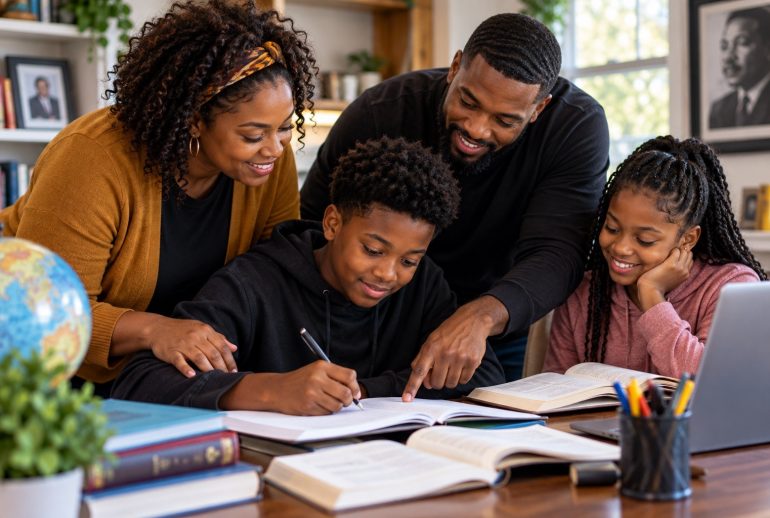
Confidence Can Change the Way a Child Learns
Two students can sit in the same classroom, hear the same lesson, receive the same assignment, and walk away with completely different experiences.
One may think, “I can figure this out.”
The other may quietly think, “I’m just not good at this.”
That difference matters.
Confidence does not automatically make school easy, but it can influence whether a student raises a hand, asks for help, attempts a difficult problem, joins an activity, applies for an opportunity, or gives up after making a mistake.
For Black students growing up in communities across the United States, building that confidence requires support from several directions. Parents and caregivers matter. Teachers matter. Mentors matter. Friends matter. Representation matters.
Most importantly, young people need adults who consistently remind them that their current performance does not define their future potential.
1. Praise Effort, Progress, and Strategy
Children naturally enjoy hearing that they are smart, but there is something even more useful adults can recognize: the work behind the result.
Instead of only saying, “You’re so smart,” try noticing what the student actually did.
“You kept working even when that problem was difficult.”
“You studied differently this time, and your grade improved.”
“You asked your teacher for help instead of giving up.”
Those messages teach young people that progress is something they can influence.
A disappointing grade can then become information rather than a verdict.
Maybe the student needs more practice. Maybe the study method was ineffective. Perhaps instructions were misunderstood. Maybe additional help is needed.
The conversation changes from “I failed” to “What can I do differently next time?”
That is a powerful shift.
2. Make Home a Place Where Questions Are Welcome
Children sometimes hide academic struggles because they are afraid of disappointing the adults around them.
A student may say there is no homework when there is. A teenager may avoid mentioning a low test score. Another child might pretend to understand something because admitting confusion feels embarrassing.
Parents and caregivers can help by making questions normal.
Instead of immediately reacting to a poor grade with anger, begin by asking what happened.
Was the material difficult?
Was the student prepared?
Are assignments being completed?
Is something happening socially at school?
Does the child understand what the teacher expects?
A grade tells us something, but it rarely tells us everything.
Creating a home environment where young people can speak openly makes it easier to identify problems before they become larger.
3. Build Simple Learning Routines
Successful students are not always the ones who spend the most hours studying.
Often, they simply develop routines.
A consistent place for homework can help. So can preparing a backpack the night before school, checking upcoming assignments, reading for a short period each day, and studying several days before a test instead of the night before.
The routine does not have to look perfect.
Some households have a quiet home office. Others have several children sharing a kitchen table. Some parents work evenings. Some students have responsibilities after school.
The best routine is the one that realistically fits the household.
Even 20 or 30 focused minutes can be valuable when they become consistent.
4. Encourage Reading Beyond School Assignments
Reading is one of the most useful academic habits a young person can develop, and it does not always need to involve traditional school books.
Let children explore what interests them.
That might mean biographies, sports stories, graphic novels, history, science fiction, magazines, poetry, technology articles, or books about people and places connected to their heritage.
The important thing is that reading becomes something larger than an assignment.
Parents can also ask simple questions afterward.
“What surprised you?”
“Who was your favorite person in the story?”
“What would you have done differently?”
These conversations help children practice comprehension and critical thinking without turning family time into another classroom.
5. Give Students Examples of Black Achievement
Representation can have a meaningful effect on how young people imagine their futures.
Children benefit from learning about Black scientists, physicians, engineers, writers, entrepreneurs, educators, artists, inventors, public servants, tradespeople, community leaders, and professionals from many different backgrounds.
The goal is not simply to present famous names during Black History Month.
Representation can happen throughout the year.
A child interested in airplanes can learn about Black aviators. A student fascinated by computers can explore Black innovators in technology. Someone who loves business can study entrepreneurs. A young artist can discover creators whose work reflects experiences that feel familiar.
When children see people who look like them succeeding in many different fields, possibility becomes easier to imagine.
6. Help Young People Discover Their Strengths
Not every student will shine in exactly the same way.
One child may excel in mathematics while another communicates beautifully through writing. Someone else may understand machines, music, art, athletics, leadership, technology, cooking, design, or hands-on problem solving.
Academic performance is important, but adults should be careful not to reduce a child’s identity to a report card.
Strengths outside the classroom can sometimes become bridges back into learning.
A student interested in basketball can explore statistics. Someone interested in music can learn about sound engineering. A child who loves gaming may become curious about coding, animation, storytelling, or digital design.
Education becomes more meaningful when students begin connecting what they learn with what they care about.
7. Teach Students How to Ask for Help
Asking for help is a skill.
Young people sometimes believe needing assistance means they are not intelligent. In reality, successful adults ask questions constantly.
Students can learn simple ways to advocate for themselves.
They can approach a teacher after class. They can ask which part of an assignment needs improvement. They can request clarification when instructions are confusing. Older students can learn to write respectful emails to teachers, counselors, coaches, or college representatives.
Parents can practice these conversations with younger students at home.
The goal is to gradually help children become comfortable speaking for themselves.
That ability will matter far beyond school.
8. Pay Attention to What Is Happening Socially
Sometimes an academic problem is not really an academic problem.
A child who suddenly stops participating may be experiencing bullying. A teenager whose grades fall may be dealing with friendship problems, social pressure, lack of sleep, stress, or another difficulty.
That is why regular conversation matters.
Not every conversation needs to begin with, “How are your grades?”
Ask about friends. Ask what made them laugh. Ask which class feels easiest and which feels hardest. Ask what they wish adults understood about school.
Then listen.
Children and teenagers may not share everything immediately. But knowing there is an adult willing to listen without instantly judging or lecturing can keep communication open.
9. Celebrate Improvement, Not Only A’s
A student who moves from a D to a C has accomplished something.
So has the student who finally turns assignments in on time.
Or the child who reads an entire book independently.
Or the teenager who previously avoided math but attends tutoring every week.
These moments deserve recognition.
Celebrating progress teaches young people that growth matters.
It also helps prevent education from becoming a constant chase for perfection.
High expectations can be valuable, but they work best when paired with encouragement.
Children should understand that adults believe they can improve while also knowing they are valued during the process.
10. Connect Education to Real Life
Students frequently ask a reasonable question:
“When am I ever going to use this?”
Whenever possible, show them.
Cooking can involve fractions and measurements. Grocery shopping can teach budgeting and percentages. A family road trip involves geography and planning. Comparing phone plans requires math and decision-making.
Running a small business combines communication, budgeting, marketing, technology, and problem-solving.
Education becomes more interesting when young people understand that learning is not confined to a classroom.
Life itself provides opportunities to practice.
11. Introduce Mentors and Positive Community Connections
Parents do not have to provide every answer themselves.
Sometimes another trusted adult can reach a young person in a different way.
A mentor, coach, teacher, church leader, business owner, college student, relative, or community volunteer may offer guidance that complements what a child receives at home.
These relationships can be especially valuable when young people begin thinking about careers.
A teenager interested in nursing may benefit from meeting a nurse. Someone curious about construction might learn from a contractor. A student interested in entrepreneurship could spend time talking with a local business owner.
Young people need opportunities to see adulthood up close.
Those conversations can transform an abstract career into something that feels achievable.
12. Teach Children That Mistakes Are Part of Learning
One of the biggest threats to confidence is the fear of being wrong.
A child who believes mistakes are embarrassing may stop taking risks.
But mistakes are unavoidable in learning.
People misspell words before becoming better writers. They solve equations incorrectly before understanding mathematics. They stumble through presentations before becoming confident speakers.
Adults can model this attitude too.
When you make a mistake, acknowledge it.
When something does not work, talk about what you learned.
Children who see adults adjusting, learning, and trying again begin to understand that competence develops over time.
Education Is a Partnership
Schools have an enormous responsibility, but education cannot belong to schools alone.
Parents and caregivers provide encouragement and expectations. Teachers provide instruction. Community organizations create opportunities. Mentors provide perspective. Libraries provide resources. Local businesses can introduce careers.
And students themselves gradually learn to take responsibility for their own growth.
When these pieces work together, education becomes more than earning grades.
It becomes preparation for life.
Conclusion: Help Them Believe They Belong in the Room
One of the most valuable messages we can give a young person is simple:
You belong here.
You belong in the advanced class.
You belong in the library.
You belong in the science lab.
You belong in college if that is your path.
You belong in skilled trades, entrepreneurship, technology, medicine, education, the arts, public service, and every other field where your abilities can grow.
Confidence will not remove every obstacle a student encounters. But confidence combined with preparation, support, discipline, and opportunity can help young people face those obstacles differently.
Every encouraging conversation, every mentor introduction, every book read together, and every celebrated improvement can contribute to something larger.
We are not simply helping students pass the next test.
We are helping them recognize what they are capable of becoming.
At Akukulu Family, we believe strong communities grow when young people are given the encouragement, knowledge, and opportunities they need to thrive. Share the educational strategies that have helped the students in your life, and continue exploring Akukulu Family for conversations and resources designed to support our children, households, and communities.
