

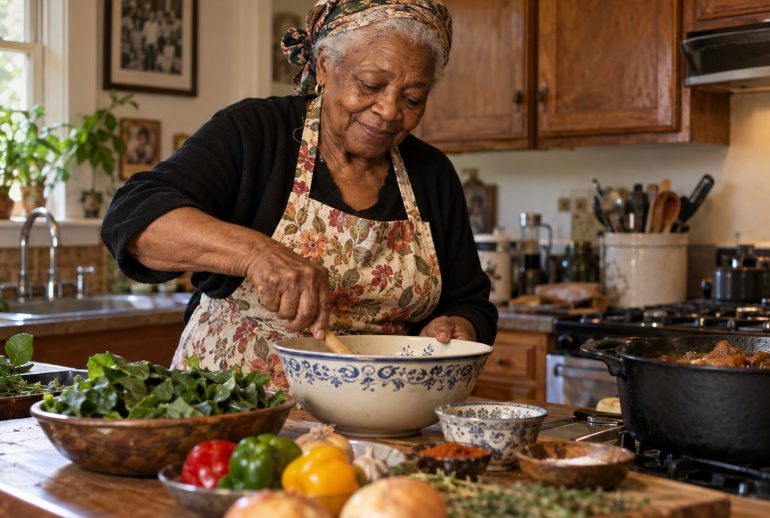
A family recipe can hold more history than people realize. A pot of greens, a rice dish, a stew, a dessert, a spice blend, or a holiday meal may carry memories of grandparents, migration, church gatherings, celebrations, hardship, survival, and love. Food often remembers what written records do not.
Across the Black community and the wider African Diaspora, recipes have traveled through generations in many ways. Some were written carefully on index cards. Others lived only in memory. A grandmother may have measured ingredients by sight. An uncle may have known exactly when something was ready by smell. A family may have changed a recipe after moving to a new city, state, or country because different ingredients were available.
These changes tell stories.
When families teach children where recipes came from, they help preserve more than instructions. They preserve memory, identity, geography, culture, and family experience. A child learning how to cook a favorite dish may also learn who first made it, when the family ate it, why it mattered, and how it changed over time.
Food gives families an easy place to begin talking about history.
1. Recipes Can Carry Stories That Were Never Written Down
Many family histories survive through oral tradition.
A recipe may come with stories about who made it best, who taught whom, or what happened every time the dish appeared at a gathering.
Those stories can disappear if no one asks about them.
Families can preserve them by talking with elders while they cook. Ask where the recipe came from. Ask who taught them. Ask whether the ingredients were always the same.
These questions often lead far beyond food.
An elder may begin talking about childhood, migration, school, work, church, farming, neighborhoods, or family celebrations.
A recipe can become the doorway to a much larger story.
2. Food Can Reveal Migration History
Recipes often change when families move.
A dish made in one country may use different ingredients after migration. A Southern recipe may change after a family moves north. Caribbean or African recipes may adapt depending on what can be found locally.
These changes are part of history.
Families can talk about why substitutions happened.
Was an ingredient too expensive?
Was it unavailable?
Did the family learn a new cooking method from neighbors?
Did one generation make the dish differently from another?
These small differences help children understand that migration shapes culture.
Food adapts because families adapt.
3. Family Recipes Can Connect Children To The African Diaspora
Many foods eaten across Black communities have connections that reach across countries and centuries.
Ingredients such as rice, okra, yams, plantains, beans, greens, peanuts, peppers, and spices appear in many food traditions across Africa and the Diaspora.
Families can use a familiar recipe as a starting point for learning.
Where did this ingredient originate?
How is it prepared in different countries?
Why does a similar dish appear in several cultures?
These questions help children see connections between African American, African, Caribbean, Afro-Latin, and other Black food traditions.
Food can make the idea of the Diaspora easier to understand.
4. Cooking With Elders Preserves More Than Flavor
Older relatives often know details that are not written anywhere.
They may know how the dough should feel, when the oil is hot enough, how much seasoning is right, or how long something should cook even without a timer.
That knowledge is valuable.
Young family members can learn by watching closely.
They can record videos, take notes, ask questions, or write down measurements as the elder cooks.
The goal is not to force every traditional method into exact instructions.
It is to preserve enough that the next generation can continue the tradition.
Cooking together also creates time for stories that may never come up otherwise.
5. Holiday Meals Can Carry Generational Memory
Certain dishes appear again and again at holidays, reunions, church gatherings, graduations, and family celebrations.
Children may expect them without knowing why they became important.
Families can explain.
Maybe the dish belonged to a great-grandmother.
Maybe it was always served after church.
Maybe it became part of Thanksgiving decades ago.
Maybe a relative brought the recipe from another country.
When children know the story, the food becomes more meaningful.
The meal is no longer simply tradition.
It becomes memory.
6. Recipes Can Teach Children About Hard Times
Not every family food tradition began during abundance.
Some recipes were created because families needed to stretch ingredients, avoid waste, or feed many people with limited resources.
These stories can teach children about resilience.
A parent might explain how grandparents made several meals from one ingredient or how leftovers were reused creatively.
The lesson does not need to romanticize hardship.
Instead, it can highlight resourcefulness.
Children learn that previous generations found ways to care for families even when circumstances were difficult.
That understanding can build gratitude and perspective.
7. Family Recipes Can Teach Practical Math And Reading
Recipes are also learning tools.
Children can practice fractions, measurements, multiplication, timing, reading instructions, and sequencing while cooking.
If a recipe serves four and the family needs eight portions, the child can help double it.
If ingredients need to be measured, children can compare cups, teaspoons, and tablespoons.
This makes math practical.
Reading a recipe also teaches children to follow steps carefully.
Learning becomes part of family life instead of something that happens only at school.
8. Recipes Can Help Children Understand Geography
Food can lead directly to maps.
If a recipe has roots in Louisiana, Jamaica, Ghana, Nigeria, Haiti, South Carolina, Trinidad, Ethiopia, or another place, families can locate it together.
What is the climate like there?
What crops grow there?
What languages are spoken?
What other foods are common?
Geography becomes more interesting when it connects to something the child already eats.
A recipe can turn a place on a map into part of the family story.
9. Food Traditions Can Build Cultural Pride
Children can sometimes feel embarrassed by foods that seem different from what classmates eat.
Families can help by explaining the history and meaning behind those foods.
A strong sense of context changes how a child sees a dish.
Instead of “This smells different,” the child may understand, “This is something my family has made for generations.”
That knowledge can build confidence.
Cultural pride grows when children understand why traditions matter.
Food can become something they are excited to share rather than hide.
10. A Family Cookbook Can Preserve History
Families can create their own cookbook.
It does not need to be professionally printed.
A binder, notebook, digital document, or photo album can work.
Each recipe can include the name of the person connected to it, where it came from, when the family usually prepares it, and a short memory.
Children can help type recipes, take photos, decorate pages, or interview elders.
Over time, the cookbook becomes more than a collection of food.
It becomes an archive.
Future generations can use it to understand both what the family ate and who the family was.
11. Photos Can Help Preserve Food Memories
Food photographs are common today, but families can use them more intentionally.
Take a picture of the person preparing the recipe, not only the finished plate.
Photograph hands kneading dough, children helping in the kitchen, an elder seasoning a pot, or the family gathered around the table.
These images preserve process and people.
Years later, a photograph of Grandma cooking may matter more than a perfect picture of the meal.
Families can save photos alongside recipes and stories.
This creates a richer record of family life.
12. Children Should Be Allowed To Help
Sometimes adults avoid letting children cook because it takes longer or creates more mess.
But participation is how traditions survive.
Young children can wash produce, stir, measure, or set the table.
Older children can chop with supervision, season food, follow recipes, or prepare simple dishes independently.
Teens can gradually learn full family recipes.
The process may not be perfect at first.
That is okay.
A tradition continues only when someone younger learns how to do it.
13. Family Recipes Can Change Without Losing Their Meaning
Traditions do not have to stay frozen.
A family may reduce salt, adjust sugar, change cooking methods, or substitute ingredients for dietary needs.
Younger generations may add new flavors or combine traditions.
These changes do not automatically erase the original recipe.
Families can preserve both versions.
Write down the traditional method and the updated one.
This shows children that culture can evolve while still respecting its roots.
Tradition and change can exist together.
14. Food Stories Can Help Children Understand Identity
Identity is often built through small repeated experiences.
A child may connect family identity with the smell of a certain dish, a holiday meal, a grandmother’s kitchen, or a food served every Sunday.
These memories become emotional anchors.
Later in life, preparing the same food may bring back a sense of home.
Families can help children understand that heritage is not only something found in textbooks.
It lives in kitchens, tables, recipes, and everyday routines.
Food can become one of the most personal forms of history.
15. Community Food Traditions Matter Too
Family recipes are part of a larger community story.
Church meals, neighborhood cookouts, cultural festivals, fish fries, family reunions, barbecues, and community gatherings all create shared food traditions.
Children should understand that these events are part of cultural memory.
Who cooked?
Who served?
Which dishes always appeared?
What music played?
Who gathered around the table?
Community food traditions help children see that history happens through ordinary people as well as famous events.
16. Recipes Can Be Passed Forward Intentionally
Families should not assume traditions will automatically survive.
They need to be taught.
A parent can choose one recipe each year to teach a child.
An elder can demonstrate a holiday dish.
A teenager can record the process.
A family can create a yearly cooking day where several generations prepare food together.
These small acts protect knowledge.
Without them, traditions can disappear quietly.
Passing a recipe forward is one way of saying, “This story matters enough to keep.”
Conclusion
Family recipes can help preserve Black community history by connecting food to migration, culture, resilience, family memory, and the wider African Diaspora.
Families do not need perfect records to begin.
Start with one dish.
Ask who made it first. Find out where the ingredients came from. Write down the recipe. Take a photograph. Let a child help prepare it. Ask an elder what they remember.
One recipe may reveal generations of history.
When families preserve those stories, children receive more than cooking instructions.
They receive a clearer understanding of where they come from and something meaningful they can carry forward.
Akukulu Family encourages parents, caregivers, elders, and community members to preserve one family recipe this month. Cook it with a young person, record an elder explaining the steps, write down the story behind the dish, or begin a family recipe book. One meal can preserve a piece of history for generations to come.
