

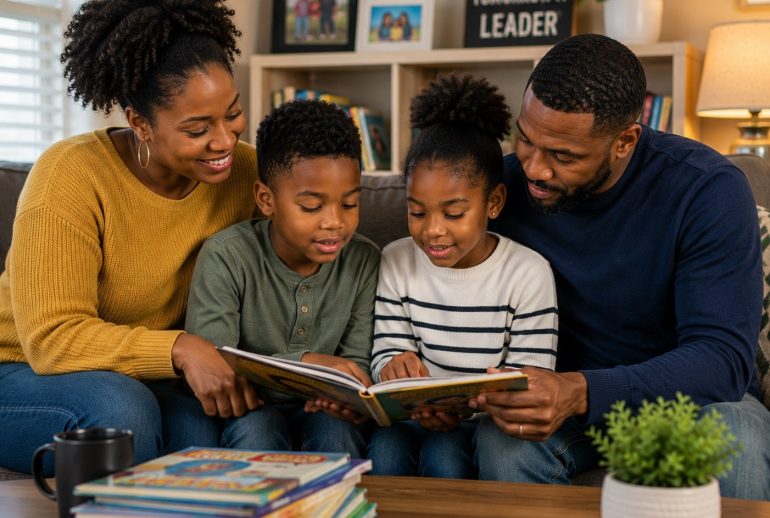
Reading at home is one of the most powerful ways families can support children’s learning, confidence, imagination, and future success. A child’s reading life does not begin and end inside the classroom. School is important, but the home plays a major role in how children think about books, words, stories, language, and learning. When reading becomes part of family life, children begin to understand that books are not only assignments. They are tools for discovery, communication, culture, creativity, and growth.
Across the Black community, reading has always carried deep meaning because literacy has been connected to freedom, opportunity, self-expression, leadership, faith, business, and community progress. Families and communities have long understood that the ability to read gives children access to knowledge, confidence, and choices. Reading helps young people understand the world, ask better questions, speak more clearly, write more strongly, and imagine futures beyond what they immediately see around them.
Many parents and caregivers want children to read more, but daily life can make it difficult. Work schedules, homework, sports, phones, video games, social media, chores, younger siblings, and family responsibilities can all compete for attention. Some children love books naturally, while others resist reading because it feels hard, boring, embarrassing, or disconnected from their interests. Families may also feel unsure about how to support reading if they are tired, busy, or dealing with their own memories of struggling in school.
The good news is that reading at home does not have to be complicated. A family can begin with ten minutes a day, one bedtime story, one library visit, one book by a Black author, one article read together, one elder telling a story, or one conversation about something the child read. Small habits can grow into strong routines. When families make reading warm, consistent, and meaningful, children are more likely to build skills that support them for life.
1. Reading At Home Helps Children Build Confidence.
Children become stronger readers through practice, but they also need encouragement. A child who struggles with reading may feel embarrassed, especially if classmates seem to read faster or answer questions more easily. If reading becomes connected to shame, a child may avoid books even more. Home can become a safe place where children practice without fear of being laughed at.
Parents and caregivers can help by creating a patient reading environment. A child may need to sound out words, reread a sentence, ask what something means, or listen while an adult reads first. These moments should not be rushed with frustration. When adults respond calmly, children learn that reading is a skill they can improve, not a test of their worth.
Confidence grows when children see progress. A child who once struggled with a page may later read it more smoothly. A child who avoided books may begin choosing stories. A child who was nervous about reading aloud may become more willing to try. Adults should notice these steps and celebrate growth.
Reading confidence also affects school confidence. A child who feels more capable with books is often more willing to participate in class, complete assignments, and ask questions. That confidence can reach far beyond reading time.
2. Vocabulary Grows Through Everyday Reading.
Children learn new words by hearing and seeing them in context. Books expose children to language they may not hear in ordinary conversation. Stories, poems, biographies, science books, history books, recipes, articles, and even instructions can introduce words that help children express themselves more clearly.
A strong vocabulary helps children in every subject. Math word problems, science lessons, social studies, writing assignments, tests, and classroom discussions all require language. When children understand more words, they can understand more ideas. Reading at home gives them regular exposure to that language growth.
Families can support vocabulary by talking about words naturally. If a child asks what a word means, adults can explain it in simple language and use it in another sentence. Parents can also ask children what they think a word means based on the story. This teaches children to pay attention to context.
Vocabulary should not feel like a punishment or a long quiz. It can grow through conversation. A family reading a story might pause and say, “That word means brave,” or “That means the character was nervous,” or “Have you ever felt that way?” These simple moments help language become personal and memorable.
3. Reading Helps Children Use Their Imagination.
Books give children room to imagine people, places, problems, adventures, emotions, and possibilities. A child can visit another country, explore history, solve a mystery, meet a brave character, learn about space, imagine a future career, or understand another person’s feelings through reading. This kind of imagination is important for creativity and critical thinking.
In a world full of quick videos and fast-moving screens, books ask children to slow down and picture things in their minds. They have to imagine the setting, follow the story, remember details, and think about what might happen next. These skills help children develop focus and mental flexibility.
Imagination also helps children see possibilities for themselves. A book about a young inventor, artist, athlete, scientist, leader, or entrepreneur may help a child think, “Maybe I can do something like that too.” Stories can widen a child’s view of the future.
Families can encourage imagination by asking open questions after reading. What do you think the character should do? How would you change the ending? What would this place look like? Which character reminds you of someone you know? These questions help children interact with the story instead of simply finishing the page.
4. Books By Black Authors Help Children Feel Seen.
Children need books that reflect their lives, families, culture, history, and community. Books by Black authors and Diaspora writers can help children see characters who look like them, speak like people they know, face familiar situations, celebrate similar traditions, and carry stories connected to their heritage. Representation matters because it tells children that their lives are worthy of being written about.
A child who sees themselves in books may feel more connected to reading. They may recognize family gatherings, hairstyles, neighborhoods, food traditions, faith experiences, school situations, cultural celebrations, or community values. This familiarity can make reading feel less distant and more meaningful.
Books by Black authors also expose children to the diversity within the Black community. Children can read African American stories, African folktales, Caribbean stories, Afro-Latin stories, biographies, poetry, fantasy, history, and modern family stories. This helps them understand that their community is not one single story. It is wide, creative, global, and full of many voices.
Families can intentionally include these books at home. They can visit libraries, ask for recommendations, support Black-owned bookstores when possible, and create a small family shelf of books that reflect identity and pride. When children feel seen in books, reading can become a source of confidence.
5. Reading Together Strengthens Family Connection.
Reading at home can become a family bonding activity. A parent reading to a child, a grandparent sharing a story, siblings reading together, or a teen discussing a book with an adult can all create meaningful connection. These moments show children that reading is not only a school task. It can be part of love and family time.
Younger children often enjoy being read to because they receive attention, warmth, and comfort. A bedtime story, afternoon reading break, or weekend library book can become a routine they look forward to. Older children and teens may not want bedtime stories, but they may enjoy talking about a book, article, poem, or topic connected to their interests.
Reading together also creates conversation. A story may lead to a discussion about kindness, courage, family, history, friendship, money, faith, culture, or decision-making. These conversations can help children process life through stories.
Families should not underestimate these moments. A child may forget the exact words of a book, but remember that someone took time to read with them. That memory can shape how they feel about learning and family connection.
6. Libraries Can Become A Family Resource.
Libraries are one of the best tools families can use to support reading. They offer free access to books, computers, research tools, children’s programs, teen spaces, homework help, reading challenges, and community events. For families trying to build reading habits without spending a lot of money, the library can be a powerful partner.
A library visit can become a family outing. Children can explore shelves, choose books, attend story time, ask librarians for recommendations, and discover topics they enjoy. Giving children choice matters because they are more likely to read when they feel some ownership over what they select.
Libraries can also help parents and caregivers who are unsure where to begin. A librarian can suggest age-appropriate books, beginner readers, culturally relevant titles, graphic novels, audiobooks, or books for children who struggle with reading. Families do not have to figure everything out alone.
A regular library routine can make reading feel normal. Whether families visit weekly, monthly, or during school breaks, the habit teaches children that books and learning are part of life. The library can become a safe and encouraging space for growth.
7. Children Should Be Allowed To Read Different Kinds Of Books.
Some adults think children should only read traditional chapter books, but many types of reading can help build skills. Graphic novels, picture books, poetry, biographies, magazines, recipes, sports articles, science books, history books, comic books, devotionals, manuals, and audiobooks can all support literacy in different ways.
A child who resists chapter books may enjoy graphic novels because the pictures help them follow the story. A child who loves sports may read about athletes. A child interested in cooking may read recipes. A teen who enjoys music may read artist interviews or songwriting books. The key is helping children connect reading to their interests.
Families should guide children toward quality materials, but they should also remain open-minded. If a child reads something appropriate and engaging, that reading can become a bridge to other books later. The goal is to build the habit and confidence first.
Different formats also support different learners. Some children benefit from audiobooks while following along with the printed text. Some enjoy short articles more than long books. Some need high-interest books that match their age but are easier to read. Flexibility helps more children succeed.
8. Reading Helps Children Become Better Writers.
Reading and writing are connected. Children who read more often are exposed to sentence structure, storytelling, vocabulary, grammar, organization, and different writing styles. Over time, this exposure can help them become stronger writers. They begin to understand how ideas are expressed on the page.
Writing matters for school and life. Children need to write essays, answer questions, send emails, apply for programs, communicate at work, and express ideas clearly. Reading gives them examples of how words can be used. A child who reads stories may become better at storytelling. A child who reads biographies may learn how to explain real events. A child who reads opinion pieces may learn how to make an argument.
Families can support writing by connecting it to reading. After reading a story, a child might write a short response, draw and label a scene, create a new ending, write a letter to a character, or summarize what happened. These activities help children practice putting thoughts into words.
Parents do not need to correct every mistake immediately. Too much correction can make children afraid to write. It is helpful to encourage expression first, then guide improvement over time. Confidence and skill can grow together.
9. Reading Can Help Children Understand Emotions.
Stories help children understand feelings. A character may feel afraid, proud, jealous, angry, lonely, excited, embarrassed, or hopeful. When children read about emotions in a story, they can begin to understand their own feelings and the feelings of others. This supports emotional growth.
A parent can ask, “How do you think the character felt?” or “Have you ever felt that way?” or “What could the character do next?” These questions help children build empathy and self-awareness. They learn that feelings have names and that people respond to emotions in different ways.
Books can also help children process difficult topics. Stories about moving, grief, friendship problems, bullying, family changes, courage, or anxiety can give children language for experiences they may not know how to explain. A child may open up after reading about a character who faced something similar.
Reading does not replace emotional support, but it can create a gentle doorway into important conversations. Families can use books to help children talk about life in a safe and meaningful way.
10. Reading Routines Work Best When They Are Realistic.
Many families want children to read more but struggle to create a routine. The routine does not need to be long or perfect. A realistic habit is better than an unrealistic plan that disappears after a few days. Ten to twenty minutes of reading a few times a week can be a strong beginning.
Families can choose a time that fits their schedule. Reading might happen before bed, after dinner, during breakfast, on Sunday afternoon, after homework, or during a quiet weekend moment. The best routine is the one the family can actually keep.
It helps to make books easy to reach. A small basket of books in the living room, bedroom, car, or kitchen can remind children to read. Families can also keep library books in a special place so they do not get lost. Visibility encourages use.
Parents should avoid making reading feel like a punishment. If reading is only used when a child loses screen time, the child may begin to resent it. Reading should be presented as a normal and valuable part of life, not only a consequence.
11. Elders Can Help Pass Down A Love Of Stories.
Reading at home is connected to storytelling. Elders can play a special role by sharing family stories, reading with children, telling memories, and connecting books to lived experience. A grandparent, auntie, uncle, neighbor, or older community member can help children understand that stories are part of family and cultural memory.
An elder may read a picture book, tell a story from childhood, explain an old saying, share a recipe memory, or talk about how education mattered in earlier generations. These moments help children connect reading to real people and family history.
Families can invite elders into reading routines. A child might call a grandparent and read a short passage. An elder might record themselves reading a story. During family gatherings, someone can ask an older relative to share a memory connected to school, books, faith, or community life.
These interactions honor elders and strengthen children. They show that learning is not only between a child and a textbook. It is between generations.
12. Reading Builds A Stronger Future.
Reading is more than an academic skill. It is a foundation for opportunity. Children who read well are better prepared to learn new subjects, express ideas, understand information, ask questions, follow instructions, and make decisions. Reading supports school success, career readiness, financial literacy, health understanding, civic participation, and personal growth.
Across the Black community, building strong readers is part of building stronger futures. A child who reads with confidence can better understand history, explore culture, prepare for leadership, and access new opportunities. Reading helps children become thinkers, communicators, creators, and problem-solvers.
Families, schools, libraries, churches, mentors, and community organizations all have a role to play. Children need books, encouragement, time, representation, and adults who believe in their ability to grow. When the village supports reading, children receive a powerful message: your mind matters.
A stronger future begins with repeated small investments. One book, one story, one library visit, one reading routine, and one encouraging adult can make a lasting difference.
Conclusion.
Reading at home builds stronger children across the Black community because it supports confidence, vocabulary, imagination, school success, cultural pride, emotional growth, and family connection. Children do not become strong readers only through school assignments. They grow when reading becomes part of everyday life at home and in the community.
Families do not need a perfect plan to begin. They can read for ten minutes, visit the library, choose books by Black authors, let children pick topics they enjoy, ask elders to share stories, or talk about what a child is reading. Small steps can build strong habits over time.
When children learn to love reading, they gain more than words on a page. They gain tools for thinking, dreaming, communicating, learning, and leading. A child who reads with confidence is better prepared to walk into the future with knowledge, imagination, and purpose.
Akukulu Family encourages parents, caregivers, elders, mentors, and community members to support one child’s reading this week. Read a story together, visit a library, recommend a book by a Black author, ask a child what they enjoy reading, or invite an elder to share a family story. One reading moment can help strengthen a child’s confidence and future.
