

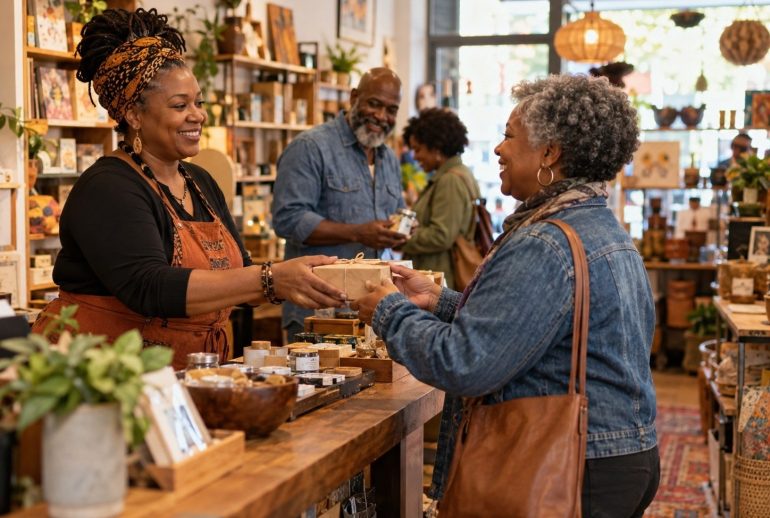
A neighborhood business can be much more than a place to buy something. A barbershop may become a meeting place. A restaurant may employ local teenagers. A boutique may feature the work of local designers. A contractor may train a young apprentice. A bookstore may host community events. A small business often becomes part of the social and economic fabric of the neighborhood around it.
Across the Black community, entrepreneurship has long been a way for families to build income, create opportunity, share skills, and serve local needs. Business owners have opened restaurants, salons, shops, transportation companies, professional services, childcare programs, construction firms, creative studios, and countless other ventures. Many began with limited resources and built through relationships, reputation, and persistence.
Supporting Black-owned businesses does not mean families must purchase something they do not need or ignore quality, price, and service. Consumers should still make thoughtful choices. But when a Black-owned business offers something a family already needs, intentionally considering that business can help keep more economic activity circulating within the community.
It can also create an important lesson for children. Young people begin to see entrepreneurship not as something distant but as something real people around them are doing every day.
1. Small Businesses Can Create Local Jobs
One of the clearest ways businesses support communities is through employment.
A restaurant may need cooks, servers, delivery workers, and managers. A salon may employ stylists and assistants. A retail shop may hire teens for weekends or summer work. A growing professional firm may eventually need administrative, marketing, accounting, or technical support.
Those jobs matter.
A first job can teach a teenager punctuality, customer service, teamwork, and responsibility. A steady job can help an adult support a household. A business that grows may create opportunities for several families.
When families support local businesses, they are often supporting more than the owner.
They may also be supporting the people that business employs.
2. Local Entrepreneurs Give Youth Visible Examples
Young people need to see possibilities.
A child who regularly sees business owners who look like them may begin to understand entrepreneurship as something achievable rather than abstract.
A teen may watch a barber manage appointments, a caterer organize orders, a photographer work with clients, or a contractor lead a crew.
These experiences show that business involves real skills: communication, planning, problem-solving, money management, consistency, and service.
Parents can point these lessons out.
“How do you think this business gets customers?”
“What expenses do you think they have?”
“What makes people come back?”
Those questions turn everyday shopping into business education.
3. Buying Local Can Keep More Money Connected To The Community
When money is spent at a locally owned business, some of that money may continue moving through the local economy.
The owner may hire nearby workers, purchase services from another local company, sponsor a youth team, donate to a school event, or spend money with other businesses in the area.
This does not mean every dollar stays local or that every small business operates the same way.
But strong local business networks can create more economic connections between households.
Families can teach children that spending is not only about what they buy.
Where money is spent can also matter.
That is a practical introduction to community economics.
4. Black-Owned Businesses Often Carry Cultural Knowledge
Some businesses preserve traditions and expertise that are deeply connected to the community.
A restaurant may keep family recipes alive. A natural hair salon may understand textures and styles that larger chains do not serve well. A bookstore may carry authors that are harder to find elsewhere. A clothing designer may draw inspiration from African Diaspora traditions.
These businesses provide more than products.
They may also preserve knowledge, craft, language, taste, style, and history.
Families can help children notice these connections.
Who taught this person the skill? Where did the recipe come from? What culture influenced this design?
Businesses can become another place where cultural learning happens naturally.
5. Good Reviews Can Make A Real Difference
Supporting a business does not always require spending large amounts of money.
A thoughtful online review can help.
When a family receives good service, leaving an accurate review can help other customers discover the business. Sharing a business with friends can also be useful.
Parents can teach teens that digital reputation matters for businesses.
A few careless negative comments can hurt a small company, while honest positive feedback can help it grow.
That does not mean people should hide legitimate problems.
Consumers should still be truthful.
But when a business does something well, saying so publicly is one simple form of support.
6. Word Of Mouth Is Still Powerful
Small businesses often grow because people recommend them.
A customer tells a relative about a good restaurant. Someone recommends a contractor. A parent shares the name of a tutor. A friend sends another friend to a local stylist.
These recommendations create trust.
Families can support businesses they genuinely value by talking about them.
This is especially helpful for businesses that do not have large advertising budgets.
A good recommendation may bring a customer who returns for years.
Community networks can become powerful marketing networks.
7. Business Ownership Can Create Mentorship Opportunities
Entrepreneurs can become valuable mentors for young people.
A teenager interested in photography may learn from a local photographer. A student curious about food service may shadow a restaurant owner. A young person interested in construction may learn from a contractor.
Even a short conversation can be useful.
What was difficult when you started?
How did you find your first customers?
What skill matters most?
What would you learn earlier if you could start again?
These questions give teens access to real-world wisdom.
Parents and community organizations can help create safe, structured opportunities for these connections.
8. Families Can Teach Children To Evaluate Businesses Fairly
Supporting Black-owned businesses should not mean abandoning normal consumer judgment.
Children should learn that good businesses still need quality, reliability, honesty, and service.
A family can support a business and still expect clear prices, professional communication, and a good product.
This is an important lesson because entrepreneurship grows stronger when customers and businesses respect one another.
Families can teach children to ask: Was the product good? Was the service respectful? Was the price reasonable? Would we return?
Support should be meaningful, not blind.
Healthy business communities depend on both responsible owners and informed customers.
9. Families Can Include Black-Owned Businesses In Celebrations
Birthdays, graduations, reunions, weddings, church events, and holiday gatherings often involve spending.
Families may need catering, photography, decorations, clothing, gifts, beauty services, entertainment, transportation, or event spaces.
These moments can create opportunities to explore local Black-owned vendors.
Families can research options ahead of time rather than waiting until the last minute.
Even choosing one local vendor can introduce the family to a business they may use again.
Celebration spending can therefore become part of community support.
10. Teen Entrepreneurs Benefit From Community Customers
Supporting Black-owned businesses can begin with young entrepreneurs.
A teen selling artwork, baked goods, jewelry, lawn services, photography, clothing, or digital work may be learning their first business lessons.
Adults can help by becoming thoughtful customers.
That does not mean buying poor-quality products simply because a young person made them.
Constructive feedback is valuable too.
Adults can ask questions, offer encouragement, share the business, or teach the teen how to improve pricing and presentation.
A young entrepreneur who receives serious support learns that their effort matters.
11. Black-Owned Businesses Can Strengthen Community Identity
Certain businesses become landmarks.
People remember where they got their first haircut, where families gathered after church, where teenagers bought clothes, or where elders met for coffee.
These spaces become part of community memory.
When long-standing businesses disappear, communities sometimes lose more than a storefront.
They lose places where relationships formed.
Supporting strong local businesses can help preserve those gathering spaces.
Community identity is shaped partly by the places people return to.
12. Business Owners Can Support Schools And Youth Programs
Local entrepreneurs often contribute to community activities.
They may sponsor uniforms, donate food, provide raffle items, support scholarships, host internships, or help youth organizations.
These contributions are easier when the business itself is healthy.
Families supporting local businesses may therefore indirectly support programs that benefit children.
Parents can also teach youth to notice businesses that consistently show up for the community.
Supporting companies that demonstrate responsibility can encourage more of that behavior.
Community investment can work in both directions.
13. Social Media Can Help Small Businesses Reach More People
A simple social media share may help a local business reach customers it could never afford to advertise to directly.
Teens especially understand how quickly information moves online.
Families can share a business page, tag a restaurant they enjoyed, post a product they genuinely liked, or send a business profile to someone looking for that service.
Businesses should still earn the recommendation.
Authentic support is more valuable than exaggerated promotion.
Digital word of mouth can help small businesses compete in a marketplace dominated by larger brands.
14. Families Can Explore Black Business History
Entrepreneurship also provides an opportunity to learn history.
Black communities have a long history of building businesses despite discrimination and limited access to capital.
Families can learn about historic business districts, Black banks, newspapers, beauty companies, insurance firms, restaurants, inventors, farmers, and entrepreneurs.
Local museums, libraries, books, and historical societies can be useful starting points.
Understanding this history gives children context.
Entrepreneurship did not suddenly appear with social media.
Black business owners have been building, adapting, and creating opportunity for generations.
15. Spending Intentionally Does Not Mean Spending More
Supporting local businesses should not put families under financial pressure.
A household budget still comes first.
Families should not feel guilty if a product or service is outside their price range.
Intentional spending simply means considering options.
If two businesses offer comparable products at reasonable prices, a family may choose the local business because they value the community connection.
Support can also happen through referrals, reviews, attending free events, or sharing information.
Community support should strengthen families, not create financial strain.
16. Strong Businesses Help Build Stronger Communities
Healthy communities usually need a mix of strong families, schools, organizations, public institutions, and businesses.
Entrepreneurs create services people need.
They also create jobs, train workers, rent or own commercial spaces, purchase supplies, and build relationships.
When local businesses succeed responsibly, neighborhoods can become more economically resilient.
No single purchase will transform a community.
But repeated decisions by many households can have an impact over time.
That is how economic ecosystems grow.
Conclusion
Supporting Black-owned small businesses can strengthen families across the Black community by encouraging entrepreneurship, creating local jobs, expanding mentorship, preserving cultural knowledge, and building stronger neighborhood economies.
Families do not need to purchase everything locally or support a business simply because of who owns it. Quality, service, affordability, and trust still matter.
The opportunity is to become more intentional.
Look at who is providing the products and services your family already needs. Discover entrepreneurs in your community. Recommend businesses that serve you well. Introduce young people to owners who are building something meaningful.
Those small decisions can do more than complete a purchase.
They can help children see how communities build opportunity together.
Akukulu Family encourages families, entrepreneurs, educators, and community members to discover one Black-owned small business they have not supported before. Make a thoughtful purchase if it fits your needs, leave an honest review, recommend the business to someone else, or introduce a young person to the owner’s story. One intentional connection can help strengthen both a business and the community around it.
