

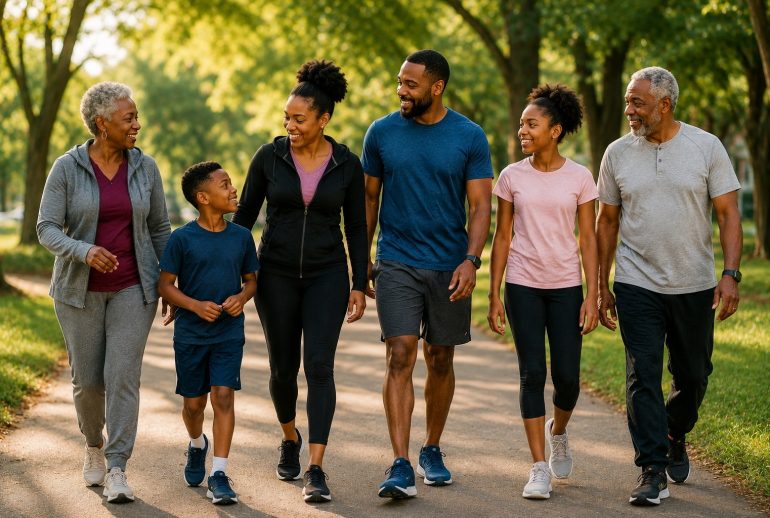
Walking is one of the simplest wellness habits a family can build. It does not require expensive equipment, a gym membership, a complicated schedule, or special training. A short walk after dinner, a weekend walk at the park, a walk to school when safe, a stroll with an elder, or a family walk around the neighborhood can support the body, calm the mind, and create space for connection. Sometimes the most powerful health habits are also the most ordinary.
Across the Black community, many families are carrying full schedules and real responsibilities. Parents and caregivers may be balancing work, bills, school needs, transportation, meals, caregiving, church, and household routines. Children and teens may spend long hours sitting in classrooms, doing homework, watching screens, gaming, or scrolling on phones. Elders may need gentle movement and social connection. In the middle of busy life, walking can become a practical way to bring wellness into the day without making it feel overwhelming.
Walking supports more than physical health. It can become a time for conversation, prayer, reflection, stress relief, problem-solving, and family bonding. A child may open up during a walk more easily than at the dinner table. A teen may talk while moving instead of feeling pressured by a serious face-to-face conversation. An adult may feel calmer after stepping away from work stress. An elder may feel included when invited to move at their own pace.
Family walking routines do not need to be perfect. They can begin with ten minutes. They can happen once or twice a week. They can happen at a park, school track, community center, mall, sidewalk, trail, or safe indoor space. What matters is consistency, safety, and making walking feel like care instead of punishment.
1. Walking Helps Families Move More Without Pressure.
Many people hear the word exercise and immediately think of hard workouts, sweat, gyms, weight loss, or strict routines. Walking can feel less intimidating. It allows families to move their bodies in a way that is simple, familiar, and flexible. A child, parent, teen, or elder can often participate at a pace that fits their ability.
This matters because families are more likely to keep habits that feel realistic. A long workout plan may disappear after a few days, but a short walk after dinner may become easier to repeat. A walk does not need to be perfect to be helpful. Even a little movement can be better than no movement at all.
Walking can also help families shift away from thinking of movement only as a way to change appearance. Movement is not only about body size. It is about energy, heart health, mood, mobility, sleep, and long-term wellness. Families can teach children that walking is a way to care for the body.
When walking becomes normal, children and teens grow up understanding that movement belongs in everyday life. That lesson can follow them into adulthood.
2. Walking Can Support Heart Health.
Heart health matters for families and communities. Walking is a gentle activity that can help support circulation, stamina, and overall wellness when practiced regularly. Families do not need to begin with long distances. A steady routine, even in small steps, can support healthier habits over time.
Adults often know they need to move more, but daily life can make it difficult. Walking gives them an approachable starting point. A parent may walk before work, after dinner, during a lunch break, or on weekends. A caregiver may invite children to join instead of trying to find separate workout time.
Children also benefit from seeing adults care for their health. When a parent says, “Let’s take a walk because our bodies need movement,” children learn that health is a family value. They see that wellness is not only talked about. It is practiced.
Walking should be done safely and within each person’s ability. Anyone with serious health concerns should follow medical guidance. Still, for many families, walking can be one practical step toward a stronger wellness routine.
3. Walking Gives Families Time To Talk.
Sometimes the best conversations happen when people are walking side by side. Sitting face-to-face can feel too intense, especially for children and teens. Walking creates a relaxed setting where conversation can happen naturally. People can talk while looking around, moving forward, and sharing the same experience.
Parents can use walks to check in gently. They might ask, “How was school today?” “What has been on your mind?” “Who did you sit with at lunch?” or “What is something you are looking forward to?” These questions can feel less like interrogation when they happen during a walk.
Teens may especially benefit from this kind of conversation. They may not always want a formal talk, but they might share more while walking. A walk gives them space to think and speak without feeling trapped.
Family walking can also include lighter conversation. Jokes, memories, observations, and simple comments about the neighborhood can all strengthen connection. Not every walk needs to become serious. The value is being together.
4. Walking Can Reduce Stress.
Stress can build in the body and mind. Work pressure, school demands, financial concerns, social media, family responsibilities, and daily noise can leave people feeling tense. Walking can help create a healthy break. Fresh air, movement, and a change of scenery can help the body release some of that pressure.
A parent who feels overwhelmed may benefit from a quiet walk before responding to a stressful situation. A child who is restless may settle down after moving. A teen who feels anxious may feel calmer after stepping outside. Walking does not solve every problem, but it can help people return to problems with a clearer mind.
Families can use walking as a reset habit. Instead of only turning to screens, snacks, or arguments during stress, they can try stepping outside together. A ten-minute walk may be enough to shift the mood in the home.
Walking also teaches children a healthy coping skill. They learn that when emotions are high, movement and fresh air can help. This is a lesson they can use throughout life.
5. Walking Supports Better Sleep Routines.
Movement during the day can help children and adults feel more ready for rest at night. Many children and teens spend long hours sitting at school and then sitting again with screens or homework. A walk can help the body use energy in a healthy way before bedtime.
A short evening walk can also become part of a calming family routine. After dinner, the family might walk, return home, prepare for the next day, reduce screens, and begin bedtime routines. This rhythm can help the household slow down.
For adults, walking may help create a mental transition between the workday and home life. For children, it can help release extra energy. For elders, a gentle walk earlier in the day may support movement and rest.
Families should choose safe times and places for walking. Evening walks can be peaceful, but safety, lighting, weather, and neighborhood conditions should always be considered. When outdoor walking is not safe or practical, indoor walking at a mall, school track, community center, or even around the house can still help.
6. Walking Can Include Elders.
Walking routines can help elders feel included in family wellness. Many older adults benefit from gentle movement, fresh air, and social connection. However, they may need a slower pace, shorter distance, rest breaks, shade, comfortable shoes, or a safer walking surface.
Families can invite elders without pressuring them. A walk with an elder may be short and slow, but it can still be meaningful. A grandparent walking with a child can share stories, point out familiar places, or simply enjoy being together. These moments build intergenerational connection.
Some elders may prefer walking in a park, mall, church hallway, community center, or quiet neighborhood street. Others may enjoy sitting outside while younger family members walk nearby. Inclusion can be flexible.
When children see elders included, they learn respect. They understand that wellness is for every age and that family activities should make room for different abilities.
7. Walking Helps Children Explore Their Neighborhood.
Walking helps children notice their surroundings. They may see trees, flowers, birds, murals, small businesses, neighbors, parks, churches, schools, and community spaces they usually pass quickly in a car. This can help them feel more connected to where they live.
A family walk can become a simple learning experience. Parents can ask children what they notice. They can talk about neighborhood history, safety, local businesses, community helpers, or changes they see. Children may become more aware of both beauty and needs in their community.
Walking can also build pride. A child who knows the neighborhood may feel more rooted. They may recognize the people and places that make the community unique. This sense of place can strengthen belonging.
Families can also use walks to teach safety. Children can learn how to cross streets, stay aware of surroundings, walk with others, respect private property, and greet neighbors appropriately.
8. Walking Groups Can Strengthen Community Connection.
Walking does not have to happen only within one household. Community walking groups can bring people together for health and connection. Parents, elders, teens, church members, school families, neighbors, and community organizations can organize regular walks.
A walking group can create accountability. People may be more likely to show up when others are expecting them. It can also create friendships. A parent may meet another caregiver. An elder may find companionship. Teens may see healthy habits modeled by adults.
Walking groups can be simple. A group might meet once a week at a park, school track, community center, or safe neighborhood route. They can walk for twenty minutes, stretch, drink water, and encourage one another. No expensive program is required.
Community walking also makes wellness visible. When families see neighbors walking together, health becomes part of the culture. It reminds everyone that wellness can be shared.
9. Walking Can Support Family Prayer, Reflection, Or Gratitude.
For families with faith practices, walking can become a time for prayer or reflection. A parent may quietly pray while walking. A family may talk about gratitude. A child may share something they are thankful for. A teen may use the walk to clear their mind.
Even for families who do not use formal prayer, walking can support reflection. Everyone can name one good thing from the day, one challenge, or one hope for tomorrow. This helps family members become more aware of their inner life.
Gratitude walks can be especially helpful with children. Families can notice things they appreciate: sunlight, trees, health, family, food, a safe moment, or the chance to be together. These small observations help children develop a more thankful mindset.
Walking gives the body movement and gives the mind room. That combination can help families slow down and reconnect with what matters.
10. Safety Planning Makes Walking More Comfortable.
Walking routines work best when families plan for safety. This includes choosing safe routes, walking in daylight when possible, using sidewalks or paths, watching traffic, staying hydrated, wearing comfortable shoes, checking weather, and staying aware of surroundings. Safety helps families relax and enjoy the habit.
Parents should teach children walking rules. Stay with the group. Do not run into the street. Look both ways. Avoid unsafe areas. Listen to adults. Be respectful of neighbors. These rules help children participate safely.
Families should also consider heat, cold, rain, allergies, asthma, and mobility needs. A walk should support wellness, not create unnecessary risk. Water, hats, sunscreen, jackets, or indoor alternatives may be needed depending on the season.
Safety planning is not about fear. It is about wisdom. When families prepare well, walking becomes easier to enjoy and repeat.
11. Walking Can Help Reduce Screen Time.
Many families want to reduce screen time but struggle to replace it with something meaningful. Walking gives children and adults an easy alternative. Instead of saying only, “Put the phone down,” a caregiver can say, “Let’s take a walk together.”
A walk gives the body something to do and gives the mind a break from digital noise. Children may complain at first, but many begin to enjoy the change once the habit becomes familiar. Teens may be more willing to walk if it is framed as a short break rather than a forced exercise session.
Families can make walks more engaging by creating small challenges. Count how many birds you see. Find three different flowers. Notice one new thing in the neighborhood. Choose the route. Listen to music together if appropriate. These simple ideas can make walking feel more enjoyable.
Reducing screen time is easier when families create better options. Walking is one option that supports both health and connection.
12. Walking Routines Build Long-Term Wellness.
Long-term wellness is built through small habits repeated over time. A family walk may seem simple, but when repeated weekly or daily, it can become part of a stronger lifestyle. It supports movement, connection, stress relief, sleep, conversation, and community awareness.
Children who grow up walking with family may carry that habit into adulthood. They may one day walk with their own children, friends, spouse, or community group. A simple family routine can become a generational wellness habit.
Families should celebrate progress. If the first walk is short, that is fine. If the family misses a week, they can start again. If everyone moves at different speeds, the walk can be adjusted. The goal is consistency, not perfection.
Walking reminds families that wellness does not always need to be complicated. Sometimes it begins with stepping outside together and moving forward one step at a time.
Conclusion.
Walking routines support family wellness across the Black community by helping children, teens, adults, and elders move more, reduce stress, talk openly, improve routines, and spend meaningful time together. Walking is simple, affordable, flexible, and easy to adjust for different ages and abilities.
Families can begin with one short walk a week, a safe route, comfortable shoes, and a willingness to be present. They can walk after dinner, at a park, around the neighborhood, at a school track, or inside a community space. Small walking habits can grow into stronger wellness routines over time.
When families walk together, they build more than physical health. They build conversation, connection, confidence, and community awareness. One step can become the beginning of a healthier family rhythm.
Akukulu Family encourages parents, caregivers, elders, mentors, and community members to take one walk this week with someone they care about. Walk with a child, invite an elder, start a small neighborhood walking group, or use a walk to check in with a teen. One simple walk can support health, connection, and family wellness.
