

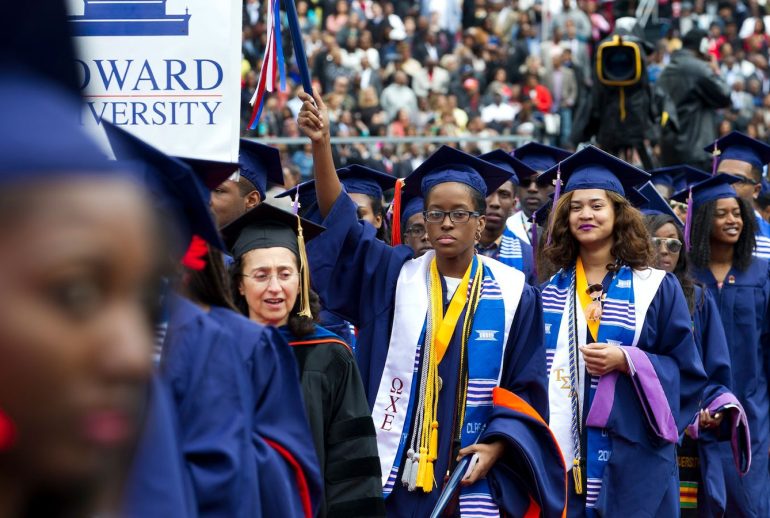
There is a place in Northwest Washington, D.C. — 256 acres in the Shaw neighborhood, sitting on a hill above Georgia Avenue — that its community does not call a campus. They call it the Yard. And they do not call the university a school. They call it the Mecca.
The name carries weight deliberately. A mecca is a place that draws pilgrims — people who travel toward it because it represents something essential, something they cannot find anywhere else. For over 157 years, Howard University has functioned exactly that way: as a gathering point for Black intellectual life, a training ground for Black leadership, a laboratory for the ideas and movements that shaped American history, and a home for people of African descent from across the world who came here to learn, to grow, and to belong.
For the African Diaspora community in the DMV — whether you attended Howard, sent your children there, live in its shadow, or simply benefit from the generations of leaders it produced — the Mecca is not just a university. It is a landmark, a legacy, and a living force in the community around it.
This is the full story of what Howard is, what it has built, and why it matters more right now than it ever has.
Founded in Crisis, Built for Excellence — Howard’s Origin Story
Howard University was established by Congress on March 2, 1867 — just two years after the end of the Civil War. The country was in the middle of Reconstruction, the formerly enslaved were navigating freedom without the education, capital, or institutional support that freedom required, and the question of what America owed its Black citizens was being asked and largely evaded at every level of government.
The institution was named after General Oliver Otis Howard — the head of the Freedmen’s Bureau, who worked with Congress to charter the university and later served as its president from 1869 to 1874. The original concept was modest: a theological seminary to train Black ministers. Within weeks, the vision expanded to something far more ambitious — a full university open to all, with the principal purpose of educating African Americans who had been systematically denied access to higher education for their entire lives.
The first five students to enroll were, remarkably, daughters of white faculty members. But the university’s mission was never in question: Howard was built for Black education, Black leadership, and Black excellence — at a moment when those ideas were considered radical by the American mainstream.
Mordecai Wyatt Johnson, who became Howard’s president in 1926, transformed it into the modern research university it is today — building its professional schools, expanding its faculty, and establishing the institutional seriousness that would attract some of the greatest Black minds in American history to its campus as students, professors, and scholars.
The Numbers That Tell the Full Story of Howard’s Impact
Before going further into the human stories, it is worth sitting with some numbers — because the scale of Howard’s contribution to Black America and the African Diaspora is genuinely staggering.
- Howard has educated more than half of the Black doctors, dentists, and pharmacists in America — a statistic that reflects what Howard’s College of Medicine and College of Dentistry have meant to Black health access for over a century. The College of Medicine was the first and oldest at any HBCU
- According to a recent White House report, HBCUs produce 40 percent of Black engineers, 50 percent of Black teachers, 70 percent of Black doctors and dentists, and 80 percent of Black judges — and Howard, as the nation’s flagship HBCU, drives a significant portion of those numbers
- Howard produces more STEM PhDs than any other institution — a fact that directly challenges every stereotype about Black students and STEM fields
- In February 2025, Howard became the first HBCU to achieve the Research One (R1) Carnegie Classification — the highest designation for doctoral research activity in the country, putting it in the company of institutions like MIT, Stanford, and Johns Hopkins. It is the only HBCU with this designation
- In November 2025, MacKenzie Scott donated an $80 million gift to Howard — one of the largest in its history. Scott has now donated $132 million to Howard in recent years, recognizing the institution’s extraordinary return on investment for the Black community
- Howard’s alumni network spans over 130,000 leaders worldwide across every industry and every continent
- Howard’s traditional MBA program is the only HBCU program ranked among Fortune’s 2025 Best MBA Programs
- Howard’s law school graduated Charlotte E. Ray in 1872 — the first Black woman lawyer in the United States. It ranks among the top 20 public service law schools in the country
These are not legacy statistics from an institution resting on historical achievements. They are current, active, and growing — reflecting a university that is producing at the highest level right now.
The Alumni Who Changed the World — Howard’s Human Legacy
The measure of any university is ultimately its people — and Howard’s alumni roster is, by any measure, one of the most extraordinary collections of achievers produced by any single institution in American history.
Thurgood Marshall studied at Howard’s School of Law, where he trained under the great Charles Hamilton Houston — himself a Howard law graduate and the architect of the legal strategy that would eventually dismantle school segregation. Marshall went on to argue Brown v. Board of Education before the Supreme Court, winning the decision that declared segregation unconstitutional, before becoming the first African American Supreme Court Justice in 1967. The legal framework of modern American civil rights runs directly through Howard’s law school hallways.
Kamala Harris — the first woman, first Black American, and first Asian American Vice President of the United States — is a Howard alumna, having graduated in 1986 with a degree in political science and economics. She returned to Howard’s campus during the 2024 election season, standing in front of Frederick Douglass Memorial Hall, in one of the most symbolically powerful images of that campaign. Harris has described Howard as foundational to her identity and purpose.
Toni Morrison — Nobel Prize winner, Pulitzer Prize winner, one of the greatest novelists in the English language — spent twenty years as an editor at Random House, worked at Howard, and is counted among its distinguished alumni. Zora Neale Hurston, the author of Their Eyes Were Watching God and one of the pillars of the Harlem Renaissance, attended Howard and co-founded the university’s renowned student newspaper, The Hilltop. Alain Locke — the first African American Rhodes Scholar and the philosophical architect of the Harlem Renaissance — was a Howard professor whose influence shaped an entire cultural movement.
Chadwick Boseman — the actor who brought Black Panther to life on the global stage, making him one of the most important cultural figures of his generation — graduated from Howard’s College of Fine Arts in 2000. In his final major public appearance before his death, he returned to Howard to deliver the 2018 commencement address — telling graduates that their Bison identity was something to carry with pride, not apologize for.
The full list reads like a curated library of Black achievement: Taraji P. Henson, Elijah Cummings, Patricia Bath (who earned her medical degree at Howard and became the first woman to chair an ophthalmology residency program in the U.S.), Roberta Flack, David Dinkins, Ossie Davis, and seven foreign heads of state. The university’s own description is simply accurate: its alumni roster reads like a Who’s Who of African Americans.
Howard as an Incubator of Movements — Not Just Careers
What makes Howard genuinely unique — not just as a great university but as a cultural institution — is that it has consistently been more than a place where individuals built careers. It has been a place where movements were born.
Charles Hamilton Houston, Howard law’s dean and Thurgood Marshall’s mentor, designed what he called the legal blueprint for dismantling segregation decades before Brown v. Board of Education was argued. He trained an entire generation of civil rights lawyers at Howard who fanned out across the country to challenge Jim Crow in courtroom after courtroom. He called Howard’s lawyers social engineers — people who used the tools of law to reshape society itself.
The Howard University student body has been at the forefront of activism across multiple generations. In the 1960s, Howard students organized sit-ins, freedom rides, and campus protests as part of the broader Civil Rights Movement. In more recent decades, Howard students have led campaigns on issues ranging from gun violence and police accountability to climate justice and voting rights. The 2021 commencement address drew national attention when Howard announced its rejection of Betsy DeVos — the former Secretary of Education — as an honorary degree recipient, citing her record of policies harmful to students. The student body’s voice has consistently been one of moral clarity.
As one alumnus described it: the energy around Blackness at Howard gives students a commitment, a solidarity with each other — an understanding that they are in this struggle together and that they need to uplift all of them. That energy does not stay on campus. It graduates with every class and spreads into communities across the DMV and beyond.
Howard and the African Diaspora — A Global Institution in a Local City
Howard’s relationship with the African Diaspora extends far beyond its role in African American education and civil rights. From its earliest years, Howard drew students from across the African continent, the Caribbean, and wherever in the world people of African descent sought higher education at a place that genuinely welcomed them.
Seven foreign heads of state are among Howard’s alumni. Its Center for African Studies is the only comprehensive National Resource Center at an HBCU, as designated by the U.S. Department of Education — a recognition of Howard’s unique position as a center of scholarship on African history, politics, culture, and development. The Moorland-Spingarn Research Center on Howard’s campus is recognized as one of the world’s largest and most comprehensive repositories for the documentation of the history and culture of people of African descent in Africa, the Americas, and other parts of the world.
For African immigrants arriving in the DMV from Nigeria, Ethiopia, Ghana, Senegal, Cameroon, and dozens of other nations, Howard is often the first recognizable cultural landmark — a place that connects their own experience of African identity with the broader story of the African Diaspora in America. Many choose Howard specifically because it offers education that does not require leaving their cultural identity at the door.
Howard’s homecoming — which celebrated its 101st anniversary in 2024 and 2025 — has become one of the most significant cultural events in the African American calendar, drawing tens of thousands of alumni, students, artists, and community members to the Yard each October. It is described by those who attend as coming back home — a space where you can let your hair down, be in your full self, and celebrate Blackness without explanation or apology.
Howard’s Presence in the DMV — What It Gives the Community Every Day
Howard’s impact on the DMV extends far beyond what happens inside its classrooms. The university is embedded in the fabric of the region in ways that touch healthcare, culture, economics, and political life.
- Howard University Hospital — the only HBCU with its own teaching hospital — is a critical safety-net institution serving some of the most underserved communities in the District. It has been a training ground for Black physicians for over a century and continues to provide medical care to patients who have historically been poorly served by the healthcare system
- Howard’s location in the nation’s capital gives its students unmatched access to internships and career pipelines in federal government agencies, law firms, hospitals, nonprofits, tech companies, media organizations, and international institutions. Students at Howard can intern at the NIH, the State Department, the Supreme Court, and major media companies — all within reach of the Yard
- Howard’s economic footprint in the DMV region is significant. The university is one of the largest employers in the Shaw neighborhood and generates substantial economic activity in the surrounding community through employment, student spending, and the events that draw tens of thousands of visitors to the region annually
- The tech partnerships Howard has built — including Google’s Tech Exchange program, the first U.S. Department of Defense University Affiliated Research Center at an HBCU, and a NASA University Research Center at its Beltsville campus — are connecting Howard students to the cutting edge of technology development and positioning the Mecca as a center of innovation, not just tradition
Howard Right Now — What the Mecca Looks Like in 2025
Howard in 2025 is not resting on its history. It is building on it with remarkable urgency and ambition.
The R1 Carnegie Classification achieved in February 2025 represents a watershed moment — formal recognition that Howard operates at the highest level of doctoral research in the country, opening new avenues for federal research funding, faculty recruitment, and institutional partnerships that will compound over decades. Forbes recognized Howard as the number one HBCU in the nation. The Niche publication named Howard the number one HBCU for student life in 2025.
The Class of 2025 graduated with the charge to emerge as the next leaders of a new age renaissance — a generation shaped by the school’s long tradition of excellence but also by the specific challenges and opportunities of this political moment. In a commencement address, LeVar Burton encouraged graduates to remember that it was the resilient hands of enslaved peoples that built the empire of America — and that they now carry the responsibility of pushing the nation toward its full potential.
University president Ben Vinson’s charge to the 2025 graduates captured something essential: “You leave here not only with your degrees, but with discernment, with character, with purpose. Your presence is your superpower, your preparation is your armor, and your purpose is your North Star.” That language — that combination of excellence and identity and mission — is what the Mecca has always been producing. And it shows no signs of stopping.
The Mecca Belongs to All of Us — Engage With It
Howard University is not a museum. It is not a monument to something that used to exist. It is a living, producing, evolving institution that is shaping the African Diaspora in the DMV and across the world right now — in its classrooms, its research labs, its hospital, its law school, and the 130,000-strong alumni network that carries its spirit into every corner of public life.
For families in the DMV — whether your child is in elementary school or approaching college, whether you are a long-time Washington resident or a recent arrival from the continent or the Caribbean — Howard is part of your community. Visit the Yard. Attend Homecoming. Support the hospital. Encourage your children to consider the Mecca when the time comes. Connect with its alumni network.
The Mecca was built for people like you. It has been shaping people like you for 157 years. And it is not finished yet.
