

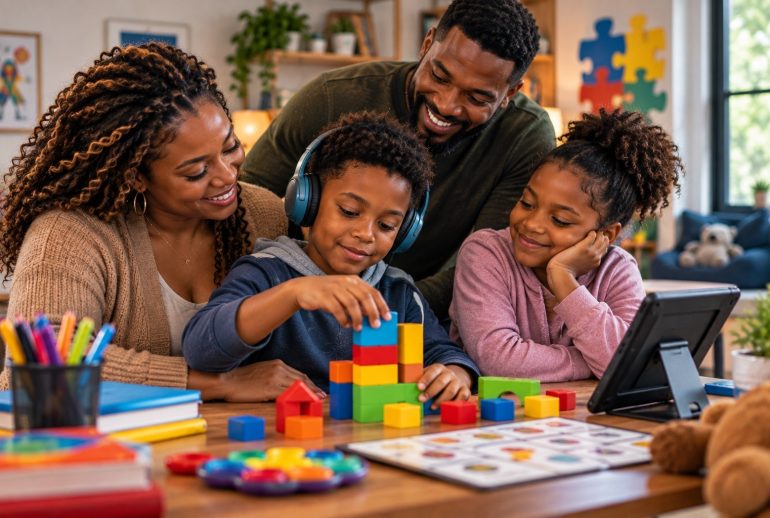
Understanding the Child Before the Label
When a family first hears the word “autism,” it can bring many emotions and questions.
What does this mean for our child?
What kind of support might they need?
What happens at school?
Will they make friends?
What will adulthood look like?
These are understandable questions. But autism does not provide a single answer to any of them because autistic people are individuals.
One child may communicate verbally and have an extensive vocabulary. Another may use fewer spoken words or communicate in other ways. Some children seek social interaction while others need more space. One child may be extremely sensitive to noise, while another actively seeks certain sounds, movements, or sensations.
Autism is a spectrum, and support works best when families begin with the person rather than assumptions about the diagnosis.
For Black families, conversations about autism can also involve cultural expectations, extended family members, schools, healthcare systems, community attitudes, and questions about where to find reliable support.
Families do not need to know everything immediately.
They can begin by learning the child in front of them.
1. Autism Does Not Look the Same in Every Child
Popular culture sometimes presents a narrow image of autism.
Real life is much broader.
Autistic children can have different personalities, abilities, interests, communication styles, learning needs, and levels of support.
A child may struggle with certain social situations while performing extremely well academically.
Another may need substantial assistance with communication or daily routines.
Some autistic children may strongly prefer predictable routines. Others may have intense interests in particular subjects. Some may repeat movements, sounds, or actions as a way of regulating themselves.
There is no single behavior that represents every autistic child.
This is why comparing one autistic child with another can be misleading.
The better question is:
What helps this particular child learn, communicate, feel safe, and participate in daily life?
2. Pay Attention to Communication Beyond Words
Communication is much larger than speech.
Children communicate through facial expressions, gestures, movement, behavior, pictures, assistive technology, body language, sounds, and actions.
Sometimes adults interpret behavior as defiance when a child may actually be communicating discomfort, confusion, fear, sensory overload, frustration, or a need for a break.
Instead of immediately asking, “How do we stop this behavior?” it can be helpful to ask:
“What might the child be communicating?”
Perhaps the room is too loud.
Maybe instructions are unclear.
The child might be tired.
A routine may have unexpectedly changed.
The child may not know how to express what they need.
Understanding the reason behind behavior can help families respond more effectively.
3. Learn About Sensory Needs
Imagine trying to concentrate while someone shines a bright light directly into your eyes.
Or trying to have a conversation while several alarms are sounding.
For some autistic people, ordinary environments can sometimes feel similarly overwhelming.
Sounds, lights, textures, smells, crowds, clothing, food textures, and physical contact can affect people differently.
A busy grocery store may be manageable one day and overwhelming another.
A school cafeteria might be especially difficult because of noise.
Certain clothing fabrics may feel uncomfortable.
Recognizing sensory needs does not mean eliminating every challenge from a child’s environment.
It means understanding that the child’s reaction may have a real cause.
Families can experiment with quieter spaces, predictable routines, comfortable clothing, sensory tools, breaks, or other accommodations appropriate for the individual child.
4. Create Predictability Where Possible
Many children benefit from routines, and some autistic children may find predictability particularly helpful.
Knowing what comes next can reduce uncertainty.
A morning routine might follow the same general order: wake up, get dressed, eat breakfast, brush teeth, prepare belongings, and leave for school.
Pictures or visual schedules can sometimes help children understand upcoming activities.
Families can also prepare children for changes.
Instead of suddenly announcing that plans have changed, explain the change beforehand when possible.
For example:
“We normally go home after school, but today we are stopping at the grocery store first.”
That small warning may make the transition easier.
Of course, life cannot always be predictable.
The goal is not to control every moment. It is to provide enough structure that unexpected changes become easier to navigate.
5. Work With the School as a Team
Parents and caregivers know their children in ways teachers cannot.
Teachers, specialists, and school staff may see other parts of the child’s learning and social experience.
Both perspectives matter.
Families can communicate regularly with educators about what is working and what is difficult.
Ask specific questions.
How does my child participate in class?
What happens during transitions?
Are there particular subjects they enjoy?
When does frustration usually occur?
What strategies seem to help?
Parents can also share information from home.
Maybe the child responds well to visual instructions.
Perhaps certain words or approaches reduce anxiety.
Maybe there is a strong interest that could be incorporated into learning.
When families and schools exchange useful information, support becomes more consistent.
6. Prepare for School Meetings
Educational meetings can feel intimidating, especially when several professionals are sitting around a table discussing one child.
Preparation can help.
Write down questions beforehand.
Bring notes about concerns.
Keep copies of important documents.
Ask for unfamiliar terminology to be explained.
If something is unclear, say so.
Parents should not feel embarrassed about asking professionals to explain recommendations in everyday language.
It can also help to write down what was discussed and what actions were agreed upon.
The purpose of the meeting should remain focused on the child’s educational needs and access to appropriate support.
7. Recognize Strengths Alongside Challenges
Support conversations can become heavily focused on what a child cannot do.
That can create an incomplete picture.
Autistic children also have interests, abilities, humor, curiosity, preferences, talents, and personalities.
One child might remember extraordinary amounts of information about a favorite subject.
Another may be highly creative.
Someone may enjoy numbers, music, drawing, computers, animals, maps, building things, or organizing objects.
These interests should not automatically be dismissed as distractions.
They can sometimes become powerful learning tools.
A strong interest in trains might encourage reading.
An interest in computers could eventually lead to technical skills.
A love of animals might become a pathway toward volunteering, education, or a future career.
Supporting development includes helping children discover what they enjoy and what they do well.
8. Help Siblings Understand
Autism affects family dynamics, including relationships between siblings.
Brothers and sisters may have questions.
Why does my sibling get extra help?
Why do plans sometimes change?
Why does a certain sound bother them?
Why do they communicate differently?
Age-appropriate explanations can help reduce confusion.
It is also important for siblings to receive individual attention.
They should have opportunities to discuss their own feelings without being made to feel guilty.
The goal is not to turn siblings into caregivers.
It is to help them understand one another and build healthy relationships.
9. Talk With Extended Family Members
Grandparents, aunts, uncles, cousins, and family friends may love the child deeply while understanding very little about autism.
Sometimes comments such as “They’ll grow out of it,” “That child just needs more discipline,” or “We didn’t have autism when I was growing up” can create tension.
Education can help.
Families can explain specific needs rather than expecting relatives to immediately understand everything about autism.
For example:
“Large gatherings can become overwhelming for him, so he may need a quiet room for a while.”
Or:
“She communicates better when we give her extra time to answer.”
Specific information is often easier to understand than abstract explanations.
Family members may need time to learn too.
10. Avoid Measuring Progress Against Other Children
Every parent notices milestones.
It can be difficult not to compare.
But constantly measuring an autistic child against siblings, classmates, cousins, or another autistic child can create unnecessary frustration.
Progress may look different.
Perhaps a child tolerates a haircut that previously felt overwhelming.
Maybe they communicate a need independently.
Perhaps they participate in a classroom activity for longer than before.
Maybe they learn how to prepare a simple snack.
These achievements matter.
Progress should be measured against the child’s own development and meaningful goals rather than someone else’s timeline.
11. Teach Self-Advocacy as Children Grow
As autistic children become teenagers and adults, understanding their own needs can become increasingly important.
When appropriate for the individual, young people can learn to explain what helps them.
“I need written instructions.”
“This room is too loud for me.”
“I need a few minutes before answering.”
“I don’t understand what you mean.”
“I need a break.”
Self-advocacy can help young people participate more actively in education, employment, healthcare, relationships, and community life.
Adults can support this process by listening when children communicate discomfort or preferences.
A child who learns that their voice matters is better prepared to use that voice later.
12. Build Independence Without Removing Support Too Soon
Independence does not mean doing everything without assistance.
All adults rely on other people in some way.
For autistic young people, independence may involve learning skills that are meaningful to their own lives.
That might include preparing food, managing personal belongings, using transportation, understanding money, communicating needs, maintaining personal hygiene, following a schedule, or completing household responsibilities.
Break larger skills into smaller steps.
Practice consistently.
Allow extra time.
Celebrate improvement.
Support can gradually change as skills develop.
The goal is not to force independence according to someone else’s expectations.
It is to help the individual gain as much confidence, choice, and practical ability as possible.
13. Parents and Caregivers Need Support Too
Supporting a child can involve appointments, school meetings, paperwork, transportation, advocacy, daily routines, financial pressures, and countless decisions.
Caregivers are people too.
They need rest.
They need information.
They may need someone who understands what they are experiencing.
Connecting with other families, community organizations, trusted professionals, or support groups can reduce isolation.
Asking for assistance is not a failure.
A family functions better when the people providing care also have opportunities to recharge and receive support.
14. Be Careful With Information Online
Families searching for autism information can encounter an overwhelming amount of content.
Some of it is helpful.
Some is based on personal experience.
Some may oversimplify complicated issues or make claims that are not supported by reliable evidence.
Be especially cautious when someone promises a guaranteed cure, dramatic transformation, or expensive solution that supposedly works for every autistic person.
Reliable professionals should be willing to explain what is known, what is uncertain, what a particular intervention is designed to accomplish, and what alternatives exist.
Families deserve information that helps them make informed decisions rather than information designed to frighten them.
15. Acceptance and Support Can Exist Together
Accepting an autistic child does not mean ignoring areas where support is needed.
And providing support does not mean trying to erase everything that makes the child different.
Both ideas can exist together.
A child can receive help developing communication skills while still having their communication style respected.
A student can learn strategies for navigating challenging environments while also receiving reasonable accommodations.
A family can encourage growth without sending the message that the child must become someone else in order to belong.
That balance matters.
Conclusion: See the Whole Child
Autism is one part of a person’s life.
It is not the entire person.
Behind every diagnosis is a child with preferences, relationships, interests, challenges, abilities, emotions, and possibilities.
Families do not need to have every answer.
They can learn.
Schools can learn.
Extended families can learn.
Communities can learn.
The most important starting point is listening to the individual, paying attention to what helps, seeking reliable information, and remembering that progress does not have to look identical for everyone.
When children know they are supported and valued, we create more room for them to learn about themselves and participate in the world with greater confidence.
At Akukulu Family, we believe families deserve spaces where they can learn, share experiences, and find community without judgment. If autism is part of your family’s journey, consider sharing the practical strategies, lessons, resources, or moments of progress that have helped you. Your experience may help another family within the Akukulu Family community feel better informed, better connected, and less alone.
