

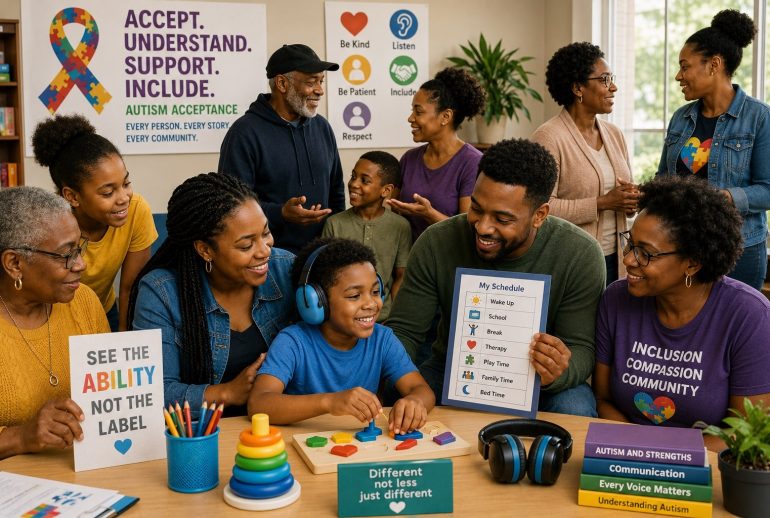
Autism acceptance begins with a simple but powerful truth: every child deserves to be understood before they are judged. In many families and community spaces, children are often expected to behave, communicate, learn, and respond in ways that adults already understand. When a child does not fit those expectations, people may quickly label the child as rude, spoiled, difficult, disrespectful, stubborn, or badly behaved. But for a child with autism, what looks like misbehavior on the outside may actually be communication, sensory overwhelm, anxiety, confusion, or the need for support.
Across the Black community, autism acceptance matters because many parents and caregivers are still fighting two battles at the same time. They are trying to understand and support their child, while also dealing with stigma, judgment, limited access to resources, delayed diagnosis, school challenges, and family members who may not fully understand what autism is. Some caregivers may hear comments like, “That child just needs discipline,” or “Do not put a label on them,” or “They will grow out of it.” These comments may come from people who care, but they can still make families feel isolated and unsupported.
Acceptance does not mean pretending that autism brings no challenges. Many families experience difficult days. A child may struggle with communication, changes in routine, loud environments, food textures, school expectations, sleep, social situations, or emotional regulation. Caregivers may feel tired, worried, and unsure of what to do next. Acceptance means meeting these realities with compassion instead of shame. It means recognizing that a child with autism is not broken. They are a whole person with feelings, strengths, needs, personality, and potential.
When community spaces become more accepting, families do not have to hide or apologize for their children. Children can participate in family gatherings, schools, churches, events, libraries, recreation programs, and cultural spaces with more dignity. Parents can ask for help without fear of judgment. Siblings can learn understanding instead of embarrassment. Elders can become part of the support system. Acceptance helps the whole village become more patient, informed, and loving.
1. Autism Acceptance Is More Than Awareness.
Awareness means people have heard of autism. Acceptance means they are willing to change how they respond to autistic children and adults. A person can know the word autism and still treat a child unfairly. A school can hold an awareness event and still fail to support a student’s needs. A family member can say they understand autism but still become angry when a child covers their ears, avoids hugs, repeats phrases, or struggles during a noisy gathering.
Acceptance goes deeper because it asks people to look at the child with compassion. It asks adults to slow down before assuming the worst. It asks families to learn why a child may need routine, quiet space, extra processing time, visual supports, sensory breaks, or a different way to communicate. It also asks the community to stop treating difference as something shameful.
This matters because children can sense when they are only being tolerated. They can also sense when they are truly welcomed. A child who is constantly corrected for being different may begin to feel that they are a problem. A child who is supported with patience can begin to feel safe enough to learn, grow, and participate in family and community life.
Autism acceptance is not about lowering expectations. It is about making expectations fair, realistic, and supportive. Children can still learn responsibility, communication skills, social skills, and daily routines, but they should be taught in ways that respect how they process the world. Acceptance gives the child room to grow without feeling rejected.
2. Families Need Support, Not Judgment.
Parents and caregivers of autistic children often carry responsibilities that others may not see. They may be managing school meetings, therapy appointments, behavior concerns, communication challenges, sleep struggles, sensory needs, family expectations, and worries about the child’s future. They may also be trying to explain their child’s needs again and again to teachers, relatives, neighbors, and community members who misunderstand.
Judgment makes this journey harder. When people stare, whisper, criticize, or offer harsh comments during a child’s difficult moment, caregivers may feel embarrassed and alone. They may stop attending events, avoid family gatherings, or keep their child home because public spaces feel too stressful. Over time, that isolation can affect both the child and the entire household.
Support can look very simple. A relative can ask, “What helps your child feel calm?” A church volunteer can offer a quieter seat. A teacher can listen to the parent’s experience. A friend can bring a meal after a hard week. A grandparent can learn about sensory needs. A community member can respond with patience instead of criticism when a child becomes overwhelmed in public.
Families do not need everyone to have perfect knowledge. They need people who are willing to learn. A supportive community makes the caregiver feel less alone and helps the child feel more welcome. That kind of support can be a powerful form of love.
3. Stigma Can Delay Help That Children Need.
Stigma is one of the biggest barriers to autism support. Some families avoid evaluations because they fear what others will say. Some worry that a diagnosis will limit the child or make people treat them differently. Others may believe that seeking help means admitting failure as a parent. In some households, older relatives may discourage parents from using words like autism, therapy, special education, or developmental support.
These fears are understandable, especially in communities where labels have sometimes been used unfairly or where children have been misunderstood by schools and systems. However, delaying support can make things harder for the child and the family. Early understanding can help children receive speech therapy, occupational therapy, classroom accommodations, communication tools, social support, and family guidance that may improve daily life.
A diagnosis should not be treated as a sentence. It is information. It can help families understand why certain challenges are happening and what kind of support may help. It can also help parents advocate more effectively in school and healthcare settings. When families have clearer information, they can make better decisions.
Reducing stigma begins with changing the way people talk. Autism should not be discussed as shame, punishment, or embarrassment. It should be discussed as a different way of experiencing the world that may require support, understanding, and respect. When the community speaks with kindness, more families feel safe seeking help.
4. Children With Autism Communicate In Different Ways.
Communication does not always look like spoken words. Some autistic children speak clearly. Some use fewer words. Some repeat phrases. Some use gestures, pictures, devices, signs, facial expressions, sounds, or behavior to communicate. A child may not say, “This room is too loud,” but they may cover their ears, cry, run away, or become upset. A child may not say, “I need a break,” but they may refuse to continue an activity or hide under a table.
When adults only recognize one kind of communication, they may miss what the child is trying to express. This can lead to frustration on both sides. The child feels misunderstood, and the adult may think the child is being defiant. Acceptance means learning to pay attention to the child’s patterns, triggers, and attempts to communicate.
Families can help by asking what the behavior may be saying. Is the child hungry, tired, overwhelmed, confused, anxious, overstimulated, or unable to explain a need? Did something change suddenly? Is the environment too loud or crowded? Is the child being asked to do something that feels too difficult without enough support? These questions help adults respond with care instead of only punishment.
Supporting communication also means celebrating progress. A child who learns to point, use a picture card, say a new word, ask for help, or express a feeling has made an important step. Communication growth should be honored, even when it looks different from what others expect.
5. Sensory Needs Deserve Respect.
Many autistic children experience the world through their senses in a very intense way. Sounds may feel louder, lights may feel brighter, clothing may feel uncomfortable, food textures may feel overwhelming, and crowded spaces may feel stressful. A child who covers their ears during music, refuses certain foods, avoids bright lights, or becomes upset in a busy room may not be trying to cause trouble. They may be responding to sensory discomfort that feels very real in their body.
Sensory needs are sometimes misunderstood because other people may not experience the environment the same way. An adult may say, “It is not that loud,” or “That shirt feels fine,” or “Just eat it,” but the child’s nervous system may be responding differently. Acceptance means believing the child’s experience even when it does not match our own.
Families can support sensory needs by preparing ahead for events, offering noise-reducing headphones, bringing familiar foods when needed, choosing comfortable clothing, creating quiet spaces, using soft lighting, and giving the child breaks before they become overwhelmed. These supports are not special treatment in a negative sense. They are tools that help the child participate more successfully.
Community spaces can also become more sensory-friendly. A festival, church service, classroom, library event, or family gathering can include quieter areas, flexible seating, clear schedules, and patient adults who understand that a child may need a break. These small changes can make inclusion possible.
6. Schools Must See The Child Beyond Behavior.
School can be difficult for autistic children when teachers and staff do not understand their needs. A child may struggle with transitions, loud cafeterias, group work, changes in routine, handwriting, sitting still, following multi-step directions, or understanding social cues. If these struggles are viewed only as behavior problems, the child may be disciplined instead of supported.
Parents and caregivers often have to advocate strongly to make sure their child is understood. They may need to request evaluations, attend meetings, ask about accommodations, review learning plans, and communicate regularly with teachers. This can be stressful, but advocacy is one of the most important ways families protect a child’s educational experience.
Schools should listen to families because parents often know what helps the child calm down, learn, communicate, and transition successfully. A strategy that works at home may help at school. Teachers may also have valuable observations from the classroom. When families and schools work together respectfully, the child benefits.
The goal should be to help the child learn with dignity. A child should not be treated as a problem because they need support. They should be given tools, patience, structure, and encouragement so they can grow academically, socially, and emotionally.
7. Churches And Community Spaces Can Become More Inclusive.
Faith communities, cultural organizations, libraries, recreation programs, and family events can all play a role in autism acceptance. Many families want to participate in community life, but they may hesitate if they fear judgment or lack of support. A child who becomes overwhelmed during a service, event, or gathering may cause the family to feel embarrassed if people respond with criticism instead of compassion.
Inclusive community spaces think ahead. They ask how children with different needs can participate. They train volunteers to respond kindly. They offer quiet areas when possible. They avoid forcing physical contact like hugs. They explain routines clearly. They welcome families without making them feel like a burden.
This kind of inclusion does not require perfection or expensive changes. Often, it begins with attitude. A warm greeting, a patient response, a flexible expectation, or a simple question like “What would help your child feel more comfortable?” can change the entire experience for a family.
The community becomes stronger when all children are welcomed. Inclusion teaches everyone patience, empathy, and respect. It reminds families that belonging should not depend on whether a child behaves exactly like everyone else.
8. Siblings Need Honest Conversations And Care.
When a child has autism, siblings may have their own feelings and questions. They may love their brother or sister deeply, but they may also feel confused, protective, frustrated, embarrassed, or overlooked at times. If family life often revolves around the child with higher support needs, siblings may quietly wonder if their own needs matter too.
Parents and caregivers can help by having honest, age-appropriate conversations. They can explain that autism affects how their sibling communicates, responds to change, handles sensory input, or manages emotions. They can also make it clear that the sibling is still responsible for kindness, but they are not responsible for becoming another parent.
Siblings need one-on-one time with adults. Even a short walk, a quiet conversation, help with homework, or a special outing can remind them that they are seen and valued. Their feelings should not be dismissed. If they feel frustrated or confused, they need a safe place to say so without being called selfish.
With support, siblings can become compassionate allies. They can learn patience, advocacy, and acceptance, but they should be allowed to grow at their own pace. The whole family becomes healthier when every child’s emotional needs are respected.
9. Autistic Children Have Strengths That Should Be Celebrated.
Autistic children are often described only by their challenges, but they also have strengths, interests, and gifts that deserve attention. A child may have a strong memory, deep focus, honesty, creativity, musical ability, visual thinking, love of patterns, humor, attention to detail, problem-solving skills, or a special interest that brings them joy. These strengths should be noticed and encouraged.
When adults focus only on what is difficult, the child may begin to feel like they are always being corrected. Celebrating strengths helps the child build confidence. It also helps family members see the child as a full person, not only a diagnosis or a list of needs.
Special interests can be powerful learning tools. A child who loves animals, maps, trains, music, numbers, cooking, art, computers, or space may be more motivated to read, write, talk, count, create, or explore when learning connects to that interest. Instead of dismissing the interest as strange or repetitive, adults can use it as a bridge.
Every child deserves to be known for what makes them light up. Acceptance includes making room for joy, not only managing difficulty. When a child’s strengths are celebrated, they learn that they have something valuable to offer.
10. Caregivers Need Rest And Community Support.
Caregivers often give so much of themselves that their own well-being becomes an afterthought. They may be researching services, driving to appointments, communicating with schools, managing meltdowns, planning routines, protecting the child in public, and carrying worries about the future. This work can be emotionally and physically exhausting, even when it is done with deep love.
Caregivers need rest, encouragement, and practical help. They need people who will listen without judging, offer support without taking over, and understand that tiredness does not mean lack of love. A parent can love their child completely and still need a break. A caregiver can be strong and still need support.
Community members can help in practical ways. A trusted relative might learn the child’s routine so they can help safely. A friend might bring food, assist with errands, or spend time with siblings. A community organization might offer caregiver support groups, resource lists, or family-friendly events. Even a kind conversation can reduce isolation.
Supporting the caregiver supports the child. When parents and caregivers have a stronger support system, they are better able to respond with patience, clarity, and hope. Autism acceptance must include care for the whole family.
11. Acceptance Should Continue Into The Teen And Adult Years.
Autism does not disappear when a child gets older. Autistic teens and adults also need understanding, opportunity, respect, and support. As children grow, their needs may change. They may need help with friendships, school transitions, job training, independent living skills, transportation, college planning, emotional wellness, or workplace expectations.
Too often, conversations about autism focus only on young children. Families also need to think about the future. What support will the child need as a teenager? What strengths can be developed into skills? What environments help them thrive? What kind of work, education, or community participation may be meaningful for them? These questions should be approached with hope and planning.
Autistic teens may also become more aware of how others see them. They may need support building self-confidence, understanding their diagnosis, explaining their needs, and advocating for themselves. Families can help by speaking about autism with respect from the beginning. A teen who has grown up hearing shame may struggle to accept themselves. A teen who has grown up hearing truth and dignity may be better prepared to understand who they are.
Autistic adults also deserve inclusion in community life. They deserve employment opportunities, friendship, respect, safe housing, healthcare, and spaces where their voices are heard. Acceptance is not only for childhood. It is a lifelong commitment to dignity.
12. The Whole Community Benefits From Greater Understanding.
When the community becomes more accepting of autism, everyone benefits. Children learn empathy. Adults become more patient. Families feel less isolated. Schools become more supportive. Churches and community spaces become more welcoming. Caregivers feel seen. Autistic children and adults are able to participate with more dignity.
Greater understanding also helps reduce fear. People are often uncomfortable with what they do not understand. Once they learn more about sensory needs, communication differences, routines, meltdowns, and support strategies, they are more likely to respond with compassion. Education can turn judgment into patience.
This kind of understanding fits the best traditions of community care. A strong village does not only welcome children who are easy to understand. It makes room for children who need extra support. It listens to parents. It honors differences. It learns and adjusts.
Autism acceptance is not one person’s job. It belongs to families, schools, churches, businesses, libraries, healthcare providers, youth programs, and community leaders. Every space can become more welcoming when people choose understanding over judgment.
Conclusion.
Autism acceptance matters across the Black community because every child deserves dignity, understanding, and belonging. Families should not have to fight stigma alone. Children should not be judged for communicating, learning, or experiencing the world differently. Caregivers should not be isolated because others refuse to learn.
Acceptance begins with listening, patience, education, and compassion. It means seeing the whole child, including their needs, strengths, personality, and potential. It means supporting families in schools, homes, churches, community events, and public spaces. It means creating a culture where asking for help is not shameful and difference is not treated as failure.
When communities become more accepting, children with autism can grow with greater safety and confidence. Families can participate more fully. Siblings can learn empathy. Elders can become part of the support system. The whole village becomes stronger when every child is welcomed with care.
Akukulu Family encourages families and community members to take one step toward autism acceptance this month. Learn more about autism, listen to a caregiver, support an inclusive event, speak with kindness about children with different needs, or help make a community space more welcoming. One patient response and one informed conversation can make a meaningful difference for a child and family.
