

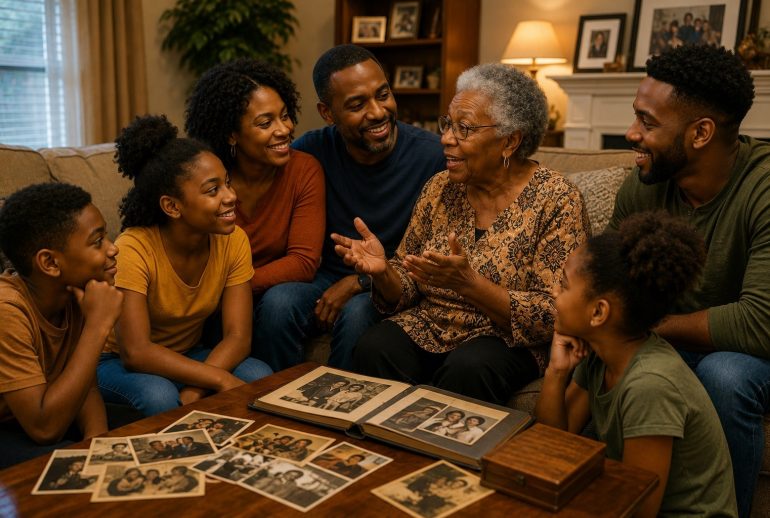
Family storytelling is one of the most powerful ways a community keeps its memory alive. Long before children understand history books, records, documents, or timelines, they often understand stories. They hear about where a grandparent grew up, how a parent handled a hard season, what an elder remembers from childhood, how the family moved from one place to another, what traditions mattered, what lessons were learned, and what values helped people keep going. These stories may be shared at the kitchen table, on the porch, during a holiday meal, after church, in the car, at a reunion, or during a quiet moment when someone finally asks the right question.
Across the Black community, storytelling has always carried deep meaning because so much history was preserved through voice, memory, music, food, faith, family gatherings, and community spaces. Not every story was written down. Not every sacrifice was recorded in official documents. Not every ancestor’s name was protected by institutions. Many families carried their history through the people who remembered, repeated, and passed it forward. That is why family storytelling should not be treated as something small or old-fashioned. It is part of cultural survival.
When children hear family stories, they learn that they are connected to something larger than themselves. They begin to understand that their family did not begin with them. They learn about people who worked, prayed, migrated, served, cooked, built, studied, cared for children, started businesses, survived hardship, made mistakes, found joy, and created a path for the next generation. These stories help children feel rooted. They also help them understand that ordinary family lives are part of history too.
Storytelling also strengthens relationships. It gives elders a chance to be heard, parents a chance to teach values, children a chance to ask questions, and families a chance to laugh, grieve, remember, and connect. A story can carry wisdom in a way that advice alone cannot. It can teach patience, courage, responsibility, faith, love, identity, and resilience without sounding like a lecture. When families keep telling their stories, they help protect culture, memory, and belonging.
1. Family Stories Help Children Understand Where They Come From.
Children need to know where they come from because identity is stronger when it has roots. A child who knows something about their family’s journey may feel more connected to the people around them and more confident in who they are becoming. They may learn that their grandparents came from a small town, that their parents worked hard to build stability, that an aunt was the first to graduate, that an uncle served in the military, that a great-grandmother cooked for the neighborhood, or that the family moved for work, safety, education, or opportunity.
These details may seem simple, but they help children understand that their family has a story. They learn that people before them made choices, carried burdens, created traditions, and opened doors. This can help children feel less alone when they face their own challenges. If they know their family has already survived hard seasons, they may believe they can keep going too.
Family stories also help children understand that history is not only about famous people. It is also about everyday people who loved, worked, raised children, helped neighbors, and made a way. A child may hear about national leaders in school, but at home they can hear about family leaders whose names may never appear in textbooks. These personal stories make history feel closer and more meaningful.
Parents and caregivers can begin by sharing simple memories. They can talk about where they grew up, what school was like, what games they played, what foods they ate, what relatives taught them, and what moments shaped them. Over time, these stories become part of the child’s understanding of family identity.
2. Elders Carry Wisdom That Should Be Preserved.
Elders are living libraries. They carry memories of people, places, traditions, struggles, celebrations, and lessons that younger generations may never know unless someone takes time to ask. Many elders remember neighborhoods before they changed, family members who have passed away, recipes that were never written down, old sayings, church traditions, school experiences, work stories, migration journeys, and the values that helped families survive.
When elders are invited to share stories, they are being honored. They are reminded that their lives matter and that their memories are still useful. Too often, older relatives are only asked for help, childcare, money advice, or prayer, but not always asked to tell their own stories. Listening to elders gives them dignity and gives younger generations a deeper inheritance.
Families can preserve elder stories in simple ways. A younger relative can record a conversation on a phone, write notes in a family notebook, ask questions during a meal, or invite an elder to share a memory at a family gathering. Children can ask about childhood, favorite foods, first jobs, music, holidays, family lessons, and important moments. These questions can open the door to stories that might otherwise remain hidden.
Preserving elder stories is also urgent because time is not guaranteed. Many families regret not asking more questions while elders were still able to answer. Starting now, even with one conversation, can help protect memories for future generations.
3. Storytelling Makes History Personal.
History can feel distant when it is only presented through dates, names, and major events. Family storytelling makes history personal because it connects larger events to real lives. A child may learn about migration in school, but a grandparent’s story about moving from one state to another for work makes that history more real. A child may learn about segregation, but an elder’s memory of attending a certain school or using certain public spaces gives the lesson emotional meaning.
Personal stories help children understand that history happened to families like theirs. It happened in homes, churches, schools, buses, workplaces, neighborhoods, and kitchens. It shaped where people lived, what jobs they had, how they raised children, what opportunities they could access, and what dreams they pursued. This kind of learning helps children see history not as something separate from their lives, but as something connected to them.
Storytelling can also help children understand complexity. Family stories may include struggle, but they also include humor, love, creativity, faith, and joy. This balance matters because children should not learn history only as pain. They should also learn about the ways people celebrated, helped each other, created music, cooked meals, built businesses, raised families, and found beauty in difficult times.
When families connect history to personal stories, children are more likely to remember it. A story about a great-grandparent’s courage may stay in a child’s heart longer than a paragraph from a textbook. That memory can shape how they see themselves and their community.
4. Stories Teach Values Without Sounding Like Lectures.
Young people do not always respond well to long lectures, especially when they feel judged or pressured. Stories can teach values in a more natural way. A parent might tell a story about a time they made a mistake and learned responsibility. An elder might share a memory about helping a neighbor during a hard season. An aunt might tell a story about working hard for an opportunity. These stories teach lessons without making the child feel attacked.
Values such as honesty, patience, faith, hard work, courage, generosity, respect, and perseverance can be passed through storytelling. A story shows how a value looks in real life. It helps children understand not only what the family believes, but why those beliefs matter. For example, telling a child to be responsible is helpful, but telling them a story about how responsibility helped the family through a hard time can make the lesson more memorable.
Stories also allow adults to be honest about growth. Children benefit from hearing that adults were not always perfect. When a trusted adult shares how they learned from failure, changed direction, apologized, or kept going after disappointment, children learn that mistakes do not have to define them. They learn that growth is possible.
The best family stories do not always need to have a dramatic ending. Sometimes the lesson is found in a small moment, a choice, a sacrifice, or a sentence an elder once said. These stories become part of the family’s moral foundation.
5. Family Stories Strengthen Cultural Identity.
Cultural identity is strengthened when children hear stories about traditions, food, music, language, faith, celebrations, hairstyles, clothing, work, migration, and community life. These stories help children understand that culture is not only something seen at festivals or taught in school. It lives inside the family. It lives in the way people cook, gather, worship, speak, celebrate, comfort one another, and remember the past.
Across African Diaspora families, cultural identity can include many different influences. A household may carry African American, Caribbean, African, Afro-Latin, Southern, DMV, immigrant, faith-based, or multigenerational traditions. Storytelling helps children understand these layers. It gives them language for who they are and what shaped their family.
A parent might tell a story about a family reunion. An elder might explain why a certain dish is cooked during holidays. A cousin might talk about a cultural festival. A grandparent might remember a church song or a neighborhood celebration. These stories make culture feel alive and personal.
Children who hear cultural stories often develop more pride. They begin to see their family as part of a larger community story. They learn that their traditions have meaning. They also learn to respect the diversity within the Black community, understanding that there are many ways to belong, remember, and celebrate.
6. Storytelling Helps Families Heal And Remember.
Some family stories are joyful, but others are painful. Families may carry stories of loss, migration, hardship, illness, discrimination, separation, financial struggle, grief, or difficult choices. These stories can be hard to tell, but when shared with care, they can help families heal. Silence sometimes protects people for a season, but it can also leave younger generations confused about what shaped the family.
Healing stories should be shared with wisdom and age-appropriate care. Children do not need every painful detail, but they can benefit from understanding that their family has faced challenges and survived them. A story about a difficult time can be told in a way that emphasizes strength, support, lessons learned, and the love that helped people keep going.
Storytelling can also help families grieve. Talking about loved ones who have passed away keeps their memory alive. A funny story about a grandparent, a recipe connected to an aunt, a song that reminds people of an uncle, or a lesson from a parent can bring comfort. Remembering allows love to continue in a new form.
Families should create space for both laughter and tears. A strong family story culture does not pretend everything was easy. It allows people to tell the truth while still holding hope. That kind of storytelling helps families carry memory without being crushed by it.
7. Children Learn Confidence From Stories Of Resilience.
Resilience becomes more real to children when they hear examples from their own family. A child may be told to work hard, stay focused, or believe in themselves, but those words can become stronger when connected to a family story. They may hear about a relative who finished school while working, a parent who started over after a setback, an elder who raised children through difficult times, or a family member who stood up for what was right.
These stories teach children that they come from people who kept going. This does not mean families should pressure children to be strong all the time or ignore their feelings. True resilience includes honesty, support, rest, and community care. But knowing that others before them endured can help children face challenges with more courage.
Stories of resilience also help children understand that success is not always quick or easy. Many people had to try more than once, ask for help, change plans, and keep learning. This can help young people develop patience with their own growth. They learn that a hard season does not mean the story is over.
When children hear family resilience stories, they may begin to see themselves as capable. They can say, “My family has been through hard things, and I can get through this too.” That kind of inner strength is a gift.
8. Storytelling Can Bring Generations Closer.
Different generations do not always understand one another easily. Children and teens may feel that elders are too strict or out of touch. Elders may feel that young people do not listen or respect tradition. Parents may feel caught in the middle. Storytelling can help bridge these gaps because it allows people to see one another more fully.
When an elder tells a story about their youth, a child may realize that the elder was once young, curious, nervous, and hopeful too. When a parent tells a story about a mistake they made as a teenager, a teen may feel less judged. When children share their own stories, adults may better understand the pressures they face today. Storytelling creates empathy across generations.
Family gatherings can include intentional story moments. Instead of only eating and watching television, families can ask one person to share a memory. They can ask elders about childhood games, first jobs, school experiences, family traditions, or major lessons. They can ask young people to share what life feels like for them now. These exchanges can create respect in both directions.
Strong families are built when generations listen to one another. Storytelling makes that listening easier because stories invite connection instead of argument.
9. Stories Preserve Family Names And Places.
Family stories often include names and places that might otherwise be forgotten. A street name, church name, school name, town name, family nickname, old workplace, cemetery, farm, restaurant, neighborhood, or home can all become part of the family record. These details help future generations understand where the family has been.
Names matter because they keep people from disappearing from memory. A child may never meet a great-grandparent, but hearing their name and story gives that ancestor a place in the family imagination. A family may not live in an old neighborhood anymore, but stories can preserve what that place meant. These details become part of the family’s map.
Families can write down names and places as they hear them. They can create a family timeline, photo album, digital folder, voice recording collection, or simple notebook. Even if the information is incomplete, it is better to save what is known than to let it fade.
Preserving names and places can also support genealogy later. Younger generations may one day want to research the family tree. The stories collected today can become clues for tomorrow. Every remembered name is a doorway.
10. Storytelling Encourages Children To Ask Better Questions.
Children are naturally curious, but they may not always know what to ask. Family storytelling teaches them how to ask better questions about people, history, choices, and meaning. Instead of only asking what happened, they can learn to ask why it mattered, how someone felt, what they learned, and what they want future generations to remember.
These questions build listening skills. A child who interviews an elder learns patience and respect. They learn not to interrupt. They learn to pay attention to tone, emotion, and detail. They learn that older relatives have inner lives and stories worth hearing. This kind of listening can strengthen emotional intelligence.
Parents can help children prepare questions for family members. What was your childhood like? What did you do for fun? Who taught you the most? What was the hardest season you went through? What family tradition do you want us to keep? What advice would you give young people today? These questions can lead to meaningful conversations.
As children learn to ask better questions, they also become better storytellers themselves. They begin to understand that their own experiences matter too. This helps them develop communication skills and confidence in sharing their voice.
11. Family Stories Can Be Preserved In Modern Ways.
Storytelling does not have to stay only in spoken form. Families today have many ways to preserve memories. They can record audio, take videos, scan old photographs, create digital albums, write family blogs, make printed memory books, save recipes, create private family group chats, or record elders telling stories during gatherings.
Technology can be a helpful tool when used with care. A phone can record a grandparent explaining a recipe. A video call can connect relatives who live far away. A shared digital folder can store photos and voice notes. A family group chat can collect memories, old pictures, and stories from different branches of the family.
Still, the heart of storytelling is not the technology. It is the intention. The goal is to preserve memory and connection. Families should also respect privacy. Not every story needs to be posted online. Some stories are meant for the family only. The people sharing should have a say in how their memories are saved and shared.
Modern tools can help protect old wisdom. When families use them thoughtfully, they can keep voices, faces, and memories alive for children who may not yet understand how valuable those stories will become.
12. Storytelling Helps Build A Stronger Future.
Family storytelling is not only about looking backward. It helps build the future. Children who know their family stories often have a stronger sense of identity, belonging, and purpose. They understand that they are part of a larger journey. They may feel more responsibility to honor what came before them and make wise choices for what comes next.
Stories can guide the future by teaching what the family values. If the stories celebrate education, children may take learning more seriously. If the stories honor service, children may become more community-minded. If the stories remember courage, children may be more willing to stand for what is right. If the stories include honest lessons from mistakes, children may learn humility and growth.
Families across the community can use storytelling as part of building stronger generations. A child who knows their history is less likely to feel rootless. A teen who hears stories of resilience may feel more prepared for difficulty. An adult who listens to elders may gain wisdom for parenting, leadership, and community life.
The future is stronger when memory is not lost. Every story saved today can become guidance for someone tomorrow.
Conclusion.
Family storytelling matters across the Black community because it preserves identity, culture, history, values, and connection. It helps children understand where they come from, honors elders, makes history personal, teaches wisdom, strengthens relationships, and keeps family memory alive across generations. A story can carry more than information. It can carry love, courage, warning, humor, faith, and hope.
Families do not need a perfect plan to begin. They can start with one question, one elder, one photo, one recipe, one memory, or one conversation at the table. They can record a voice, write down a story, ask about a name, or invite children to listen. Small storytelling moments can become a powerful family inheritance.
When families tell their stories, they remind the next generation that they belong to a living history. They show children that their roots are deep, their community is strong, and their own story matters too.
Akukulu Family encourages families and community members to preserve one family story this month. Ask an elder about their childhood, record a parent’s memory, write down the story behind a family photo, or invite children to ask questions during a family meal. One story shared today can become a gift for generations to come.
