

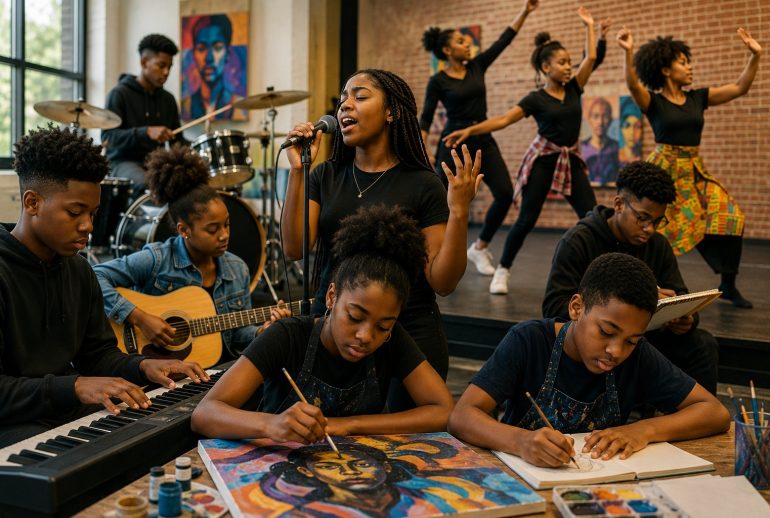
Arts and music programs can give young people more than a fun activity after school. They can give children and teens a voice, a safe outlet, a place to belong, and a way to discover gifts they may not yet know they have. Music, dance, theater, painting, photography, poetry, fashion, drumming, choir, digital art, storytelling, and performance can all help youth express what they feel, imagine what is possible, and connect with others in meaningful ways.
Across the Black community, creativity has always carried deep power. Music, art, dance, spoken word, storytelling, fashion, and performance have helped families and communities celebrate, grieve, worship, organize, teach, remember, and survive. From spirituals and gospel to jazz, blues, hip-hop, dance, visual art, theater, and spoken word, creative expression has often been one of the strongest ways the community tells its story. When children participate in the arts, they are not only learning a skill. They are stepping into a living tradition.
Many young people need healthy spaces where they can be seen without being judged only by grades, behavior, sports ability, or popularity. A child who struggles in math may shine on stage. A quiet teen may write powerful poetry. A student who feels restless in class may find focus through drums, dance, or painting. Arts and music programs can help youth build confidence in ways that traditional settings may not always reveal.
Families, schools, churches, community centers, mentors, artists, and local organizations can all help make creative opportunities available. Youth do not need expensive instruments, perfect studios, or professional stages to begin. They need encouragement, access, guidance, and safe spaces where creativity is treated as valuable.
1. Creative Programs Help Youth Express Emotions.
Children and teens often carry feelings they do not know how to explain. They may feel anger, sadness, pressure, anxiety, excitement, confusion, grief, or hope, but struggle to put those emotions into ordinary conversation. Arts and music can give them another way to express what is happening inside.
A young person may write a song, draw a picture, dance through emotion, act out a scene, play an instrument, or create a poem that says what they could not say directly. This kind of expression can be healing because it gives feelings a safe place to go. It helps youth understand themselves instead of holding everything inside.
Creative expression does not replace counseling or family support when those are needed, but it can support emotional wellness. A child who has a creative outlet may feel less alone. A teen who writes or performs may begin to process experiences more honestly. Art can become a bridge between silence and communication.
Parents and caregivers can support this by asking gentle questions. “What inspired that drawing?” “How did that song make you feel?” “What story are you telling?” These questions show youth that their inner life matters.
2. Arts And Music Build Confidence.
Confidence grows when young people practice a skill and see improvement. A child who learns a song, finishes a painting, performs in a school play, writes a poem, or plays in a band begins to understand that effort can create progress. This helps them believe in their ability to learn.
Creative programs also give youth opportunities to be recognized for their gifts. Applause, encouragement, display walls, recitals, open mics, church performances, community showcases, and family praise can help young people feel proud of their work. That pride can carry into other areas of life.
Confidence in the arts is not only about talent. It is about courage. A child who performs in front of others learns bravery. A teen who shares original writing learns vulnerability. A student who displays artwork learns to let others see their perspective. These are powerful growth moments.
Families should celebrate effort as much as achievement. Not every child will become a professional artist or musician, but every child can benefit from learning discipline, courage, and creative confidence.
3. Creative Spaces Can Give Youth A Sense Of Belonging.
Many young people are looking for a place where they feel accepted. Arts and music programs can create that kind of space. A choir, dance group, theater team, band, art club, writing circle, or creative workshop can help youth connect with others who share similar interests.
Belonging matters because youth who feel disconnected may become lonely, discouraged, or drawn toward unhealthy influences. A positive creative group can provide supportive peers, caring adults, and a shared purpose. Young people learn that they are part of something larger than themselves.
Creative spaces often allow different personalities to shine. Some children are bold performers. Others are quiet creators. Some enjoy being on stage, while others prefer writing, designing, painting, producing, or helping behind the scenes. A strong program makes room for many kinds of gifts.
When youth find a healthy place to belong, they are more likely to stay engaged, build friendships, and develop confidence. The arts can become one doorway into stronger community connection.
4. Music Teaches Discipline And Practice.
Music can be joyful, but it also teaches discipline. Learning an instrument, singing in a choir, writing songs, practicing rhythm, or preparing for a performance requires repetition and patience. Young people learn that improvement does not happen instantly. They must practice, listen, correct mistakes, and try again.
This lesson is valuable beyond music. A child who learns to practice piano, drums, voice, or guitar is also learning how to stay committed. A teen who rehearses with a group is learning teamwork and responsibility. A choir member who shows up on time is learning dependability.
Music also teaches listening. Young people must listen to melody, rhythm, harmony, timing, and other performers. They learn that their part matters, but they must also work with the group. This is an important life lesson.
Families can encourage music practice without turning it into pressure. The goal is to help youth enjoy growth while understanding that skill takes work. Discipline learned through music can support school, work, relationships, and future goals.
5. Dance Helps Youth Connect Body, Culture, And Confidence.
Dance is a powerful form of expression. It helps youth move their bodies, release energy, build coordination, and express emotion. Dance can also connect young people to culture through African dance, hip-hop, step, praise dance, Caribbean dance, modern dance, jazz, and many other forms.
For children and teens, dance can build confidence in the body. It teaches movement, rhythm, posture, and presence. It can help youth feel strong and expressive rather than self-conscious. This is especially important in a world where young people often face pressure about appearance.
Dance programs also teach teamwork and focus. Youth may rehearse choreography, support one another, prepare for performances, and learn how to stay disciplined. They learn that every person’s movement affects the group.
Families can support dance as both art and wellness. It gives young people a healthy outlet for movement while also connecting them to tradition, creativity, and joy.
6. Theater And Performance Build Communication Skills.
Theater helps youth practice speaking, listening, memory, teamwork, emotion, and confidence. A child who acts in a play learns how to use voice, facial expression, body language, and timing. A teen who performs a monologue learns how to stand before others and communicate clearly.
These skills can help in school and life. Public speaking, job interviews, classroom presentations, leadership roles, and community involvement all require communication. Theater gives youth a safe way to practice those skills creatively.
Performance also builds empathy. When young people act as different characters, they must think about another person’s feelings, choices, and point of view. This can help them understand people more deeply.
Theater programs can also help youth tell community stories. Plays and performances about family, history, culture, and current issues can give young people a chance to explore meaningful topics. Performance becomes both art and education.
7. Visual Art Helps Youth Think Creatively.
Visual art gives children and teens a way to explore color, shape, design, memory, imagination, and identity. Drawing, painting, photography, sculpture, collage, digital design, fashion sketching, and mural work can all help young people think creatively and solve problems.
Art teaches youth that there is often more than one way to approach something. A blank page can become many different things. A mistake can become part of the design. A simple idea can grow into something beautiful with time and effort. These lessons support flexible thinking.
Visual art can also help youth process experiences. A child may draw a family memory. A teen may create a piece about identity, community, justice, hope, or grief. Art can communicate things that are difficult to say out loud.
Families and communities can support young artists by displaying their work, asking about their ideas, providing basic supplies when possible, and connecting them to local art programs. A child’s creativity should be treated as something worth nurturing.
8. Creative Programs Can Support Cultural Pride.
Arts and music programs can help young people connect with Black history and African Diaspora culture. Through music, dance, theater, visual art, poetry, and storytelling, youth can learn about ancestors, movements, traditions, leaders, spiritual life, migration, resistance, and creativity.
This matters because cultural pride strengthens identity. When young people understand that their community has produced powerful art, music, literature, dance, fashion, and performance, they may feel more rooted. They see that creativity is part of their inheritance.
Programs can include Black composers, artists, playwrights, dancers, poets, photographers, designers, and musicians. They can also invite local artists and elders to share stories. This helps youth see that culture is not only in museums or history books. It is alive in the people around them.
When creative programs honor culture, youth learn that their voices belong in the larger story. They are not only consuming culture. They can help create and carry it forward.
9. Arts Mentors Can Make A Lasting Difference.
A creative mentor can change a young person’s life. A music teacher, dance instructor, drama coach, poet, painter, producer, photographer, designer, or community artist can help youth develop both skill and character. A mentor can see potential before the young person sees it in themselves.
Mentors can teach practice, discipline, confidence, professionalism, and creative honesty. They can also guide youth through disappointment, stage fright, criticism, and growth. These lessons help young people mature.
A good arts mentor does not only praise talent. They help youth develop responsibility. They may say, “Show up on time,” “Practice your part,” “Respect the group,” “Finish what you started,” or “Try again.” This kind of guidance builds character.
Families should value positive creative mentors. They can become part of the village that helps children grow into confident, disciplined, and expressive young adults.
10. Creative Opportunities Can Keep Youth Positively Engaged.
Youth need positive things to do with their time. When young people have access to music, art, dance, theater, writing, or creative technology, they are more likely to spend time building something instead of drifting into boredom or negative influences. Creative engagement can provide structure and purpose.
After-school and weekend programs are especially important. These are times when many youth need safe spaces, caring adults, and meaningful activities. A creative program can give them something to look forward to and a reason to stay connected.
Creative programs can also help youth who may not be interested in sports. Not every child wants to play basketball, football, or soccer. Some need a stage, a studio, a notebook, a camera, a dance floor, or a paintbrush. Communities should provide different paths for different gifts.
When youth are positively engaged, families and communities benefit. Young people gain focus, friendships, and purpose.
11. Creative Skills Can Open Future Opportunities.
Arts and music can also connect to future careers and business opportunities. Young people may develop interests in performance, production, design, photography, video editing, sound engineering, fashion, animation, writing, marketing, teaching, event planning, or entrepreneurship. Creative skills can become part of a larger future.
Families should not dismiss creative interests as unrealistic. Not every child will become famous, but creative skills can still be valuable. The modern economy includes many creative fields. A young person who learns design, storytelling, media production, music, or performance may later use those skills in business, education, technology, nonprofit work, or community leadership.
Parents can help youth think practically. What skills are you learning? What careers connect to this? What education or training might help? How can you use this gift to serve others? These questions help youth connect creativity to planning.
Creative dreams need both encouragement and wisdom. Families can support talent while also teaching discipline, budgeting, education, and responsibility.
12. Arts And Music Help Build A Stronger Community Future.
A community that supports youth creativity is investing in its future. Creative young people can become storytellers, leaders, teachers, entrepreneurs, healers, performers, designers, organizers, and culture keepers. They help the community remember, imagine, and grow.
Arts and music bring people together. A youth concert, art show, dance performance, poetry night, theater production, or cultural festival can create pride and connection. Families gather. Elders smile. Children are encouraged. Young people feel seen.
Creative programs also help communities tell their own stories. Instead of waiting for others to define them, communities can raise youth who know how to speak, sing, paint, dance, write, film, and perform their truth. That is powerful.
When the village supports the creative gifts of young people, it gives them more than an activity. It gives them a voice, a mirror, and a stage for becoming who they are meant to be.
Conclusion.
Arts and music programs support youth across the Black community by helping children and teens express emotions, build confidence, practice discipline, strengthen cultural pride, and find positive places to belong. Creativity gives young people a healthy outlet and helps them discover gifts that may not always appear in traditional settings.
Families and communities can support youth creativity through school programs, church choirs, dance groups, theater clubs, art classes, writing circles, community showcases, mentorship, and local cultural events. These opportunities do not need to be perfect or expensive to make a difference. They need to be consistent, encouraging, and safe.
When young people are given creative spaces, they learn that their voices matter. They learn to practice, perform, imagine, and contribute. A community that nurtures creativity is helping build stronger, more confident, and more expressive future leaders.
Akukulu Family encourages parents, caregivers, mentors, educators, artists, and community members to support one young person’s creativity this month. Attend a performance, encourage a child’s drawing, help a teen join a music program, support a dance class, visit an art show, or ask a young person what they love to create. One creative opportunity can help a child feel seen, confident, and inspired.
