

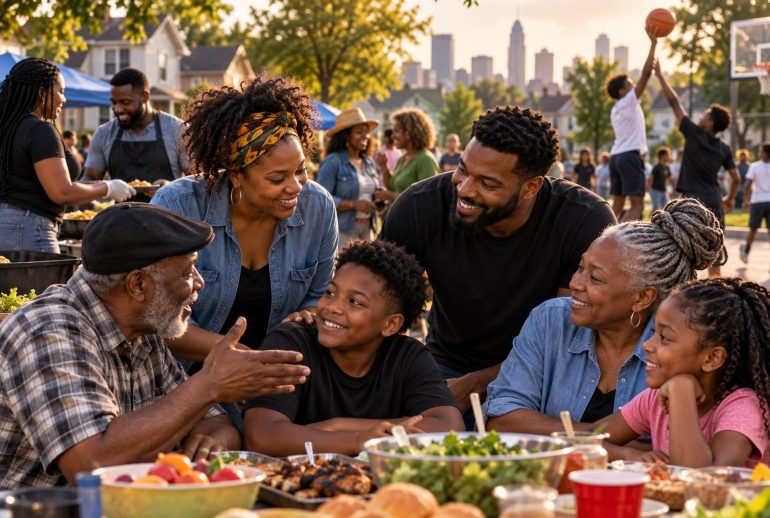
Community Is More Than Living Near One Another
There was a time when knowing your neighbors felt ordinary.
Children knew which houses they could visit. Families shared food. Someone noticed when an elderly neighbor had not been outside for a few days. Parents knew other parents. Local business owners recognized customers by name, and community events brought together people who might otherwise have had little reason to meet.
That experience has not disappeared, but modern life has changed the way many people connect.
Work schedules are demanding. Families move more frequently. Entertainment comes directly into our homes. Social media gives us access to hundreds or thousands of people while sometimes leaving us unfamiliar with the person living a few doors away.
For communities across the United States, including Black and African Diaspora households, rebuilding meaningful local connections can create something digital interaction alone cannot provide: a genuine sense of belonging.
Strong communities are not created by slogans.
They are created by relationships.
1. Start With the People Already Around You
Building community can sound like a large project.
It does not have to be.
Sometimes it starts by learning someone’s name.
Say hello to the neighbor you regularly pass. Introduce yourself to another parent at your child’s school. Talk with the owner of a local store. Attend a neighborhood gathering instead of assuming you will go next time.
Small interactions create familiarity, and familiarity can eventually create trust.
You do not need to become close friends with everyone around you. Community simply becomes stronger when people recognize one another and feel comfortable communicating.
A five-minute conversation can be the beginning of a relationship that lasts for years.
2. Create More Opportunities to Gather
Relationships need places to develop.
Community events, neighborhood cookouts, youth activities, cultural celebrations, school programs, recreational leagues, book clubs, workshops, and local festivals all create opportunities for people to meet naturally.
These gatherings do not always need large budgets or complicated planning.
A group of families could organize a picnic at a local park.
Neighbors could create a monthly potluck.
Parents might arrange a weekend activity for children.
A community organization could host a discussion around careers, education, health, technology, or financial literacy.
The activity gives people a reason to arrive.
The conversations that happen while they are there often become the more valuable part.
3. Make Room for Different Generations
One of the greatest resources available to any community is experience.
Older adults carry stories, lessons, skills, and perspectives that younger generations may never encounter online. Younger people bring new technology, ideas, creativity, energy, and ways of seeing the world.
Both have something to contribute.
The problem is that generations do not always have enough opportunities to interact.
Imagine a community program where older residents teach cooking, gardening, sewing, home maintenance, history, or traditional skills while younger participants help with smartphones, computers, social media, or other technology.
Nobody arrives simply as the teacher.
Everybody has something to learn.
Those exchanges can create respect while preserving knowledge that might otherwise disappear.
4. Support Local Businesses With More Than Likes
Supporting community businesses has become a common message on social media, but meaningful support requires action.
If a local business provides something you need and offers good service, consider purchasing from it.
Leave a thoughtful review.
Recommend the business to friends.
Share its information when someone asks for a recommendation.
Return when you need the service again.
Small businesses depend heavily on repeat customers and referrals.
Supporting a local entrepreneur can help more than one individual. Businesses hire workers, purchase supplies, sponsor activities, pay for services, and contribute to the economic activity of the surrounding area.
A thriving business community can become part of a thriving neighborhood.
5. Check on People Without Waiting for a Crisis
People are often surrounded by others while still feeling alone.
A coworker may be struggling.
An elderly relative may spend most days without meaningful conversation.
A new parent may be exhausted.
A teenager may feel disconnected.
Someone who recently moved into the neighborhood may not know anybody nearby.
Checking on someone does not require a dramatic reason.
A simple phone call, message, visit, or invitation can matter.
“Hey, I haven’t talked to you in a while. How are you doing?”
Those words can open a door.
Community care works best when relationships exist before emergencies happen.
6. Give Young People Meaningful Roles
Children and teenagers should not only attend community activities.
They should help shape them.
Young people can volunteer, help organize events, create social media content for local organizations, assist older residents with technology, participate in neighborhood cleanups, mentor younger children, or help plan recreational activities.
Responsibility communicates trust.
It tells a young person, “You are not just living in this community. You are part of what makes it work.”
That sense of ownership can change the way young people view the places where they live.
It also gives adults an opportunity to discover talents that may otherwise go unnoticed.
7. Bring Back the Practice of Sharing Knowledge
Every community contains people who know useful things.
Someone understands taxes.
Someone knows how to repair cars.
Another person understands college admissions.
Someone knows construction.
Another person understands computers.
There may be nurses, teachers, entrepreneurs, artists, tradespeople, chefs, engineers, financial professionals, caregivers, and retirees living within a few miles of one another.
What happens when that knowledge remains isolated?
Not much.
But imagine regularly creating opportunities for people to share what they know.
A mechanic could teach teenagers basic vehicle maintenance.
A business owner could explain how they started.
A college graduate could help families understand applications.
A gardener could teach families how to grow vegetables.
A technology professional could host a basic digital-skills workshop.
Knowledge becomes more powerful when it moves between people.
8. Use Technology to Strengthen Real Relationships
Technology does not have to compete with community.
It can support it.
Neighborhood groups can share information about events, lost pets, local services, school activities, job opportunities, and safety concerns.
Families separated by distance can stay connected through video calls.
Community organizations can use social media to reach people who might never see a printed flyer.
The challenge is remembering that technology should often be the bridge rather than the destination.
A group chat can organize the cookout.
The cookout creates the relationship.
An online announcement can promote the workshop.
The workshop creates the conversation.
Digital connection becomes especially valuable when it leads to meaningful human interaction.
9. Learn to Disagree Without Destroying Relationships
Strong communities do not require everyone to think alike.
People will disagree about parenting, money, education, politics, culture, religion, neighborhood priorities, and countless other subjects.
The question is whether disagreement automatically becomes disrespect.
Listening does not mean agreeing.
Asking someone why they see an issue differently does not mean abandoning your own beliefs.
Communities become healthier when people can discuss differences without treating every disagreement as a reason to end a relationship.
Sometimes the most important thing neighbors share is not an opinion.
It is the neighborhood itself.
10. Celebrate Community Success
Problems deserve attention, but success deserves visibility too.
When a student earns a scholarship, celebrate it.
When a neighborhood business reaches an anniversary, recognize it.
When someone graduates, opens a business, publishes a book, completes training, buys a home, organizes an event, or volunteers consistently, tell the story.
Communities need examples of progress.
Young people especially benefit from seeing achievement close to home.
Success feels different when the person accomplishing something is not a distant celebrity but someone who grew up on the same street, attended the same school, or shops at the same grocery store.
Local success makes possibility visible.
11. Make Community Service Normal
Helping others should not only happen during holidays or after disasters.
Community service can become part of ordinary family life.
Families can volunteer together.
Teenagers can help with local events.
Neighbors can participate in cleanups.
People can donate useful items rather than throwing them away.
Professionals can occasionally contribute their knowledge to community organizations.
Even a few hours can matter.
Children who grow up seeing adults serve others learn that community membership includes responsibility.
The lesson becomes simple:
If this place belongs to us, then caring for it belongs to us too.
12. Remember the People Who Are Easy to Overlook
Community building should include people who may not naturally appear at every gathering.
That can include older adults, people with disabilities, newcomers, single parents, caregivers, families with limited transportation, and individuals who simply do not feel comfortable entering unfamiliar social spaces.
An invitation can make a difference.
So can considering accessibility, transportation, timing, childcare, and cost when planning activities.
Sometimes people are absent not because they are uninterested but because participation is difficult.
A strong community asks not only, “Who came?”
It also asks, “Who might we be missing?”
13. Preserve Stories Before They Disappear
Every family and neighborhood contains history that may never appear in a textbook.
Grandparents remember things grandchildren do not.
Longtime residents remember businesses that disappeared, neighborhoods that changed, people who shaped the community, and events younger generations never experienced.
Ask questions.
Record conversations when appropriate.
Save photographs.
Write down recipes.
Document family stories.
Encourage young people to interview older relatives.
African Diaspora history is not only something stored in museums and archives. It also lives in kitchens, family albums, churches, businesses, community organizations, conversations, music, traditions, and memories.
Preserving those stories gives future generations something priceless: context for understanding where they came from.
14. Do Something Small Instead of Waiting for Something Big
It is easy to say communities need to become stronger.
The harder question is what each person can actually do.
Maybe you cannot organize a major community program.
But you can introduce yourself to a neighbor.
You can attend a local event.
You can recommend a small business.
You can call an older relative.
You can mentor one young person.
You can volunteer for two hours.
You can invite another family to dinner.
None of these actions will transform an entire city overnight.
That is not the point.
Community is built through repetition.
One conversation becomes a relationship.
One relationship becomes a network.
A network of people who know, trust, help, and learn from one another gradually becomes something stronger.
Conclusion: Strong Communities Are Built One Relationship at a Time
The word “community” can describe a neighborhood, a culture, an organization, an online group, or millions of people who share parts of a common heritage.
But at its most basic level, community is about people recognizing that their lives are connected.
Strong relationships cannot solve every challenge facing Black communities in America. They can, however, create an environment where information travels faster, young people encounter more mentors, local businesses receive more support, older generations remain connected, and families know they are not facing every challenge alone.
We do not need to recreate the past exactly as it was.
We can build something appropriate for the lives we live today.
It starts with showing up.
Listening.
Sharing.
Helping.
And learning the names of the people around us.
At Akukulu Family, we believe stronger communities begin when people have meaningful opportunities to connect, learn from one another, and share their experiences. Tell the Akukulu Family community what is helping people connect where you live—whether it is a neighborhood tradition, local organization, youth program, small business, cultural event, or simply something one person started that brought others together.
