

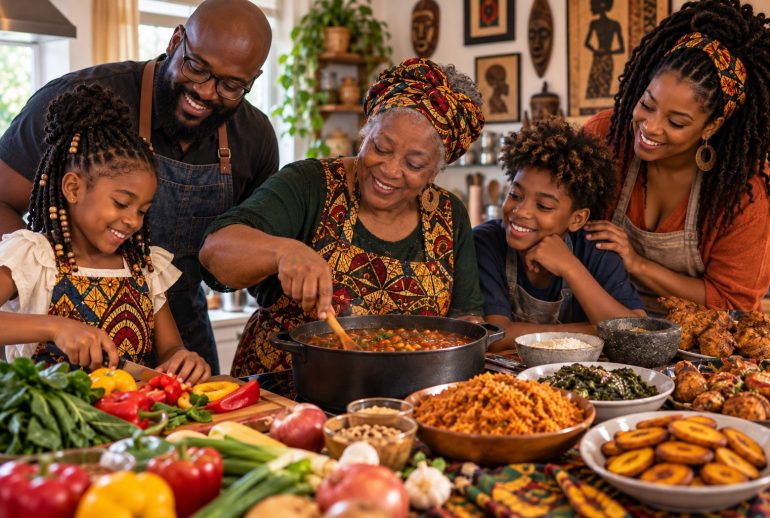
Food can tell a family story in a way that few other things can. A recipe may carry the memory of a grandmother’s kitchen, a migration from one country to another, a Sunday dinner tradition, a holiday gathering, a church event, or a dish that helped a family stretch what they had during a difficult season. When children learn the stories behind the foods they eat, they begin to understand that meals are connected to people, places, history, and identity.
Across the Black community and the wider African Diaspora, food traditions are rich and diverse. African American, African, Caribbean, Afro-Latin, and Southern families may all have different ingredients, cooking methods, flavors, and customs, but many share the experience of using food to bring people together. Recipes become part of family memory. Certain dishes appear at celebrations, funerals, reunions, church gatherings, birthdays, and holidays because they carry meaning.
Children may enjoy the food without knowing the story behind it. They may eat greens, rice, plantains, stew, cornbread, beans, fish, jerk chicken, jollof rice, patties, gumbo, sweet potato pie, or another family favorite without knowing why it matters. That is where family storytelling can make a difference.
Families do not need formal history lessons to begin. A simple question at the dinner table can open the door. Who taught you to make this? Did you eat this when you were young? Is this recipe from our family, our region, or our country? Why do we make this during special occasions? These questions can turn an ordinary meal into a meaningful connection with heritage.
1. Recipes Can Carry Generational Memory.
Some recipes have been passed down for decades. They may not be written in a cookbook. Instead, they may live in the memory of a grandmother, auntie, uncle, father, or family friend. One person knows how much seasoning to add by sight. Another knows when the dough feels right. Someone else knows exactly how the sauce should taste.
These kinds of recipes carry memory because they are tied to the people who made them. When children learn the recipe, they are also learning about the person behind it.
Families can preserve these memories by writing down recipes, recording elders cooking, taking photos, or asking questions while preparing the dish. A child can help measure ingredients, write notes, or create a family recipe card.
Preserving recipes is not only about food. It is about preserving family knowledge before it disappears.
2. Food Can Help Children Learn Where Their Family Comes From.
A dish can become a starting point for learning geography and culture. A family recipe may connect to the American South, West Africa, the Caribbean, Latin America, or another region. Children can look at a map and see where ingredients and traditions come from.
A parent might explain that a certain spice is common in one region or that a dish changed after the family moved to a new place. These stories help children understand migration and adaptation.
For families whose ancestors moved across countries or generations, food may be one of the traditions that stayed strong. A recipe can travel even when everything else changes.
When children understand where family foods come from, they begin to see themselves as part of a larger story.
3. Elders Can Bring Food History To Life.
Elders often remember details that younger family members do not know. They may remember what people ate during childhood, how food was prepared without modern appliances, where ingredients were bought, or which dishes appeared during holidays.
Children can learn a great deal simply by sitting with an elder and asking questions.
What did you eat for breakfast when you were young? Who was the best cook in the family? What meal did everyone look forward to? Did you grow any food? What dish reminds you most of home?
These questions can lead to stories about family, neighborhoods, work, school, migration, faith, and community.
When elders share food stories, children learn history through a personal voice. That makes the past feel closer and more meaningful.
4. Shared Meals Help Children Feel Connected.
Sitting down together for a meal gives families time to connect. Even if the meal is simple, the experience of eating together can help children feel rooted.
A family meal can become a place where stories are shared naturally. Someone may mention how a dish used to be made, where an ingredient came from, or why a certain meal is connected to a holiday.
These conversations do not need to be planned. Parents can simply make room for them.
Children who hear family stories during meals may grow up with a stronger sense of belonging. They understand that the table is not only a place to eat. It is also a place where memory is passed down.
5. Cultural Foods Can Build Confidence.
Some children may feel embarrassed by foods that seem different from what classmates eat. A strong family connection to food can help protect against that embarrassment.
Parents can teach children that cultural foods are something to be proud of. The smell, texture, spice, or preparation may be different, but that difference carries history and creativity.
Families can explain the meaning behind the dish and encourage children to talk about it with confidence. A school culture day, potluck, or family event can become an opportunity to share food proudly.
When children understand the story behind their food, they are more likely to value it instead of seeing it as something unusual.
Cultural confidence grows when traditions are explained, celebrated, and respected.
6. Food Stories Can Teach Children About Migration.
Many family food traditions changed because people moved. A family may have left one country, state, city, or neighborhood and adapted recipes to what was available in the new place.
One ingredient may have been replaced with another. A recipe may have become less spicy. A dish may have been combined with another tradition. These changes tell a migration story.
Parents can explain that food traditions often evolve as families move. This helps children understand that culture is not frozen. It can adapt while still carrying its roots.
Migration stories can also help children understand sacrifice, opportunity, and resilience. A recipe may remind an elder of leaving home, starting over, or building a new community.
Food becomes a bridge between where the family came from and where it lives now.
7. Children Can Learn History Through Ingredients.
Ingredients can carry important history. Rice, okra, beans, yams, peanuts, corn, plantains, greens, spices, and other foods have traveled across regions and cultures. Families can use these ingredients as starting points for learning.
A child may ask why a certain food is common in the family. That question can lead to conversations about agriculture, trade, migration, slavery, resilience, adaptation, and cultural exchange.
Parents do not need to turn dinner into a long history lecture. One simple fact can spark curiosity. Children can then explore books, museums, documentaries, or library resources to learn more.
Food history helps children see that culture develops through real people and real events. The plate in front of them can connect to centuries of history.
8. Family Recipes Can Teach Practical Skills.
Cooking family recipes also helps children build life skills. They can learn measuring, reading, following directions, budgeting, food safety, timing, and cleanup.
These practical lessons make cultural learning active. A child is not only hearing about a family tradition. They are helping create it.
Younger children can wash vegetables, stir, set the table, or count ingredients. Older children and teens can prepare more complicated parts of the meal.
When children cook traditional foods, they gain both confidence and competence. They learn that culture is something they can carry forward themselves.
A recipe survives when someone in the next generation knows how to make it.
9. Food Can Connect Different Parts Of The African Diaspora.
The African Diaspora includes many cultures and food traditions. Families can use food as a way to explore both their own heritage and the traditions of others.
A family might try Ethiopian food one month, Caribbean food another month, West African food another time, and Southern African American recipes at home. Children can compare flavors, ingredients, and preparation styles.
These experiences help youth see both connection and diversity across Black communities. They learn that there is no single Black food tradition.
Food can become a way to build curiosity instead of stereotypes. Children can appreciate differences while recognizing shared histories and cultural creativity.
That wider understanding can strengthen cultural respect.
10. Family Celebrations Help Preserve Food Traditions.
Holidays, reunions, birthdays, graduations, and church gatherings often bring traditional foods to the table. These celebrations are important opportunities to teach children why certain dishes appear again and again.
A child may notice that the same dessert shows up every Thanksgiving or that a certain rice dish is always prepared for family reunions. Adults can explain who started the tradition and why the dish matters.
Families can also invite children to help prepare special foods instead of only waiting for the meal. This makes them part of the tradition.
Celebrations help recipes become memories. Children may forget the details of an event, but they often remember the smell, taste, and feeling of a special meal.
11. Families Can Create A Food Heritage Project.
A family food heritage project can be a fun way to preserve stories. Children can interview elders, collect recipes, take photos, draw pictures, research ingredients, or create a family cookbook.
The project does not have to be formal. A notebook, photo album, digital folder, or recipe box can work.
Teens might record short videos of relatives cooking. Younger children can decorate recipe pages. Parents can write down stories about where dishes came from.
Over time, this collection can become a family treasure.
A food heritage project gives children something they can pass on later. It helps preserve memories that might otherwise disappear.
12. Food Stories Build A Stronger Sense Of Belonging.
Children need to know where they belong. Food stories can help give them that sense of connection.
A favorite recipe can remind them of grandparents. A holiday meal can connect them to cousins. A cultural dish can connect them to a country or region. A family story can help them understand the sacrifices and creativity of earlier generations.
These connections create identity.
When children understand that their family has a story, they may feel more grounded in who they are. They realize that they did not appear out of nowhere. They are part of something that began before them and will continue after them.
Food is one of the simplest ways families can make that story visible.
Conclusion.
Family food stories help children understand their heritage by connecting meals to people, places, migration, culture, and memory. A recipe can carry the voice of an elder, the history of a community, or the story of how a family adapted and survived.
Families do not need to know every detail of their history to begin. They can start with one recipe, one elder, one meal, or one question. Who taught us to make this? Why do we eat it? Where did it come from?
Those simple conversations can grow into deeper understanding.
When families share food stories, they are doing more than preparing meals. They are passing down culture, identity, and belonging from one generation to the next.
Akukulu Family encourages parents, caregivers, elders, and community members to share one food story with a young person this month. Cook a family recipe together, ask an elder about a favorite childhood meal, write down a recipe, or explore the history behind a cultural dish. One food story can help a child understand where they come from and carry that heritage forward.
