

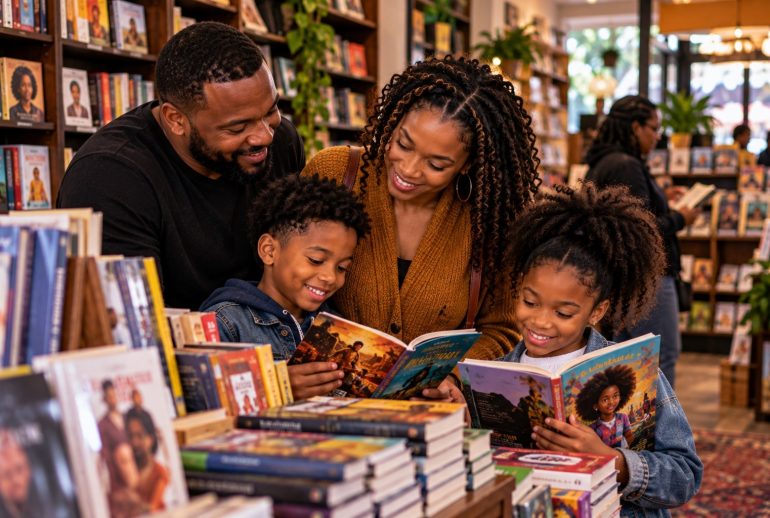
A bookstore can be much more than a place to buy a book. It can become a gathering place, a classroom, a cultural center, a business hub, and a doorway into stories that help children and adults understand themselves more deeply. Black-owned bookstores often play this wider role by bringing together literature, history, entrepreneurship, community events, and cultural pride.
Across the Black community, access to books that reflect real Black experiences matters. Children need stories where they can see families, skin tones, hair textures, neighborhoods, traditions, humor, challenges, and dreams that feel familiar. Teens need books that help them understand identity, history, careers, relationships, and the wider world. Adults and elders also benefit from spaces where Black authors, thinkers, storytellers, and historians are easy to discover.
For families in the DMV and across the United States, Black-owned bookstores can also provide something important that online shopping cannot fully replace: human connection. A knowledgeable bookseller can recommend a book for a reluctant reader, introduce a parent to a new Black children’s author, host a community discussion, organize a youth event, or create a space where people feel welcomed.
Supporting these bookstores can therefore do two things at once. Families gain access to meaningful books, and local entrepreneurs gain support that can help keep cultural spaces alive.
1. Black-Owned Bookstores Help Children See Themselves In Stories.
Representation can shape how children feel about reading.
A child who rarely sees people who look like them in books may quietly assume that stories are mostly about someone else. But when children encounter characters with familiar skin tones, hairstyles, family structures, cultural traditions, and experiences, reading can feel more personal.
A child may connect with a story about a Black girl learning to love her natural hair, a boy exploring science, a family preparing for a reunion, or a young person learning about an important historical figure.
These books show children that their lives belong in literature.
That can encourage reading confidence and help children understand that their experiences are worthy of being told.
2. Bookstores Can Introduce Families To Black Authors.
Many families know a few famous Black writers but may not realize how many authors are creating children’s books, novels, biographies, poetry, history, cookbooks, business books, and educational resources today.
Black-owned bookstores can help families discover those voices.
A bookseller may recommend a children’s author for a young reader, a memoir for an adult, or a historical book that gives deeper context to something the family is discussing.
This kind of personal recommendation can be especially useful for parents who want culturally relevant books but do not know where to begin.
Exploring Black authors also helps families see the diversity of thought within the Black community. There is no single Black experience or single Black story.
Books reveal the richness of those differences.
3. Bookstores Can Help Reluctant Readers Find The Right Book.
Not every child naturally loves reading.
Some children may struggle with reading skills. Others may simply not have found a subject that excites them. A child who says, “I hate reading,” may actually mean, “I have never found a book I care about.”
A good bookstore can help change that.
One child may love graphic novels. Another may enjoy sports biographies, mysteries, fantasy, science, fashion, cars, history, or funny stories. Teens may prefer poetry, manga, entrepreneurship, romance, or books about real-world issues.
Giving children more choice can make reading feel less like an assignment.
A bookseller who listens to what a young person enjoys can often help match the child with something that finally feels interesting.
One good book can change the way a child thinks about reading.
4. Black-Owned Bookstores Preserve Cultural Knowledge.
Books help preserve history.
Many Black-owned bookstores intentionally carry books about African American history, the African Diaspora, civil rights, local history, African cultures, Caribbean history, faith traditions, Black entrepreneurship, art, politics, family life, and community leadership.
These books give families access to knowledge that may not always receive much attention in school.
Parents can use bookstores to help children explore questions about where they come from and what previous generations experienced.
Elders may also recognize books that connect to memories they want to share.
When families read history together, knowledge is not left only inside classrooms. It becomes part of family conversation.
5. Bookstore Events Can Build Community Connection.
Many independent bookstores host events that bring people together.
These may include author talks, book clubs, children’s story hours, poetry readings, youth workshops, writing groups, cultural discussions, or community conversations.
Events like these help transform a bookstore into a meeting place.
A child may hear an author speak and realize that writing could be a future career. A teenager may attend a poetry night and find a creative outlet. Parents may meet other families interested in education and culture.
These connections can strengthen community life.
Books become the starting point for conversation rather than the end of it.
6. Supporting Black-Owned Bookstores Supports Entrepreneurship.
Buying from a Black-owned bookstore is also a way to support local entrepreneurship.
Independent businesses face real challenges. Rent, inventory, staffing, marketing, and competition with large online retailers can make it difficult to stay open.
Every purchase helps.
Parents can explain this to children as part of financial education. When a family chooses to purchase locally, some of that money stays closer to the community and supports a business owner, employees, events, and other local activity.
This gives children a practical lesson in economics.
They begin to understand that where money is spent can influence which businesses remain available.
7. Bookstores Can Become Part Of Family Traditions.
A bookstore visit can become a family tradition.
A family might visit once a month, after report cards, before summer vacation, around birthdays, or at the beginning of the school year.
Children may be allowed to choose one book each time. Parents may choose something too.
These outings create positive memories around reading.
Instead of seeing books only as school materials, children begin to associate bookstores with discovery, family time, and personal choice.
Over the years, those visits may become part of the family story.
A child who grows up visiting bookstores may later continue the tradition with their own family.
8. Bookstores Can Support School Success.
Books support many academic skills.
Reading regularly can help children build vocabulary, comprehension, writing ability, concentration, and background knowledge. These skills affect nearly every school subject.
Black-owned bookstores can help families choose age-appropriate books that support both learning and enjoyment.
Parents may ask for recommendations connected to history, science, biographies, or school reading levels. Some stores may also carry workbooks, study guides, educational games, or teacher resources.
A bookstore visit can complement what children are learning in school without making the experience feel like extra homework.
The key is keeping curiosity alive.
9. Teens Can Discover Career And Business Inspiration.
Teenagers may be especially interested in books connected to the future.
Books about entrepreneurship, technology, medicine, fashion, law, music, finance, sports, design, leadership, or creative careers can help teens explore possibilities.
Biographies can also be powerful.
Reading about how someone built a business, became a scientist, wrote a novel, overcame setbacks, or entered a profession can make a career path feel more real.
Parents can encourage teens to choose books based on current interests.
A teenager does not need to know exactly what they want to become. Exploring different stories can help them understand what possibilities exist.
Books can introduce opportunities long before a teen meets someone working in that field.
10. Children’s Story Time Can Make Reading Social.
Story time events can be especially helpful for younger children.
Hearing a book read aloud by an enthusiastic adult can make the story feel exciting. Children can see pictures, answer questions, laugh together, and meet other young readers.
This makes literacy social.
A child may be more interested in bringing the book home after experiencing it with a group.
Parents can also learn new reading techniques by watching someone else read aloud. They may notice how the reader changes voices, asks questions, or pauses to discuss pictures.
Those ideas can be used at home.
Story time can help both children and parents build stronger reading habits.
11. Local Bookstores Can Highlight Local Stories.
Large national retailers may not always feature books connected to a specific city or neighborhood.
Independent Black-owned bookstores may be more likely to carry books by local authors, local historians, poets, educators, or community leaders.
For families in the DMV, that might mean discovering stories connected to Washington, D.C., Maryland, Virginia, historically Black neighborhoods, local institutions, community leaders, or regional history.
Local stories help children understand that history happened near them.
They may recognize a street, neighborhood, school, church, or landmark mentioned in a book.
That connection can make reading more immediate and meaningful.
12. Bookstores Can Create Intergenerational Conversations.
A bookstore visit can bring different generations together.
A grandparent may choose a history book. A parent may find something about business or parenting. A teen may pick a novel. A child may choose a picture book.
The family may leave with very different books, but those choices can lead to conversation.
An elder may tell a story connected to something they saw on a shelf. A parent may explain why a certain author matters. A child may ask questions about a historical photograph.
Books give generations something to discuss.
These conversations help families share knowledge without forcing a formal lesson.
13. Families Can Create A Home Library One Book At A Time.
A home library does not need hundreds of books.
It can begin with one shelf.
Each bookstore visit can add another story, biography, history book, cookbook, poetry collection, or children’s title.
Over time, the collection begins to reflect the family.
Children grow up seeing books as part of the home environment. They can return to favorites, share books with siblings, or eventually pass them to younger relatives.
A family library becomes a record of what the household values and wants future generations to know.
One book at a time is enough.
14. Bookstores Help Keep Reading Connected To Community.
Reading can sometimes feel like a private activity, but bookstores remind families that books are also part of community life.
Authors write because they want to communicate. Readers gather because stories give people something to think and talk about. Bookstores connect those groups.
For the Black community, these spaces can help preserve voices, support entrepreneurs, encourage young readers, and bring generations together.
The value goes beyond the books sitting on shelves.
The bookstore itself becomes part of the cultural ecosystem.
Conclusion.
Black-owned bookstores strengthen families across the Black community by making books, culture, history, and community connection more accessible. They give children opportunities to see themselves in stories, help parents discover Black authors, offer teens new ideas about their future, and provide spaces where families can learn together.
Supporting these businesses also strengthens local entrepreneurship. Every book purchased helps sustain a space where authors, readers, parents, children, educators, and community members can connect.
Families do not need to buy many books at once. One bookstore visit, one story hour, one book by a Black author, or one addition to the family bookshelf can be enough to begin.
When communities support places that protect stories, they also help protect memory, identity, education, and imagination.
Akukulu Family encourages families across the Black community to explore a Black-owned bookstore or local independent bookshop this month. Let a child choose a book, ask for a recommendation by a Black author, attend a story time, support a local writer, or begin a small home library. One book can start a conversation that continues for generations.
