

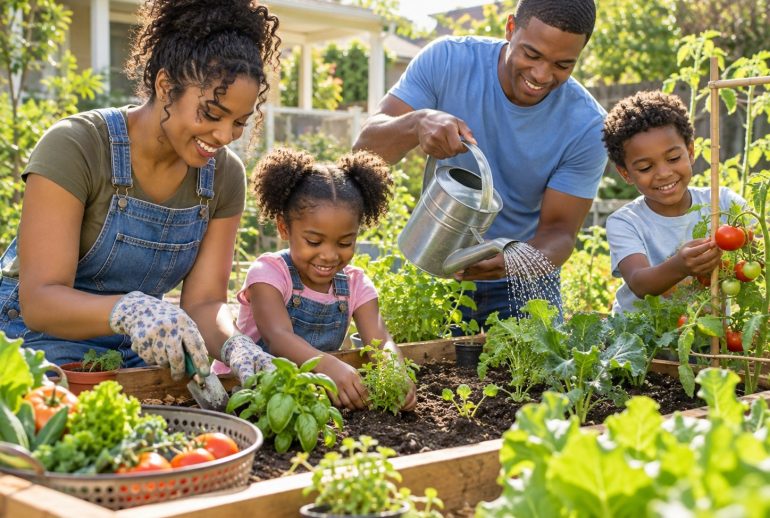
Gardening can bring together health, family time, learning, culture, and recreation in one simple activity. A garden does not have to be large. It may be a backyard plot, a few containers on a porch, herbs on a windowsill, vegetables in raised beds, or a shared space in a community garden. What matters is giving families a way to grow something together.
Across the Black community, gardening has deep roots. Families have long grown greens, herbs, tomatoes, peppers, beans, okra, sweet potatoes, fruit, and other foods that became part of everyday meals and cultural traditions. For some families, gardening connects to rural roots, Southern traditions, Caribbean agriculture, African foodways, or memories of grandparents who always kept something growing.
Today, gardening can also help families slow down. Children spend much of their time indoors, in school, on devices, or moving from one scheduled activity to another. Adults may be dealing with work stress, bills, transportation, and caregiving. A garden creates a different pace. Plants grow gradually. They need water, sunlight, patience, and attention. Families cannot rush the process, and that can be part of what makes gardening healthy.
Gardening also teaches children that food has a story. A tomato does not begin in a grocery store. Herbs do not appear in a plastic package by themselves. Food grows from soil, water, sunlight, labor, and time. When children participate in that process, they may gain a deeper appreciation for what they eat.
1. Gardening Gets Families Outdoors.
Gardening is a simple form of outdoor activity. Digging, planting, watering, carrying soil, pulling weeds, and walking around a garden all encourage movement without making exercise feel forced.
For children, gardening can be a break from screens and indoor routines. They can use their hands, get dirty, observe insects, and watch plants change from week to week. For adults, gardening can provide light physical activity and a reason to step outside.
Families can work at their own pace. A younger child might water plants. A teen may help move soil or build a raised bed. An elder may sit nearby and guide the work.
The goal is not intense exercise. It is simply creating more movement and fresh air as part of family life.
2. Gardening Helps Children Understand Where Food Comes From.
Many children see food mainly after it has already been packaged, cooked, or placed on a store shelf. Gardening helps them understand the earlier part of the process.
Planting a seed and watching it become a vegetable can be surprising for a child. They begin to see that food requires care and time.
Parents can explain simple ideas about roots, soil, pollination, sunlight, and seasons. Children can learn which foods grow well in their climate and how long different plants take to mature.
This kind of hands-on learning can make science feel real.
A child who grows a pepper, tomato, or herb may also become more curious about tasting it. The connection between growing and eating can help children become more open to fresh foods.
3. Gardening Can Support Healthier Eating.
A family garden can make fresh foods feel more familiar. Children who help grow vegetables and herbs may be more interested in trying them at the table.
This does not mean gardening automatically changes every eating habit. Children may still prefer familiar foods, snacks, and treats. But growing food can make healthy choices more personal.
A child may proudly say, “I grew that tomato,” or “Those are our herbs.” That sense of ownership can make food more exciting.
Families can use garden produce in simple ways: herbs in soups, peppers in eggs, tomatoes in salads, greens in dinner, or mint in water.
Even a small harvest can create meaningful conversations about nutrition and care for the body.
4. Gardening Can Reduce Stress.
Gardening can provide a calming break from busy schedules and digital noise. Watering plants, pulling weeds, or simply sitting outside near something growing can help people slow down.
Children and teens may benefit from having a quiet outdoor task after school. Adults may find gardening helps them mentally separate from work or daily stress.
The repetitive nature of simple garden tasks can feel grounding. There is something steady about checking the soil, noticing new growth, and caring for a plant.
Gardening does not replace professional mental health support when someone needs it, but it can be one healthy activity that supports relaxation and emotional balance.
Families can treat garden time as a low-pressure space where conversation happens naturally.
5. Gardening Gives Children Responsibility.
Plants depend on consistent care. They need water. They may need weeding, support, pruning, or protection from weather. This gives children an opportunity to take responsibility for something living.
A child might be responsible for watering one container. An older child may check several plants and report what needs attention. A teen may help research why a plant is struggling.
When children forget, adults can use the moment as a lesson rather than immediately taking over.
Responsibility becomes visible in a garden. If a plant is cared for, it grows. If it is ignored, the effects may show.
These natural consequences can help children understand consistency in a gentle way.
6. Elders Can Share Gardening Knowledge.
Many elders carry practical knowledge about plants, weather, soil, food, and cooking that younger generations may never have learned.
A grandparent may know when tomatoes should be planted, how to save seeds, how to grow greens, or which herbs belong in a family recipe. They may also remember gardens from childhood.
Inviting elders into family gardening gives them a chance to teach.
Children can ask what their grandparents grew, what foods were common, or how families preserved produce before modern convenience.
These conversations can turn a garden into a place of cultural memory.
Elders do not always need to do heavy work to participate. Their stories, advice, and presence can be just as valuable.
7. Gardening Can Preserve Cultural Food Traditions.
Certain plants may connect directly to family culture.
Okra, collard greens, mustard greens, peppers, sweet potatoes, herbs, beans, tomatoes, callaloo, or other crops may remind families of traditional meals.
Growing these foods can help children understand that culture is connected to agriculture as well as recipes.
Families can explain why certain ingredients appear often in their cooking and where those foods came from historically.
A child may learn that a plant has connections to Africa, the Caribbean, the American South, or a particular family region.
This creates a deeper relationship between the garden and the kitchen.
8. Small-Space Gardening Can Still Work.
Not every family has a backyard.
Container gardening can make growing food possible on balconies, patios, porches, windowsills, or small outdoor spaces. Herbs, lettuce, peppers, tomatoes, and some other plants can grow well in containers when conditions are right.
Families can also look for community gardens, school gardens, church gardens, or neighborhood growing spaces.
Starting small is often easier anyway.
One pot of basil, mint, or tomatoes can teach the same basic lessons about care and growth as a large garden.
Families do not need to wait until they have the perfect space. A small beginning still counts.
9. Gardening Can Teach Science And Math.
A garden is full of learning opportunities.
Children can measure plant growth, count seeds, estimate spacing, track rainfall, compare temperatures, or calculate how many plants fit in a bed. They can learn about insects, photosynthesis, roots, soil, weather, and ecosystems.
Parents do not need to turn gardening into formal schoolwork. Simple questions can be enough.
Why do you think this plant grew faster? What happens if we forget to water it? How many tomatoes did we harvest this week? Which area gets the most sunlight?
These questions encourage observation and problem-solving.
Learning through gardening can make school concepts feel more practical.
10. Gardening Can Teach Patience.
Modern life gives children many things instantly. Videos load immediately. Messages arrive quickly. Food can be ordered with a phone.
Plants do not work that way.
A seed may take days to sprout and weeks or months to produce food. Children must wait.
That waiting teaches patience.
They also learn that not every plant succeeds. Weather changes. Insects appear. Seeds sometimes fail. A plant may need to be moved or started again.
These experiences teach children that effort does not always produce instant results.
Patience learned in a garden can support patience in many other areas of life.
11. Community Gardens Can Build Relationships.
Community gardens can bring neighbors together around a shared project.
Families may work beside elders, children, experienced gardeners, and people from different backgrounds. They can exchange advice, seeds, produce, and stories.
Children see cooperation happening in a practical way.
One person may know about tomatoes. Another may understand composting. Someone else may have extra seedlings. Knowledge is shared.
Community gardens can also improve neighborhood pride by turning unused spaces into places where people gather and grow food.
A garden can become both a food source and a relationship-building space.
12. Gardening Can Support Family Cooking.
The garden becomes even more meaningful when food moves from the soil to the kitchen.
Children can harvest herbs and help add them to dinner. A teen can pick tomatoes and turn them into salsa. Families can cook greens they grew themselves.
This completes the learning cycle.
Children see that planting, caring, harvesting, preparing, and eating are all connected.
Families can even choose what to plant based on meals they already enjoy.
If the family frequently cooks with peppers, herbs, greens, or tomatoes, those plants may be a natural place to begin.
Gardening and cooking together can strengthen both food skills and family connection.
13. Gardening Can Help Families Appreciate Food More.
Growing food takes work.
Once children experience that work, they may begin to understand why wasting food matters. A tomato that took months to grow may feel more valuable than one that simply appeared in the refrigerator.
Parents can connect gardening to conversations about food waste.
How can we use what we harvested? Can extra vegetables be shared? Can scraps be composted? Can herbs be dried or frozen?
These lessons help children understand that food is a resource worth respecting.
Gratitude grows when effort becomes visible.
14. Gardens Can Become Family Traditions.
A garden can become part of family life year after year.
Children may remember planting tomatoes every spring, growing herbs with a grandparent, picking vegetables before dinner, or having a yearly harvest meal.
Families can save seeds from favorite plants, take photos each season, or keep a simple garden journal.
These traditions create continuity.
A child who grows up gardening may one day teach the same skills to their own children.
That is how practical knowledge becomes generational knowledge.
15. Gardening Builds A Stronger Connection To Community And Land.
Gardening reminds families that food, health, neighborhoods, and the natural world are connected.
Children learn that soil matters. Water matters. Weather matters. Community spaces matter.
They begin to understand that caring for a small patch of land can produce something useful and beautiful.
Across the Black community, gardening can also reconnect families with traditions of growing, sharing, preserving, and feeding others.
That connection can become both practical and meaningful.
Conclusion.
Family gardening can support wellness across the Black community by bringing together movement, fresh food, stress relief, responsibility, culture, education, and family connection. A garden can be large or small. It can grow in a backyard, container, community plot, school, or church space.
Families can start with one plant. Choose an herb used in family cooking, grow a tomato with a child, ask an elder what they used to plant, or visit a community garden together.
The goal is not a perfect harvest.
The goal is creating an experience where children learn that growth takes attention, patience, and care.
When families grow something together, they may also grow stronger relationships along the way.
Akukulu Family encourages parents, caregivers, elders, educators, and community members to plant something with a young person this season. Start a small herb pot, grow a favorite vegetable, visit a community garden, or ask an elder to share a gardening memory. One seed can become a lesson in health, patience, culture, and family connection.
