

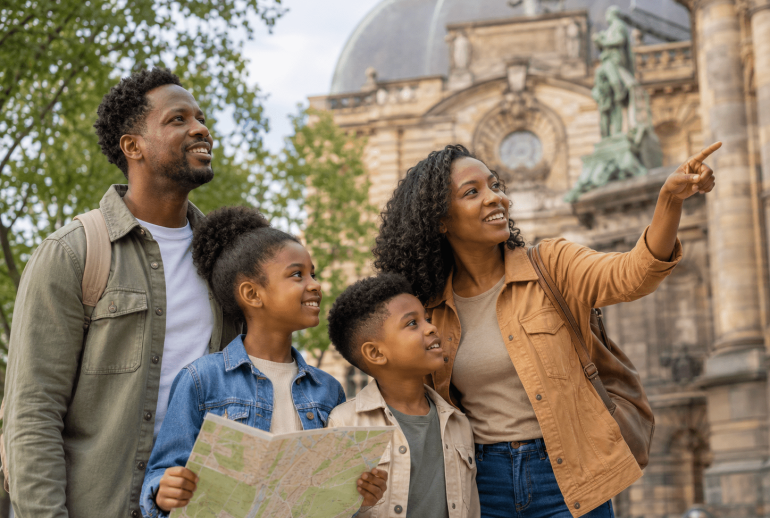
Family travel does not always have to mean expensive vacations, flights, hotels, or faraway destinations. Travel can be a weekend road trip, a visit to a nearby museum, a cultural festival, a historical site, a family reunion, a local food market, a college tour, a community event in another city, or a simple day trip to a place children have never seen before. What matters is not only the distance. What matters is the experience, the conversation, and the memories created along the way.
Across the Black community, family travel can be a powerful way to build cultural confidence. Children and teens learn about themselves not only through books and school lessons, but also through places, people, food, music, art, history, and shared family experiences. When young people visit spaces that reflect Black history, African Diaspora culture, creativity, business, education, and leadership, they begin to understand that their story is wide, rich, and meaningful.
Travel also gives families a chance to step outside normal routines. At home, families may be busy with work, school, chores, bills, screens, homework, caregiving, and daily stress. A trip, even a small one, can create room for conversation, laughter, discovery, and bonding. Children may ask questions they would not ask at home. Parents may share stories. Elders may explain family history. These moments can strengthen identity and connection.
Family travel should not be treated as something only certain families can afford. Many meaningful experiences can be planned with a modest budget. A library event, free museum day, community festival, park visit, historic neighborhood walk, family picnic, or local cultural celebration can still teach children something valuable. The goal is to help families see travel as a tool for learning, pride, wellness, and togetherness.
1. Travel Helps Children See The World Beyond Their Daily Routine.
Children can sometimes believe that their everyday surroundings are the whole world. They know their home, school, neighborhood, church, stores, parks, and familiar streets. Those places matter, but children also need opportunities to see that the world is larger than what they experience every day. Travel helps open that window.
A simple trip to a new city, museum, cultural market, nature area, college campus, historical site, or family gathering can expand a child’s imagination. They may see new buildings, hear different accents, taste new foods, observe different traditions, or learn about people who live in ways they had not considered before. These experiences can make children more curious and confident.
For teens, travel can also help them imagine future possibilities. Visiting a college campus, business district, art show, technology event, or cultural center may help a young person think differently about careers, education, creativity, and leadership. Exposure matters because young people often dream based on what they have seen.
Families can support this by talking during and after trips. What did you notice? What surprised you? What did you learn? Would you want to come back? These questions help children turn travel into reflection and growth.
2. Cultural Trips Can Build Pride And Identity.
Cultural travel can help children understand that their heritage is alive and worth celebrating. A visit to a Black history museum, African Diaspora festival, cultural food event, historical church, civil rights site, local art exhibit, music celebration, or heritage neighborhood can help children see their community represented with dignity and depth.
This matters because young people may not always see full and positive images of their culture in school, media, or online spaces. Cultural trips give families a chance to show children stories of courage, creativity, faith, entrepreneurship, education, resistance, and joy. They help children understand that Black history is not only about pain. It is also about brilliance, family, innovation, leadership, and survival.
Parents and caregivers can make these trips meaningful by preparing children ahead of time. They might explain where they are going, why the place matters, and what the family hopes to learn. After the trip, they can talk about what stood out. These conversations help children connect the experience to identity.
Cultural pride grows when children see their people’s stories honored in real places. A child who walks through a museum, attends a festival, or hears an elder explain a historical site may carry that memory for years.
3. Family Travel Creates Stronger Memories.
Some of the strongest family memories happen away from the normal routine. Children may remember the road trip music, the snacks packed in the car, the funny moment at a rest stop, the first time they saw the ocean, the family photo in front of a landmark, or the meal everyone shared after a long day. These memories become part of family identity.
Travel gives families stories to tell later. “Remember when we went to that festival?” “Remember when Grandma told us that story on the trip?” “Remember when we got lost and found that little restaurant?” These stories may seem small, but they become emotional glue. They help families feel connected across time.
Memories do not require luxury. A low-cost day trip can become just as meaningful as a big vacation if the family is present and engaged. Children often remember the feeling more than the price. They remember being together, laughing, exploring, and feeling loved.
Families can preserve travel memories through photos, journals, small souvenirs, postcards, videos, or simple conversations. A child can draw what they saw, write a few sentences, or create a scrapbook page. These activities help the memory last.
4. Travel Can Teach Children About Family History.
Many families have stories connected to certain places. A grandparent may have grown up in a small town. A parent may remember a childhood neighborhood. A family may have roots in another state, island, country, or region. Visiting these places can help children understand their family history in a deeper way.
A family history trip might include visiting an old home area, cemetery, church, school, family farm, neighborhood, or community landmark. Elders can explain who lived there, what life was like, and how the family changed over time. These stories help children understand that they are part of a long chain of people.
Even when families cannot travel far, they can still explore history locally. They can visit places connected to Black history in their city or region. They can attend community storytelling events or ask elders to talk about past family experiences. Travel and storytelling can work together.
When children know family history, they may feel more grounded. They learn that they did not appear from nowhere. They come from people who lived, worked, struggled, loved, built, prayed, migrated, created, and survived. That knowledge can build confidence.
5. Food Experiences Make Travel More Meaningful.
Food is one of the most enjoyable parts of travel. Trying a new restaurant, visiting a cultural food market, eating at a family reunion, tasting a traditional dish, or packing familiar foods for a road trip can all become part of the travel memory. Food helps children experience culture through taste, smell, and conversation.
Across the African Diaspora, food traditions are rich and diverse. Family travel can introduce children to African, Caribbean, Southern, African American, Afro-Latin, and local community foodways. A meal can lead to a conversation about where ingredients come from, who cooks that dish, and what the food means to different communities.
Families can also use food travel to support local businesses. Eating at a Black-owned restaurant, buying from a local vendor, visiting a cultural market, or supporting a family-owned bakery can teach children about community economics. They learn that spending choices can support real people and local dreams.
Food experiences do not have to be expensive. Even sharing a simple picnic in a new place can become meaningful. What matters is connecting the meal to family, culture, and memory.
6. Travel Helps Children Practice Social Confidence.
Travel often places children in new situations. They may need to ask questions, greet relatives they do not know well, speak to museum staff, order food, read signs, follow directions, or interact with people from different backgrounds. These experiences can help build social confidence.
Parents and caregivers can guide children gently. A younger child can practice saying thank you. An older child can help read a map or ask where the restroom is. A teen can help check hours, compare prices, or speak with a vendor. These small tasks help young people become more capable.
Travel also teaches flexibility. Plans may change. Weather may shift. A place may be crowded. The family may need to wait. Children learn patience, problem-solving, and how to handle small disappointments. These are real-life skills.
Social confidence grows when children are given safe opportunities to participate. Travel gives them a chance to practice independence while still being supported by family.
7. Local Travel Can Be Just As Valuable As Far Travel.
Families should not feel that travel only counts if it is far away. Local travel can be deeply meaningful. A family can visit a museum across town, a historical marker, a cultural festival, a library event, a park in another neighborhood, a farmers market, a college campus, or a community theater. These experiences can expand children’s world without requiring major expense.
Local trips are also easier to repeat. A family may not be able to take a big vacation every year, but they may be able to plan monthly or seasonal outings nearby. These smaller experiences can create a steady habit of exploration and learning.
Children may be surprised by how much history and culture exist close to home. Many cities and counties have Black history sites, local leaders, artists, churches, schools, businesses, and community stories that deserve attention. Families can learn these stories together.
Local travel teaches children to value their own region. It reminds them that culture and history are not only found in famous places. They are also found in nearby streets, neighborhoods, buildings, and people.
8. Travel Can Inspire Learning Before And After The Trip.
A trip becomes more powerful when families connect it to learning before and after they go. Before visiting a place, families can read a short article, watch a video, look at a map, learn about a historical figure, or talk about why the destination matters. This preparation helps children arrive with curiosity.
After the trip, families can reflect. Children can write about what they saw, draw a picture, share their favorite part, research one thing they noticed, or explain what they learned to a relative. These activities help the experience stay in the mind longer.
This kind of learning does not need to feel like homework. It can be natural and conversational. A parent might say, “Let’s look up who this building was named after,” or “Let’s find this place on the map,” or “What food did we try today that was new to you?”
Travel can support reading, history, geography, writing, culture, and critical thinking. When families approach trips with curiosity, the whole world becomes a classroom.
9. Family Travel Can Strengthen Relationships Across Generations.
Travel can bring generations together. Grandparents, parents, children, cousins, aunties, uncles, and family friends may share experiences that create deeper connection. A trip to a family reunion, cultural festival, historic site, or old family neighborhood can give elders a chance to share stories and youth a chance to listen.
Intergenerational travel can be especially powerful because elders often remember details that younger people do not know. They may point out where someone lived, explain a family tradition, tell a story about migration, or share how life was different years ago. These stories help children connect faces and places to family history.
Families should plan with elders in mind when traveling together. Seating, rest breaks, shade, food needs, walking distance, and accessible spaces matter. Including elders thoughtfully shows respect and makes the trip more enjoyable for everyone.
When generations travel together, the experience becomes more than an outing. It becomes a way of passing down memory, values, and belonging.
10. Travel Can Help Families Rest And Reset.
Travel is not only for learning. It can also help families rest. A change of scenery can give parents, children, and teens a break from normal stress. A beach day, nature walk, quiet cabin, park picnic, or simple weekend visit can help the family breathe and reconnect.
Many families carry stress from work, school, finances, caregiving, and daily responsibilities. Even a short trip can create space to slow down. Children may relax away from school pressure. Adults may feel refreshed by being outside the normal routine. Teens may open up more during a drive or walk.
Restful travel does not have to be packed with activities. Sometimes doing less is the point. Families can choose one main activity and leave room for quiet time, conversation, and rest. Overplanning can turn travel into more stress.
Rest is part of wellness. Families deserve opportunities to enjoy each other without constant pressure. Travel can help create those moments.
11. Budget Planning Makes Family Travel More Possible.
Many families worry that travel will cost too much. Budget planning can make travel more realistic. Families can start small, choose free or low-cost activities, pack meals, look for community events, use library passes if available, travel with relatives, or plan day trips instead of overnight stays.
A travel budget can include transportation, food, tickets, parking, snacks, and emergency money. When families plan ahead, they are less likely to overspend. Children can also learn budgeting by helping compare options or save for a small family outing.
Families can create a simple travel jar or savings goal. Even a few dollars set aside regularly can help fund a day trip, museum visit, or family event. This teaches children patience and planning.
Budget travel still has value. The goal is not to impress anyone. The goal is to create experiences that support learning, connection, and joy.
12. Travel Helps Children Carry Culture Into The Future.
When children travel with family, visit cultural spaces, hear stories, taste traditional foods, and see history honored, they carry those experiences forward. They may grow into adults who value heritage, support local culture, take their own children to meaningful places, and continue family traditions.
Cultural confidence grows through repeated exposure. One museum visit, one family reunion, one local festival, one heritage trip, or one conversation with an elder can plant a seed. Over time, those seeds help children understand who they are and why their story matters.
Families should not wait for perfect conditions to begin. They can start with one local outing, one nearby event, one family story connected to a place, or one cultural food trip. Small experiences can still shape identity.
Travel helps children see that culture is not only something behind them. It is something they can live, learn, protect, and carry into the future.
Conclusion.
Family travel builds cultural confidence across the Black community by helping children and families explore history, heritage, food, art, education, nature, and shared memory. Travel gives young people a chance to see the world beyond their routine and understand that their family and cultural story is rich, meaningful, and worth honoring.
Families do not need expensive vacations to benefit from travel. A local museum, cultural festival, family reunion, historical site, neighborhood walk, college tour, food market, or day trip can all become powerful learning experiences. What matters most is the conversation, connection, and intention behind the trip.
When families travel with purpose, children gain more than pictures. They gain stories, confidence, curiosity, and a stronger sense of belonging. These experiences can help them walk into the future with pride in who they are and where they come from.
Akukulu Family encourages parents, caregivers, elders, mentors, and community members to plan one meaningful family outing this season. Visit a cultural event, explore a local history site, support a Black-owned business, attend a family reunion, tour a college campus, or take children somewhere new. One thoughtful trip can build memories, confidence, and cultural pride.
