

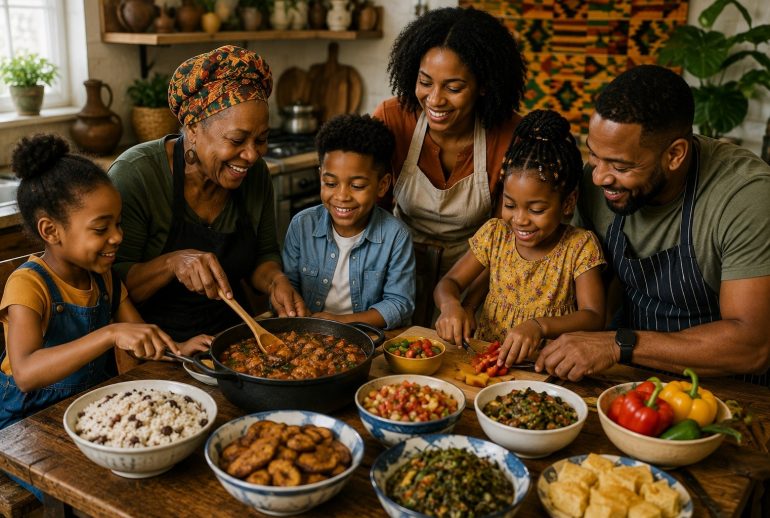
Food is never just food. A meal can carry memory, culture, family history, love, survival, creativity, and connection. One dish can remind someone of a grandmother’s kitchen, a holiday table, a church gathering, a family reunion, a neighborhood cookout, a school lunch, a homeland, a migration story, or a season when the family had to stretch what little they had and still make it feel like enough. Across the Black community, food has always been one of the ways families remember who they are.
Food stories matter because they help families pass down more than recipes. They pass down values. A child who learns how a dish was made also learns who made it, why it mattered, where it came from, and what the family was going through at the time. A pot of stew, a plate of greens, a bowl of rice, a family spice blend, a holiday dessert, or a simple breakfast can become a doorway into family identity.
Across the African Diaspora, food traditions are wide and rich. African American, Caribbean, African, Afro-Latin, Southern, and immigrant family foodways all carry different flavors and histories. Some families use rice, beans, plantains, greens, okra, fish, cornmeal, sweet potatoes, peppers, spices, stews, soups, breads, teas, and fruits in ways that reflect both heritage and adaptation. These foods can tell stories about geography, agriculture, migration, hardship, celebration, and creativity.
In today’s busy world, many families eat quickly or separately. Children may not always know the stories behind what they are eating. Elders may carry recipes in memory that have never been written down. Parents may want to cook family dishes but feel rushed by work, school, and daily responsibilities. That is why food stories should be protected intentionally. When families take time to talk about food, cook together, and preserve recipes, they strengthen connection across generations.
1. Food Helps Children Understand Family History.
Children often learn family history through stories, photos, and names, but food can make history feel real. A child may not fully understand where an ancestor lived or what a grandparent experienced, but they can taste a dish connected to that story. Food gives history texture, smell, flavor, and emotion.
A parent might say, “Your grandmother made this every Sunday,” or “This dish comes from the island where our family started,” or “We ate this when money was tight because it could feed everybody.” These simple comments help children understand that meals are connected to real people and real seasons.
Food stories can also help children ask better questions. Who taught you to cook this? Did you eat this when you were young? Was this for holidays or everyday meals? Did our family change the recipe over time? These questions open the door to deeper conversations.
When children understand the story behind food, they may develop more respect for the meal and the people who prepared it. They begin to see the table as a place where family memory lives.
2. Elders Carry Recipes That Should Be Preserved.
Many elders do not cook from written recipes. They cook by memory, touch, smell, sight, and experience. They may say “a little bit of this,” “cook it until it looks right,” or “you will know when it is ready.” That kind of wisdom is valuable, but it can disappear if younger generations do not take time to learn.
Families can preserve elder recipes by cooking together, recording conversations, taking notes, making videos, or writing down steps while the elder prepares the dish. Even if the measurements are not perfect, capturing the method, story, and meaning matters. A recipe is more than ingredients. It is a piece of family history.
Children and teens can be included in this process. They can ask questions, take pictures, write down ingredients, or help prepare the food. This gives them a role in protecting the family legacy. It also helps elders feel valued because their knowledge is being honored.
Preserving recipes does not mean freezing them in the past. Families can still adapt dishes for health, budget, or modern schedules. But the original story should not be lost. Knowing where a recipe came from helps families carry it forward with respect.
3. Cooking Together Builds Stronger Family Bonds.
Cooking together can create powerful family connection. A parent teaching a child to chop vegetables safely, an elder showing a teen how to season a dish, siblings washing fruit, or a family preparing a holiday meal can all become bonding moments. The kitchen becomes a place where conversation and learning happen naturally.
Children often open up while doing something with their hands. A child who might not want to sit for a serious conversation may talk while stirring, peeling, washing, or setting the table. Cooking creates a relaxed space for stories, laughter, questions, and encouragement.
Cooking together also teaches responsibility. Children learn that meals require planning, preparation, patience, and cleanup. They learn that feeding a family is work and care. This can help them appreciate the people who cook for them.
Family cooking does not need to be complicated. A child can help make a salad, mix batter, season vegetables, pack snacks, or help with a simple breakfast. The goal is not perfection. The goal is connection, learning, and shared memory.
4. Food Traditions Can Strengthen Cultural Pride.
Food can help children feel proud of their heritage. When families explain where dishes come from and why they matter, children learn that their culture is rich, creative, and meaningful. They begin to see food as part of identity, not only something to eat.
A family may prepare jollof rice, gumbo, jerk chicken, collard greens, injera, rice and peas, plantains, black-eyed peas, okra stew, cornbread, lentils, pepper soup, or many other dishes depending on their background. Each dish can carry a story about place, people, and tradition.
Cultural pride grows when children see their food treated with respect. If a child brings cultural food to school and others do not understand it, family confidence can help them respond with pride instead of embarrassment. They can say, “This is something my family makes,” or “This is part of my culture.”
Families can also explore foods from other parts of the African Diaspora. Trying new dishes can help children understand that the Black community is global and diverse. Food becomes a way to learn connection across continents, islands, regions, and histories.
5. Family Meals Create Space For Storytelling.
The table can be one of the best places for storytelling. During a meal, families can talk about the day, share memories, explain traditions, ask questions, and listen to one another. Even a simple dinner can become meaningful when conversation is present.
Storytelling does not have to be formal. A parent might remember eating the same meal as a child. An elder might tell a story about a holiday gathering. A child might ask why a certain food is always served at family events. These moments help food become connected to memory.
Family meals also give children a sense of belonging. They learn that they are part of a larger story. They hear names, places, struggles, victories, jokes, and lessons that help shape identity. A meal can become a classroom without feeling like a lesson.
Not every family can eat together every night. Work schedules and responsibilities may make that difficult. But even one shared meal a week can create space for connection. The key is being present when the opportunity comes.
6. Food Stories Can Teach Gratitude.
Food stories can help children understand gratitude. When they learn how much effort goes into growing, buying, preparing, and serving food, they may become more thankful. When they hear stories about seasons when food was limited, they may better understand the value of what is on the table.
Many families have stories of stretching meals, sharing with neighbors, feeding unexpected guests, or making something beautiful from simple ingredients. These stories teach creativity and appreciation. They show children that abundance is not only about having everything. Sometimes abundance is about care, resourcefulness, and community.
Gratitude should not be taught through guilt or shame. Instead, families can invite reflection. Who prepared this meal? What ingredients did we use? Who taught us this recipe? How can we avoid wasting food? Who else might need a meal this week?
These questions help children see food as a blessing and responsibility. Gratitude grows when children understand the story behind what they receive.
7. Recipes Can Be Adjusted Without Losing Their Meaning.
Some families want to honor traditional foods while also making healthier choices. This can sometimes feel difficult because certain recipes are connected to memory and comfort. But families can adjust recipes without losing their meaning. A dish can still carry love and culture even when small changes are made.
Families may choose to use less salt, reduce sugar, bake instead of fry sometimes, add more vegetables, use leaner meats, or serve smaller portions of heavier dishes. These choices do not erase tradition. They can help tradition continue in a way that supports health.
It is important to approach changes with respect. Elders or relatives may feel sensitive if a beloved recipe is changed too quickly or criticized harshly. Families can say, “We love this dish, and we want to keep making it in a way that supports our health.” This keeps the focus on care, not judgment.
Healthy adaptation is part of food history. Families have always adjusted recipes based on place, budget, ingredients, and need. Making thoughtful updates is one more chapter in that story.
8. Food Can Connect Families Across Distance.
Many families are spread across cities, states, and countries. Food can help keep them connected even when they are far apart. A recipe sent by text, a video call while cooking, a shared holiday meal, or a photo of a finished dish can create connection across distance.
A young adult living away from home may cook a family dish to feel closer to relatives. A grandparent may talk a child through a recipe by phone. Cousins in different places may make the same meal for a holiday. These moments help families stay emotionally connected.
Food can also help immigrant and Diaspora families maintain ties to homeland and heritage. Ingredients, flavors, and cooking methods can remind families of places they love, even when they now live somewhere else.
Distance can separate households, but food stories can keep memory alive. A recipe carried forward becomes a bridge between generations and places.
9. Children Can Learn Geography And History Through Food.
Food can make learning geography and history more interesting for children. A family dish can lead to a conversation about a country, island, region, river, climate, crop, trade route, migration, or historical event. Children may learn better when the lesson is connected to something they can taste and see.
For example, rice dishes can lead to conversations about agriculture and migration. Okra can open discussions about African foodways. Spices can lead to geography and trade. Caribbean dishes can connect to island history. Southern dishes can connect to family survival and creativity.
Families do not need to be experts. They can learn together. Looking up where ingredients come from, finding a map, watching a cooking video, or reading a children’s book about food culture can turn a meal into a learning experience.
This kind of learning helps children see that food is connected to the world. It also helps them understand that their family traditions belong to a larger global story.
10. Food Stories Support Community Connection.
Food brings communities together. Cookouts, church meals, cultural festivals, school events, neighborhood gatherings, family reunions, and community celebrations often center around shared food. These meals help people talk, laugh, serve, and remember that they belong to one another.
Across the Black community, food has often been part of mutual care. Families brought meals after a loss, cooked for celebrations, fed children after school, shared during hard times, and welcomed guests with a plate. These acts of service are part of community culture.
Food stories can help younger generations understand why these traditions matter. A community meal is not only about eating. It is about hospitality, generosity, and connection. It tells people, “You are welcome here.”
Local organizations can use food as a bridge for community building. Cooking classes, recipe exchanges, cultural food nights, elder storytelling meals, and youth cooking programs can all strengthen relationships. Food can open doors that formal meetings sometimes cannot.
11. Family Recipes Can Become A Legacy Project.
Families can turn food stories into a legacy project. This might include creating a family recipe book, recording elders cooking, collecting holiday menus, photographing special dishes, writing short stories behind recipes, or creating a shared digital folder. These projects can preserve memory for children and future generations.
A family recipe book does not have to be professionally printed. It can be a binder, notebook, shared document, photo album, or simple folder. What matters is capturing the information before it is lost. Names, dates, places, and stories can be included with the recipes.
Children can help design pages, take photos, interview relatives, or write what they like about certain meals. This makes them active participants in family history. Teens may enjoy using technology to record videos or organize digital files.
A recipe legacy project gives families something they can pass down. It protects the flavors and stories that make the family unique.
12. Food Stories Help Build A Stronger Future.
Food stories are not only about the past. They help build the future. When children learn family recipes, cultural traditions, and food values, they carry those lessons forward. They may become adults who cook for their families, preserve elder wisdom, make healthier choices, support cultural pride, and use food to care for others.
A strong future needs memory. Children who know where they come from may feel more grounded. Food can help provide that grounding in a simple and joyful way. It connects the senses to identity. It turns history into something children can experience.
Families should not wait for special occasions to tell food stories. Everyday meals can carry meaning too. A simple soup, breakfast, snack, or side dish can become part of the family story when someone takes time to explain it.
When food stories are shared, families become more connected. Children gain roots. Elders feel honored. Parents pass down values. The community becomes stronger through memory, care, and culture.
Conclusion.
Food stories connect families across the Black community because they carry memory, culture, identity, and love. Recipes are not only instructions. They are records of family life, survival, celebration, creativity, and care. When families talk about food, cook together, preserve recipes, and include elders, they protect something valuable for future generations.
Families do not need perfect meals or expensive ingredients to begin. They can start by asking an elder about a favorite dish, writing down one recipe, cooking with children, sharing a story at dinner, or trying a food from another part of the African Diaspora. Small moments can become lasting memories.
Food has the power to bring generations together. It can teach children who they are, where they come from, and how love is often served one plate at a time.
Akukulu Family encourages parents, caregivers, elders, mentors, and community members to share one food story this month. Cook a family recipe, ask an elder how a dish was made, write down a favorite meal, teach a child one kitchen skill, or host a small cultural food night. One recipe can carry a whole family story forward.
