

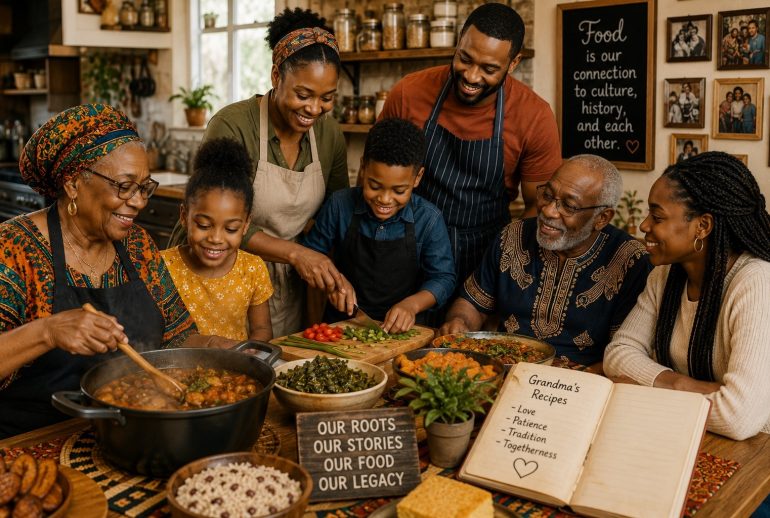
Food traditions are one of the most powerful ways families stay connected to culture and memory. A meal can carry more than flavor. It can carry the voice of an elder, the memory of a childhood kitchen, the sound of family laughter, the feeling of a holiday gathering, or the story of a place that shaped the family’s journey. Across the Black community, food has long been connected to survival, celebration, creativity, faith, family care, and identity.
Many families have dishes that show up again and again at important moments. There may be a special recipe for Sunday dinner, a holiday dessert, a family reunion meal, a soup made when someone is sick, a dish connected to a grandparent, or a food that reminds relatives of the South, the Caribbean, Africa, the DMV, or another place that holds meaning. These meals are not only about eating. They are part of how families remember who they are.
Food traditions also help children understand culture in a way that feels personal. A child may not fully understand migration, history, or ancestry from a textbook, but they may begin to understand it while standing beside an elder in the kitchen. They may learn why certain seasonings are used, why a meal is served during a holiday, why the family gathers around a particular dish, or why one recipe is treated with special respect.
When families talk about food traditions, they are also talking about history. They are talking about the people who cooked before them, the ingredients they had, the places they lived, the challenges they survived, and the love they passed forward. In this way, food becomes a bridge between generations.
1. Food Traditions Carry Family Memory.
Every family has food memories, even if they have never written them down. A child may remember the smell of a pot cooking in the kitchen, the way an elder seasoned food without measuring, the sound of relatives laughing around the table, or the excitement of seeing a favorite dish at a family gathering. These memories become part of how people understand home.
Food memories are powerful because they involve the senses. The smell of cornbread, rice and peas, jollof rice, gumbo, stew, collard greens, fried fish, plantains, sweet potato pie, jerk chicken, injera, beans, soup, or a favorite family dessert can bring back a whole season of life. One taste can remind a person of a grandparent, a neighborhood, a church event, a holiday, or a loved one who has passed away.
These memories help families feel connected even when life changes. People may move to new cities, children may grow up, elders may pass on, and traditions may shift, but food can keep memory alive. A recipe can become a way to feel close to someone who is no longer physically present.
Families can preserve these memories by asking questions while the people who carry them are still here. Who first made this dish? When did our family start eating it? Was it for special occasions or everyday meals? What does this food remind you of? These simple questions can turn a meal into a family history lesson.
2. The Kitchen Can Become A Classroom For Culture.
The kitchen is one of the most natural places for children to learn culture. They can watch, listen, taste, ask questions, and participate. Unlike a formal lesson, kitchen learning often happens through small moments. A child may learn patience while waiting for dough to rise, responsibility while washing vegetables, teamwork while setting the table, or respect while listening to an elder explain a recipe.
This kind of learning matters because culture is often passed through practice. Children may not remember a long speech about heritage, but they may remember helping stir a pot with their grandmother. They may remember a parent explaining why a dish is connected to a certain place. They may remember an uncle telling a story while grilling outside or an auntie explaining why a dessert is always made for a family celebration.
Parents and caregivers can invite children into the kitchen in age-appropriate ways. Younger children can rinse produce, mix ingredients, count items, or help set the table. Older children and teens can learn how to chop safely, season food, follow recipes, manage timing, and clean as they cook. These skills build confidence and help children feel included.
The kitchen also gives families a chance to talk naturally. Sometimes children open up more when their hands are busy. A conversation that might feel awkward face to face may feel easier while cooking together. In this way, the kitchen can support both cultural learning and emotional connection.
3. Recipes Help Preserve The Wisdom Of Elders.
Elders often carry recipes in memory rather than on paper. They may know how much seasoning to add by sight, how long to cook something by smell, or how to adjust a dish by taste. This kind of knowledge is valuable because it comes from years of experience. It is not just cooking. It is wisdom built through repetition, care, and attention.
When elders teach recipes, they often teach more than ingredients. They may tell stories about where the dish came from, who taught them, how the family used to gather, or how food was stretched during hard times. They may share lessons about not wasting food, feeding guests, caring for neighbors, or making something beautiful with limited resources.
Families should make time to capture this wisdom. A younger relative can record a video of an elder cooking, write down the recipe, take photos of each step, or ask questions during the process. Even if the measurements are not perfect, the memory matters. The sound of an elder’s voice explaining a recipe can become a treasure later.
Honoring elders through food also helps them feel valued. When younger generations ask to learn, they are saying, “What you know matters.” That message is important. It reminds elders that their lives, skills, and stories are still needed.
4. Food Traditions Connect Families To The African Diaspora.
Food is one of the clearest ways families can experience the richness of the African Diaspora. Across African American, Caribbean, African, Afro-Latin, and immigrant communities, meals carry stories of migration, adaptation, creativity, survival, and celebration. Each dish can reveal something about geography, history, climate, trade, farming, family life, and cultural exchange.
A family may eat dishes connected to the American South, West Africa, East Africa, the Caribbean, Latin America, or a combination of many places. This variety helps children understand that the Black community is not one single story. It is wide, diverse, global, and full of different traditions. Food can help make that diversity easier to understand.
Trying different Diaspora foods can also become a family learning activity. Families might cook one dish from another culture, visit a Diaspora-owned restaurant, attend a food festival, or read about the history behind an ingredient. Children can learn where certain foods are eaten, what occasions they are connected to, and how they compare to foods their own family already knows.
These experiences build respect and curiosity. They help families see connection without erasing difference. A shared ingredient, flavor, or cooking method may reveal how cultures speak to each other across time and distance. Food becomes a way to honor both roots and relationships.
5. Community Meals Help Build Belonging.
Food has always been part of community life. Families gather around meals at church events, cookouts, weddings, funerals, graduations, reunions, baby showers, festivals, school programs, and neighborhood gatherings. These meals create spaces where people can connect, laugh, share news, meet new people, and support one another.
Community meals help people feel that they belong. A plate handed to someone at a gathering can communicate welcome. A dish brought to a grieving family can communicate care. A meal served at a youth event can communicate investment. Food has a way of making people feel seen and included.
For children, community meals teach important lessons. They learn how people serve one another. They see elders being honored. They watch relatives and neighbors contribute what they can. They learn that food is not only personal. It is part of how communities take care of each other.
These gatherings also give families a chance to pass down social traditions. Children learn how to greet people, help serve, clean up, thank the cook, respect elders, and participate in community life. A shared meal becomes a classroom for manners, service, culture, and belonging.
6. Food Can Tell Stories Of Survival And Creativity.
Many food traditions were shaped by hardship, but also by creativity. Families and communities often made nourishing, flavorful meals with whatever ingredients were available. They learned how to stretch food, reduce waste, preserve ingredients, season simply, and feed many people with limited resources. That creativity is part of the story.
It is important to teach this history with dignity. Some dishes were born out of difficult conditions, but they also show intelligence, resilience, and skill. People took what they had and created meals that carried comfort, strength, and identity. That deserves respect.
Children should understand that food history is not only about recipes. It is about the people who made a way when resources were limited. It is about mothers, fathers, grandparents, farmers, cooks, workers, and neighbors who fed families through difficult seasons. It is about love expressed through labor.
When families talk about these stories, they help children see food as part of a larger legacy. A meal becomes evidence of survival and creativity. It reminds the next generation that their ancestors were not passive victims of history. They were makers, builders, problem-solvers, and caregivers.
7. Food Traditions Can Support Family Identity.
Family identity is built through repeated experiences. The meals families cook, the holidays they celebrate, the recipes they protect, and the way they gather around the table all help create a sense of who they are. Children may not realize it at the time, but these repeated food traditions help them feel rooted.
A family may become known for a certain dish. An elder may be famous for a dessert. A parent may have a special breakfast tradition. A cousin may always bring the same side dish to gatherings. These details become part of the family’s personality. They create shared memories and inside stories that hold people together.
Food traditions can also help families maintain identity after moving to a new place. A family that relocates may feel disconnected from familiar neighborhoods, relatives, or cultural spaces. Cooking familiar foods can help create a sense of home in a new environment. It can remind children that home is not only a location. It is also memory, rhythm, flavor, and love.
Parents and caregivers can strengthen family identity by explaining why certain meals matter. They can say, “This is what your grandmother used to make,” or “This dish reminds us of where our family came from,” or “We cook this every year because it brings us together.” These explanations help children understand that traditions have meaning.
8. Food Conversations Can Teach Health With Respect.
Food traditions should be honored, but families can also talk about health in thoughtful ways. Many households are trying to balance cultural foods with concerns about blood pressure, diabetes, heart health, energy, weight, allergies, or other medical needs. These conversations can be sensitive because food is emotional and tied to family history.
The goal should not be to shame traditional foods or make elders feel criticized. Instead, families can talk about balance, portions, cooking methods, and adding more nourishing options. A beloved dish may be prepared with less salt, more vegetables, leaner meat, different oils, or smaller servings while still keeping its cultural meaning. Some meals may remain special occasion foods, while everyday meals may include lighter choices.
Children can learn that caring for health does not mean rejecting culture. It means learning how to care for the body while respecting the foods and people that shaped the family. This balanced message is important because shame-based food conversations can harm confidence and create unhealthy relationships with eating.
Families can make health conversations practical and respectful. They can ask, “How can we keep the flavor and make this a little healthier?” or “What vegetables can we add?” or “How did elders stay active and strong?” These questions connect wellness to tradition instead of placing them against each other.
9. Sharing Recipes Can Strengthen Family Bonds.
Sharing recipes is a simple but meaningful way to strengthen relationships. A parent teaching a child, an aunt sharing a dessert recipe, a grandparent explaining a holiday meal, or cousins exchanging cooking tips can create moments of closeness. These exchanges give families something to do together and something to remember.
A shared recipe can also become a gift. It may be written in a notebook, sent in a family group chat, printed for a reunion, or collected into a small family cookbook. These simple efforts help preserve traditions that might otherwise disappear. They also give younger generations a way to carry family memory into their own homes.
Cooking together can help heal distance too. Relatives who do not always know what to say may find connection through preparing a meal. A teenager who seems uninterested in family history may become curious while learning a favorite dish. An elder who feels forgotten may feel honored when someone asks to learn their recipe.
The recipe is important, but the relationship is even more important. The time spent together is what gives the food its emotional value.
10. Food Traditions Help Children Appreciate Work And Service.
Children often see the finished meal, but they may not understand the work behind it. Cooking requires planning, shopping, cleaning, preparing, timing, serving, and often cleaning again afterward. When children participate in the process, they learn to appreciate the labor that goes into feeding a family.
This lesson matters because food is one of the most common ways people serve others. A person who cooks for the family is giving time, energy, thought, and care. Children should learn to respect that work. They can help by setting the table, washing dishes, carrying groceries, stirring ingredients, or thanking the person who prepared the meal.
Learning to cook also builds independence. A child who grows up knowing how to prepare simple meals is better prepared for adulthood. A teen who can cook for themselves has a practical life skill that supports health, budgeting, and confidence. Families can treat cooking as preparation for life, not only a household chore.
Service is also part of food tradition. When families cook for neighbors, elders, grieving households, new parents, or community events, children see love in action. They learn that food can be a way to show up for others.
11. Modern Families Can Adapt Traditions Without Losing Them.
Traditions can change and still remain meaningful. Families today may have different schedules, health needs, budgets, dietary preferences, and cultural influences than earlier generations. Some relatives may be vegetarian, vegan, gluten-free, managing allergies, reducing salt, or trying to eat lighter. Others may live far away and gather less often. These changes can affect how food traditions are practiced.
Adapting a tradition does not mean disrespecting it. Many food traditions were created through adaptation in the first place. People used what they had, adjusted to new places, and created meals from available ingredients. Families today can do the same while still honoring the heart of the tradition.
A family might make a healthier version of a dish during the week and keep the classic version for special occasions. They might add new dishes from different parts of the Diaspora. They might hold virtual cooking sessions with relatives who live far away. They might create a digital recipe collection instead of a handwritten one. These changes help traditions remain alive in modern life.
What matters is not that every recipe stays exactly the same forever. What matters is that the story, love, and connection continue. A living tradition can grow while still remembering its roots.
12. Passing Food Traditions Forward Protects Cultural Memory.
If food traditions are not shared, they can fade. A recipe may disappear when an elder passes away. A child may grow up loving a dish but never learn how to make it. A family may continue eating certain foods without knowing the stories behind them. This is why passing traditions forward matters.
Families can begin with one recipe. They can choose a dish that matters and make time to learn it, record it, and talk about it. They can ask elders to share memories, invite children to help cook, take photos, write down ingredients, and explain why the meal is important. Small steps can preserve a great deal.
Passing traditions forward also gives children a sense of responsibility. They learn that culture is not only something they receive. It is something they help carry. One day, they may cook the same dish for their own children and tell the story of who taught them. That is how memory continues.
Food traditions protect cultural memory because they are repeated, shared, and loved. They live in kitchens, family gatherings, community events, and everyday meals. They remind families that history can be tasted, culture can be practiced, and love can be passed down through a recipe.
Conclusion.
Food traditions connect the Black community to culture and family history because they carry memory, identity, creativity, survival, and love across generations. A recipe can hold the story of an elder. A family meal can teach children about heritage. A kitchen conversation can preserve wisdom. A community gathering can remind people that food is one way families and neighbors care for one another.
Families do not need to preserve every recipe at once. They can begin with one dish, one elder, one story, one cooking day, or one conversation at the table. These small moments can become powerful acts of cultural preservation.
When families honor food traditions, they give children more than meals. They give them roots. They give them stories. They give them connection to the people and places that shaped their lives. They remind the next generation that culture is alive, memory matters, and family history can be carried forward one plate at a time.
Akukulu Family encourages families and community members to preserve one food tradition this month. Ask an elder about a recipe, cook a meaningful dish with children, write down a family food memory, or share a meal that connects your household to culture and history. One recipe and one conversation can help keep family identity alive for the next generation.
