

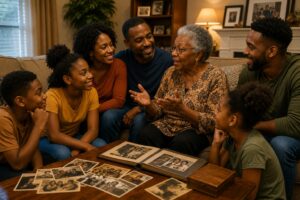

Why Family Storytelling Matters Across The Black Community.
Family storytelling is one of the most powerful ways a community keeps its memory alive. Long before children understand history books, records, documents, or timelines, they often understand stories. They hear about where a grandparent grew up, how a parent handled a hard season, what an elder remembers from childhood, how the family moved from one place to another, what traditions mattered, what lessons were learned, and what values helped people keep going. These stories may be shared at the kitchen table, on the porch, during a holiday meal, after church, in the car, at a reunion, or during a quiet moment when someone finally asks the right question. Across the Black community, storytelling has always carried deep meaning because so much history was preserved through voice, memory, music, food, faith, family gatherings, and community spaces. Not every story was written down. Not every sacrifice was recorded in official documents. Not every ancestor’s name was protected by institutions. Many families carried their history through the people who remembered, repeated, and passed it forward. That is why family storytelling should not be treated as something small or old-fashioned. It is part of cultural survival. When children hear family stories, they learn that they are connected to something larger than themselves. They begin to understand that their family did not begin with them. They learn about people who worked, prayed, migrated, served, cooked, built, studied, cared for children, started businesses, survived hardship, made mistakes, found joy, and created a path for the next generation. These stories help children feel rooted. They also help them understand that ordinary family lives are part of history too. Storytelling also strengthens relationships. It gives elders a chance to be heard, parents a chance to teach values, children a chance to ask questions, and families a chance to laugh, grieve, remember, and connect. A story can carry wisdom in a way that advice alone cannot. It can teach patience, courage, responsibility, faith, love, identity, and resilience without sounding like a lecture. When families keep telling their stories, they help protect culture, memory, and belonging. 1. Family Stories Help Children Understand Where They Come From. Children need to know where they come from because identity is stronger when it has roots. A child who knows something about their family’s journey may feel more connected to the people around them and more confident in who they are becoming. They may learn that their grandparents came from a small town, that their parents worked hard to build stability, that an aunt was the first to graduate, that an uncle served in the military, that a great-grandmother cooked for the neighborhood, or that the family moved for work, safety, education, or opportunity. These details may seem simple, but they help children understand that their family has a story. They learn that people before them made choices, carried burdens, created traditions, and opened doors. This can help children feel less alone when they face their own challenges. If they know their family has already survived hard seasons, they may believe they can keep going too. Family stories also help children understand that history is not only about famous people. It is also about everyday people who loved, worked, raised children, helped neighbors, and made a way. A child may hear about national leaders in school, but at home they can hear about family leaders whose names may never appear in textbooks. These personal stories make history feel closer and more meaningful. Parents and caregivers can begin by sharing simple memories. They can talk about where they grew up, what school was like, what games they played, what foods they ate, what relatives taught them, and what moments shaped them. Over time, these stories become part of the child’s understanding of family identity. 2. Elders Carry Wisdom That Should Be Preserved. Elders are living libraries. They carry memories of people, places, traditions, struggles, celebrations, and lessons that younger generations may never know unless someone takes time to ask. Many elders remember neighborhoods before they changed, family members who have passed away, recipes that were never written down, old sayings, church traditions, school experiences, work stories, migration journeys, and the values that helped families survive. When elders are invited to share stories, they are being honored. They are reminded that their lives matter and that their memories are still useful. Too often, older relatives are only asked for help, childcare, money advice, or prayer, but not always asked to tell their own stories. Listening to elders gives them dignity and gives younger generations a deeper inheritance. Families can preserve elder stories in simple ways. A younger relative can record a conversation on a phone, write notes in a family notebook, ask questions during a meal, or invite an elder to share a memory at a family gathering. Children can ask about childhood, favorite foods, first jobs, music, holidays, family lessons, and important moments. These questions can open the door to stories that might otherwise remain hidden. Preserving elder stories is also urgent because time is not guaranteed. Many families regret not asking more questions while elders were still able to answer. Starting now, even with one conversation, can help protect memories for future generations. 3. Storytelling Makes History Personal. History can feel distant when it is only presented through dates, names, and major events. Family storytelling makes history personal because it connects larger events to real lives. A child may learn about migration in school, but a grandparent’s story about moving from one state to another for work makes that history more real. A child may learn about segregation, but an elder’s memory of attending a certain school or using certain public spaces gives the lesson emotional meaning. Personal stories help children understand that history happened to families like theirs. It happened in homes, churches, schools, buses, workplaces, neighborhoods, and kitchens. It shaped where people lived, what jobs they had, how they raised children, what opportunities they could access, and what dreams they