

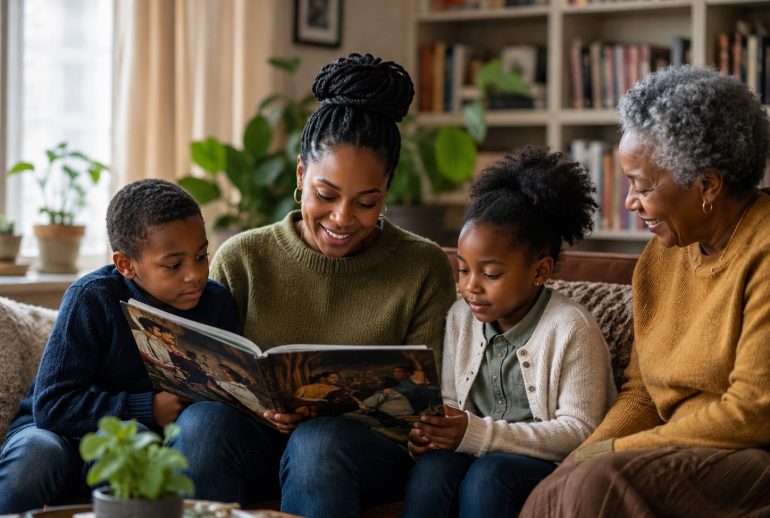
Reading Black history at home gives children something powerful that school alone may not always provide. It gives them a personal connection to people, places, stories, struggles, victories, inventions, movements, culture, and family values that helped shape the world they live in. When children read about Black history in a loving home environment, they are not only learning facts. They are learning that their community has always carried intelligence, courage, creativity, leadership, faith, resistance, beauty, and vision.
Across the Black community, children need to see history as more than a short school lesson or a special topic during one month of the year. They need to understand that Black history is part of American history, world history, family history, cultural history, and everyday community life. It is found in books, music, food, churches, schools, businesses, inventions, neighborhoods, family stories, art, sports, military service, science, literature, and the voices of elders who lived through seasons that children may only hear about in passing.
Home is one of the best places to make this history feel alive. A parent reading with a child, a grandparent telling a story, an older sibling sharing a book, or a family watching a documentary and then talking about it can create meaningful learning moments. These moments help children understand that history is not distant. It is connected to their own names, families, communities, and futures.
Reading Black history at home also helps children build confidence. When young people learn about people who created, led, organized, wrote, invented, served, taught, healed, built businesses, changed laws, raised families, and stood for justice, they begin to see possibility in themselves. They learn that greatness is not limited to one kind of person or one kind of path. They learn that they are part of a long story, and that their own life can add something meaningful to it.
1. Black History Helps Children Understand Who They Are.
Children need roots. They need to know that they come from people who lived, worked, struggled, created, loved, prayed, resisted, learned, and built before them. When children do not know their history, they may begin to rely only on what the outside world tells them about who they are. That can be dangerous because the outside world does not always tell the full truth. It may show them stereotypes, limited images, or stories that focus only on pain without showing strength, joy, intelligence, and achievement.
Reading Black history at home helps fill that gap. It gives children a stronger foundation for identity. A child who reads about Harriet Tubman, Frederick Douglass, Mary McLeod Bethune, George Washington Carver, Ida B. Wells, Katherine Johnson, Thurgood Marshall, Maya Angelou, Jackie Robinson, Shirley Chisholm, Martin Luther King Jr., Rosa Parks, and many others begins to understand that their community has shaped history in many ways. These stories can help a child stand taller because they know they are connected to a legacy of courage and excellence.
Identity is not built from one book or one conversation. It grows through repeated exposure. When children regularly hear stories about Black leaders, families, artists, scientists, soldiers, teachers, inventors, and everyday heroes, they begin to see history as part of their own inheritance. They learn that their background is not something to hide or minimize. It is something to understand, honor, and carry with pride.
Parents and caregivers can make this personal by connecting history to family stories. After reading about migration, education, faith, work, or civil rights, they can ask children if they know anyone in their own family who lived through similar experiences. This helps children understand that history is not only about famous names. It is also about grandparents, great-grandparents, neighbors, teachers, and community members whose lives matter.
2. Reading At Home Makes History Feel Personal.
When children only learn history in school, it may feel like something they must memorize for a test. Names, dates, and events can become disconnected from real life. But when history is read and discussed at home, it can feel warmer, deeper, and more personal. A family can pause, ask questions, share opinions, connect the story to real experiences, and help children understand why the lesson matters.
A book about the Civil Rights Movement can lead to a conversation about what elders remember from their childhood. A story about Black inventors can lead to a discussion about creativity and problem-solving. A biography of a writer or artist can lead to a child writing their own poem, drawing a picture, or asking about family talents. A book about African kingdoms, Caribbean history, or African American communities can help children see the wider African Diaspora in a more meaningful way.
Home reading also gives children room to ask honest questions. They may ask why unfair things happened, why people were treated differently, why certain laws existed, or why some stories were not taught earlier. These questions should not be avoided. They are signs that children are thinking deeply. Parents do not need to have perfect answers, but they can say, “That is a good question. Let’s learn more together.”
When families learn together, children see that history is not only a school subject. It becomes part of family conversation. It becomes something people care about, reflect on, and use to understand the present. This makes learning more powerful and more likely to stay with the child.
3. Black History Builds Cultural Pride Without Ignoring Hard Truths.
Some adults worry that teaching children difficult parts of history may make them sad, angry, or overwhelmed. That concern is understandable because Black history includes painful subjects such as slavery, segregation, racial violence, discrimination, and injustice. However, children also need truth. The key is to teach history in ways that are age-appropriate, balanced, and grounded in dignity.
Black history should not be taught only as suffering. Children need to learn about hardship, but they also need to learn about creativity, family, music, food, invention, business, faith, art, education, military service, sports, literature, community leadership, and joy. They need to understand that their ancestors and community members were not only people who suffered. They were people who thought, built, loved, laughed, organized, worshiped, created, and dreamed.
Cultural pride grows when children receive the full story. A child can learn about slavery and also learn about resistance. They can learn about segregation and also learn about Black-owned businesses, schools, churches, newspapers, and communities that helped people survive. They can learn about civil rights marches and also learn about songs, family meals, church gatherings, and youth leadership that gave movements strength.
Parents and caregivers can help children process hard history by reminding them that difficult stories are not told to make them feel defeated. They are told so children can understand what people overcame and why dignity, justice, education, and community care matter. When truth is paired with hope, children can build pride without being shielded from reality.
4. Books By Black Authors Help Children Feel Seen.
Representation in books matters. When children read books written by Black authors or featuring Black characters, families, communities, and cultures, they often feel a deeper connection to the story. They may see familiar hairstyles, family dynamics, foods, neighborhoods, churches, music, language, humor, or cultural experiences. This helps children understand that their lives are worthy of being written about.
Books by Black authors also bring a variety of voices. Some stories focus on history, while others focus on friendship, imagination, adventure, mystery, science, poetry, fantasy, family life, humor, or everyday childhood. Children need all of these stories. They should not only see themselves in books about struggle. They should also see themselves in stories about joy, creativity, curiosity, and possibility.
Parents and caregivers can build a small home reading collection over time. It does not need to be expensive. Families can use libraries, book swaps, used bookstores, school reading lists, community book fairs, and local recommendations. The goal is to make sure children have access to stories that reflect both their identity and their imagination.
When children see themselves in books, reading can become more inviting. A child who does not usually enjoy reading may become interested when the story feels connected to their world. That connection can build both literacy skills and self-worth.
5. Reading Black History Encourages Critical Thinking.
Black history teaches children to think deeply about fairness, courage, leadership, law, community, identity, and responsibility. It helps them ask important questions. Who gets to tell history? Whose stories were left out? What does freedom mean? How do people create change? Why do communities organize? What does it mean to stand up for others? These questions help children become thoughtful learners.
Critical thinking is important because children are growing up in a world filled with information from school, social media, videos, friends, news, and online platforms. They need to learn how to compare sources, ask questions, identify bias, and understand that history is often more complex than a short summary. Reading Black history at home gives families a safe space to practice those skills.
For example, after reading about a historical figure, parents might ask what choices that person had to make, what risks they faced, and what values guided them. After reading about a movement, families might talk about teamwork, sacrifice, strategy, and patience. These conversations help children move beyond memorizing facts into understanding meaning.
Children who learn to think critically about history may also become more thoughtful about the present. They can better understand current events, community issues, school policies, voting rights, health disparities, business ownership, media representation, and cultural pride. History becomes a tool for understanding life.
6. Family Reading Can Strengthen Bonds Across Generations.
Reading Black history at home can bring generations together. Parents, grandparents, aunties, uncles, older siblings, and children can all participate. A family might read one short biography together, talk about a historical event, share memories connected to a topic, or ask elders what they remember from earlier times. These conversations can create strong emotional bonds.
Elders can be especially important in this process. They may have lived through changes that children only know from books. They may remember segregated schools, civil rights marches, neighborhood changes, migration stories, first jobs, church life, family traditions, or community leaders who made a difference locally. When children hear these stories, history becomes personal and living.
Family reading does not have to be formal. It can happen at bedtime, after dinner, on weekends, during holidays, before a museum visit, or as part of a family culture day. A parent might read aloud to younger children, while older children might read and then lead a discussion. Teens may enjoy connecting history to documentaries, music, podcasts, or current issues.
These shared reading moments show children that learning is part of family life. They also give adults a chance to pass down values, memories, and wisdom in a natural way. A book can become the doorway to a conversation that children remember for years.
7. Black History Helps Children Understand America More Fully.
America cannot be understood fully without Black history. The story of the country includes slavery, emancipation, Reconstruction, migration, civil rights, labor movements, military service, education, business, music, sports, literature, science, faith communities, and cultural creativity shaped by people of African descent. When children learn this history, they gain a more honest understanding of the nation.
This matters because incomplete history can create confusion. If children only learn about founding documents without learning who was excluded, they may not understand why later struggles for freedom were necessary. If they only learn about civil rights as a few famous speeches, they may not understand the organizing, sacrifice, danger, and community effort behind the movement. If they only learn about pain, they may miss the brilliance and creativity that shaped American culture.
Reading at home allows families to fill in the gaps. Parents and caregivers can help children see how Black history connects to national holidays, local communities, laws, schools, music, neighborhoods, voting, business, and family life. This fuller understanding helps children become more informed citizens.
Children should learn that telling the truth about history is not unpatriotic. A country becomes stronger when its people understand the full story and work to make the future better. Black history helps children understand both the promise of America and the work required to make that promise real for everyone.
8. Learning About Black Leaders Helps Children See Many Forms Of Greatness.
Children often need examples to help them imagine who they can become. Black history offers many forms of greatness. Some leaders were writers, teachers, scientists, athletes, judges, business owners, soldiers, ministers, artists, farmers, musicians, doctors, activists, engineers, or public servants. This variety helps children understand that there is no single path to a meaningful life.
A child who loves science may connect with Katherine Johnson, George Washington Carver, or Mae Jemison. A child who loves writing may connect with Maya Angelou, Langston Hughes, Toni Morrison, or James Baldwin. A child who loves sports may connect with Jackie Robinson, Serena Williams, Jesse Owens, or Simone Biles. A child who cares about fairness may connect with Thurgood Marshall, Ida B. Wells, Fannie Lou Hamer, John Lewis, or Martin Luther King Jr.
These examples help children see that their interests can matter. A young person does not have to be famous to make a difference, but seeing famous and local examples can expand their imagination. They begin to understand that greatness can look like courage, creativity, discipline, service, intelligence, faith, leadership, or persistence.
Families can also introduce children to local heroes. Every community has teachers, business owners, nurses, veterans, mentors, pastors, artists, parents, organizers, and elders who have contributed meaningfully. Children should know national names, but they should also know that greatness can live close to home.
9. Reading Black History Can Inspire Community Responsibility.
Black history is full of people who cared about more than themselves. They built schools, organized churches, started newspapers, created businesses, led movements, mentored youth, protected families, served in the military, fought for voting rights, and created art that gave voice to others. These stories can teach children that community responsibility matters.
When children learn about people who sacrificed for future generations, they may begin to ask what they can contribute. They may become more interested in volunteering, helping elders, supporting classmates, participating in school leadership, protecting family traditions, or speaking up when something is unfair. History can inspire action.
Parents and caregivers can make this connection clear. After reading about a community leader, they can ask, “What problem did this person see?” “How did they help?” “What is one way we can help our community today?” These questions help children connect history to present-day responsibility.
The goal is not to place heavy burdens on children. The goal is to help them understand that they are part of a community and that their choices matter. Reading history can help children see themselves as future builders, not only observers.
10. Families Can Use Libraries, Museums, And Local Events To Extend Learning.
Reading at home is powerful, but families can deepen the learning by connecting books to real-world experiences. Libraries, museums, cultural centers, historical sites, community events, book festivals, author talks, and local exhibits can help children experience history beyond the page. These outings make learning active and memorable.
A family might read about a historical figure and then visit a museum exhibit connected to that period. They might read a children’s book by a Black author and then attend a library story time or community book event. They might read about the Great Migration and then ask an elder about family movement from one place to another. These connections help children see history everywhere.
The DMV and many other regions offer opportunities to explore African Diaspora history through museums, monuments, neighborhoods, schools, churches, cultural events, and local organizations. Families can choose one outing at a time and make it part of their learning routine.
Children often remember experiences. A book may introduce the topic, but a visit, conversation, or event can help the lesson stay with them. When families connect reading to community experiences, history becomes part of everyday life.
11. Black History Reading Should Happen All Year.
Black History Month is important, but children need more than one month of exposure. If Black history is only discussed in February, it can feel like a temporary subject instead of a core part of learning. Families can help by making Black history reading part of the year-round home routine.
This does not mean families need to read history every day. They can choose one book each month, one family story night, one biography per season, or one cultural learning activity during school breaks. The key is consistency. Small repeated moments can build a stronger foundation than one intense burst of learning.
Year-round reading also allows families to explore a wider range of topics. One month might focus on inventors, another on writers, another on local history, another on African kingdoms, another on Caribbean culture, another on civil rights, another on music, another on entrepreneurs, and another on family genealogy. This variety helps children see the fullness of Black history.
When children grow up with year-round exposure, they learn that their history is not limited, seasonal, or separate. It is part of life. It belongs on the bookshelf, at the dinner table, in family conversations, and in everyday learning.
12. Reading Black History Gives Children A Stronger Future.
A child who knows history is better prepared for the future. They understand that people before them faced challenges and still created change. They understand that education matters because earlier generations fought for it. They understand that voting, business ownership, health, art, science, faith, and community care all have histories connected to freedom and progress. They understand that they are not alone in the world.
This kind of knowledge can strengthen confidence. When children know they come from a legacy of thinkers, builders, leaders, and survivors, they may be more prepared to face difficulty with courage. They may also feel more responsible for how they use their own gifts. History can become a source of direction.
Reading Black history at home also helps families pass down values. Children learn perseverance, honesty, service, creativity, dignity, and respect. They learn that progress often takes time and that ordinary people can do extraordinary things when they are committed to something larger than themselves.
The future of the community depends on children who know who they are and believe their lives matter. Reading is one way to help build that future. Every book, every story, every conversation, and every question can plant something powerful in a child’s mind and heart.
Conclusion.
Reading Black history at home strengthens children across the Black community because it helps them build identity, confidence, cultural pride, critical thinking, and a deeper understanding of the world. It teaches them that their history is not small, hidden, or limited to one month. It is part of family life, community life, American history, and the wider African Diaspora story.
Families do not need perfect lesson plans to begin. They can start with one book, one elder’s story, one library visit, one conversation after dinner, or one biography read aloud. What matters is making history feel present, personal, and meaningful. Children should know both the hard truths and the beautiful victories. They should learn about struggle, but also about joy, brilliance, creativity, leadership, and love.
When families read Black history together, they give children roots and wings. They help them understand where they come from while encouraging them to imagine where they can go. That kind of learning can strengthen not only one child, but the future of the whole community.
Akukulu Family encourages parents, caregivers, mentors, and elders to read one Black history story with a child this month. Choose a book, visit a library, share a family memory, talk about a local leader, or ask children what they want to learn next. One story can open the door to pride, understanding, and a stronger connection to community history.
